Medically reviewed by the Bar Beauty Medical team · Last updated: May 2026 · Reading time: 14 minutes · Book consultation →
Acne scars are not one problem and treating them as one is why so many courses disappoint. Rolling scars respond well to collagen stimulation. Boxcar scars need resurfacing at depth. Ice pick scars are narrow and deep and often will not respond to microneedling at all, no matter how many sessions you buy. The first job at your consult is naming which types you actually have, because most people have a mix.
| Treatment | Price (CAD) | Which scars it suits |
|---|---|---|
| Single spot or small patch | $50 | One isolated scar or a very limited area. |
| Acne scar revision, small | $300 | About a palm sized area. Aerolase NeoClear. |
| SkinPen microneedling | $400 | Rolling scars and overall texture. Collagen stimulation. |
| Acne scar revision, medium | $450 | About two palms. |
| Acne scar revision, large | $600 | About three palms. |
| Microneedling with ASCE+ exosomes | $650 | Rolling scars where you want faster recovery and better texture. |
| Morpheus 8, face | $900 | Boxcar scars and deeper textural change, RF at depth. |
| Consultation | Free | Scar typing. This determines everything else. |
Bar Beauty Medical, 46 Fort York Blvd, CityPlace, Toronto. Prices in Canadian dollars from our live booking system, verified 18 August 2026. Active acne is treated before scar work begins. Resurfacing inflamed skin makes pigmentation worse.
Acne Scar Treatment in Toronto: The Complete 2026 Encyclopedia
Acne scars are the most undertreated cosmetic concern in Toronto, not because the science is uncertain, but because most patients give up after a single inappropriate treatment. The truth: every scar type responds to a different modality, and a sequenced 12-month protocol can reduce visible scarring by 60-80% in motivated patients. This 3,200-word reference walks you through the four scar types (ice pick, boxcar, rolling, hypertrophic), the evidence-based hierarchy from microneedling to laser resurfacing, and the Bar Beauty Medical protocol we have refined over thousands of treatments at our CityPlace clinic.
Quick navigation: Photo identification & scar types · Why your acne scarred · Treatment hierarchy · Why our multi-modality protocol is different · Real patient case journeys · Cost & payment · What does NOT work · Prevention · FAQ
Photo Identification: Which Acne Scar Type Do You Have?
The single most important step in acne scar treatment is correct classification. Goodman and Baron’s published acne scar classification has been the global standard since 2006, and it remains the foundation of how we plan treatment at Bar Beauty. Most patients have a mix of two or three types, rarely just one.
| Type | Description | Visual | Best-response treatment |
|---|---|---|---|
| Ice pick | Narrow (under 2 mm), deep, vertical, V-shaped pits that look “punched in” | Most common on cheeks; “look like enlarged pores but deeper” | TCA CROSS (focal trichloroacetic acid) or punch excision, often combined with overall resurfacing |
| Boxcar | Wider (2-4 mm), shallow-to-medium depth, sharp vertical edges | Look like chickenpox scars; sharp shadow line | RF microneedling (Morpheus 8), fractional resurfacing, subcision |
| Rolling | Wide (4-5 mm+), shallow, smooth/sloping edges; “wave”-like | “Like the cheek is uneven from a distance”; tethered to deeper tissue | Subcision is foundation (releases tethers), then microneedling/Morpheus + filler if depressed |
| Hypertrophic / keloid | Raised, often pink/red, sometimes itchy | Most common on jawline, chest, back | Intralesional steroid (Kenalog), Aerolase Neo for redness, silicone sheets |
| Macular (post-inflammatory) | Flat brown or red discolouration without textural change (technically not a scar) | Looks like a “stain” left after acne | Topicals, Aerolase Neo for pigment, time; full pigment protocol on hyperpigmentation Toronto |
The pull-and-light test (at home, before consultation)
In good lateral light, gently stretch the skin around the scar. If the scar disappears when stretched, it is shallow/atrophic and responds to resurfacing modalities (microneedling, fractional laser, peels). If the scar persists when stretched, it is tethered, subcision is required as a foundational step before resurfacing will work. This single test predicts treatment direction better than any photograph.
Why YOUR Acne Scarred
| Driver | Mechanism | Modifiable? |
|---|---|---|
| Acne severity and duration | Deeper, longer-lasting inflammation = more dermal damage | Yes, aggressive early treatment of active acne is the best scar prevention |
| Genetic predisposition | Family history of scarring acne; baseline collagen wound-healing tendencies | No, but modifiable by aggressive early treatment |
| Picking and squeezing | Mechanical disruption of healing dermis amplifies scarring | Yes, one of the most modifiable factors |
| Inflammatory subtype (cystic, nodular) | Cysts and nodules destroy dermal architecture; comedones rarely scar | Yes, isotretinoin (Accutane) referral can break the cycle |
| Fitzpatrick skin type | Darker skin types more prone to post-inflammatory hyperpigmentation alongside textural scarring | Partial, treatment selection must respect this |
If you still have active acne, scar treatment is premature. The first conversation at Bar Beauty, for any patient with ongoing breakouts, is acne control first, scar revision second. Treating scars while inflammation continues is wasted money.
Treatment Hierarchy: First → Last
Below is the evidence-based ladder we use at Bar Beauty. The order matters, each step builds on the previous and skipping rungs reduces final result.
Not sure which treatments suit your scars? Our guide to what works for each acne scar type breaks it down by scar type before you book.
Step 1, Active acne control (precondition)
No scar treatment until acne is controlled. Topical retinoid + benzoyl peroxide + antibiotic if needed; isotretinoin referral for severe inflammatory cases. Wait 6-12 months post-isotretinoin before laser or ablative procedures.
Step 2, Skincare foundation (3-6 months)
Daily SPF50+ (post-inflammatory hyperpigmentation prevention), evening prescription retinoid (collagen turnover and pigment), vitamin C antioxidant (collagen support), niacinamide (barrier + pigment). Many patients see meaningful improvement in macular scars and superficial textural irregularity from this alone.
Step 3, Microneedling (foundational, all scar types except deep ice pick)
SkinPen or in-house medical microneedling creates controlled micro-injuries that stimulate collagen remodelling. 4-6 sessions, 4-6 weeks apart. Excellent for shallow rolling and boxcar scars, mild-to-moderate textural irregularity. Safe across Fitzpatrick I-VI. See our microneedling Toronto and microneedling + PRP (Vampire Facial) protocols.
Step 4, Subcision (for rolling and tethered scars)
A small needle or cannula is used to mechanically release the fibrotic tether under a depressed scar. The scar “rebounds” upward. Foundational for rolling scars, nothing else works until the tether is released. 1-3 sessions; often combined with filler immediately after to maintain the lift.
Step 5, RF microneedling (Morpheus 8, gold standard 2026 for atrophic scars)
Bipolar radiofrequency delivered through microneedles to dermis and sub-dermis. The combination of microneedling collagen induction PLUS RF dermal heating outperforms either modality alone in published comparative trials. 3 sessions, 6 weeks apart. Safe across Fitzpatrick I-VI (one of its biggest advantages). The best single modality for moderate boxcar and mixed atrophic scars. See Morpheus 8 Toronto and our comparison of Morpheus 8 vs SkinPen.
Step 6, Aerolase Neo Elite (for pigment + redness + skin quality)
For the post-inflammatory hyperpigmentation and post-inflammatory erythema that accompany most acne scars in Fitzpatrick III-VI, Aerolase Neo 1064 nm is the safest choice. Does not directly resurface texture, but eliminates the red/brown that makes scars more visible. Combines beautifully with Morpheus 8 protocol.
Step 7, Chemical peels for texture (ice-pick scars are referred out for TCA CROSS)
TCA CROSS (Chemical Reconstruction of Skin Scars) uses focused 70-100% trichloroacetic acid in individual ice pick scars to coagulate the floor and induce upward remodelling. 3-5 sessions, 6 weeks apart. Highly effective for ice pick scars where nothing else works, but it is a technique we refer out for rather than perform in-clinic. For resurfacing, Bar Beauty offers Noon 20 chemical peels and Noon 30 as resurfacing options.
Step 8, Fractional laser resurfacing (ablative or non-ablative)
Fractional CO2 or Erbium creates micro-columns of ablation/coagulation that drive remodelling. Most aggressive resurfacing option, with significant downtime (7-14 days). Reserved for moderate-to-severe scarring not adequately addressed by Morpheus 8. Higher PIH risk in Fitzpatrick IV-VI; we typically prefer Morpheus 8 RF microneedling in darker skin.
Step 9, Punch excision / punch elevation (specific deep scars)
Surgical removal of individual deep ice pick or boxcar scars with primary closure or elevation. Excellent for the 5-15 scars that no resurfacing can address. Combined with overall resurfacing 4 weeks later. We refer this when indicated.
Step 10, Filler for atrophic scars
HA filler placed directly under depressed scars (often after subcision) to maintain elevation. Temporary (lasts 9-18 months) but useful as a bridge or for patients wanting immediate result.
Bar Beauty Toronto vs alternative acne scar treatments
| Treatment | Best for scar type | Sessions | Safe for Fitzpatrick V-VI? | Downtime |
|---|---|---|---|---|
| Microneedling (SkinPen) | Mild rolling, mild boxcar, textural | 4-6 | Yes | 1-2 days redness |
| Microneedling + PRP (Vampire) | Mild-moderate, with skin quality | 4-6 | Yes | 1-3 days |
| Subcision + filler | Tethered rolling scars | 1-3 | Yes | 3-5 days bruising |
| Morpheus 8 RF microneedling | Moderate boxcar, rolling, mixed atrophic | 3 | Yes, biggest advantage | 3-5 days |
| Aerolase Neo (for PIH + erythema) | Pigment + redness around scars | 4 | Yes | Hours of redness |
| TCA CROSS | Ice pick scars | 3-5 | With caution | 5-7 days crusting |
| Fractional CO2 | Moderate-severe textural (lighter skin) | 1-3 | Higher PIH risk, cautious use | 7-14 days |
| Punch excision (referred) | Individual deep ice pick | 1 | Yes | 10-14 days |
Why Bar Beauty’s Multi-Modality Protocol Is Different
The cardinal error in Toronto acne scar treatment is single-modality bias. The patient is sold a 6-session microneedling package; she completes it and her ice pick scars look identical (because microneedling doesn’t reach them) and her tethered rolling scars look 30% better but not the 80% she hoped for (because subcision was skipped). Different scar types require different tools, and no single device addresses all of them.
Our standard moderate-acne-scar protocol over 12 months looks like this:
- Month 0: Skincare foundation initiated (retinoid + SPF + niacinamide). Diagnosis confirmed.
- Month 1: Subcision of all tethered rolling scars. 1 mL HA filler placed under deepest scars to maintain elevation.
- Month 2: Morpheus 8 RF microneedling session #1 (full face).
- Month 3: Referral for TCA CROSS to the 8-12 ice pick scars identified at diagnosis, performed by an outside scar-revision specialist rather than in-clinic.
- Month 4: Morpheus 8 #2.
- Month 5: Aerolase Neo Elite session #1 for residual PIH and erythema.
- Month 6: Morpheus 8 #3, plus a second referred TCA CROSS session if advised.
- Months 7-9: Aerolase #2 and #3. Continued skincare.
- Month 10: Reassessment with high-resolution photos.
- Month 12: Optional fourth Morpheus 8, or an additional referred TCA CROSS session if needed.
This is the protocol that delivers 60-80% improvement to most motivated patients. Total cost approximately $5,500-$7,500 over 12 months. It is not cheap, but it is effective, and a fraction of what people spend on chasing single-modality “miracle” treatments.
Real Patient Case Journeys
Detailed: “N.”, 28, Fitzpatrick IV, moderate mixed atrophic scarring
N. arrived at our CityPlace clinic 4 years after a 6-year course of cystic acne ended (post-isotretinoin x 18 months). Assessment: ~30 visible scars across cheeks; mix of 12 ice pick, 14 boxcar, 8 rolling. Significant residual post-inflammatory hyperpigmentation in cheeks. No active acne.
Month 0: Tretinoin 0.05% + 4% niacinamide + SPF50+ tinted. Cost: $215.
Month 2: Subcision of 8 rolling scars + 0.5 mL HA filler ($800).
Month 3: Morpheus 8 RF #1 ($650).
Month 4: Referral for TCA CROSS to 12 ice pick scars, priced by the outside specialist.
Month 5: Morpheus 8 #2 ($650).
Month 6: Aerolase Neo Elite #1 for PIH ($350).
Month 7: Morpheus 8 #3 ($1,200), plus a second referred TCA CROSS session with the outside specialist.
Months 8-10: 3 Aerolase sessions ($1,050).
Total spend over 10 months: $5,465. Independent photographic assessment at month 12 showed ~72% reduction in visible scarring. N. now does annual maintenance: 1 Morpheus 8 + 2 Aerolase + continued topicals ($1,400/yr).
Short case 1: “J.”, 24, Fitzpatrick III, ice-pick-dominant
20 ice pick scars across cheeks; minimal other scar types. Because ice-pick pits respond best to TCA CROSS, this patient was referred to a scar-revision specialist for that technique, which we do not perform in-clinic, while we handled skin-quality maintenance around it. TCA CROSS pricing is set by the outside provider.
Short case 2: “K.”, 35, Fitzpatrick V, post-inflammatory hyperpigmentation dominant
Mild textural scarring but severe PIH that made the scars look much worse than they were. Treated primarily for pigment: 4 Aerolase Neo + topicals + tinted SPF ($1,200 + $215 skincare). 80% improvement in visible scarring, mostly by removing the pigment overlay. Textural component never addressed.
Short case 3: “P.”, 32, Fitzpatrick II, severe textural with hypertrophic chin scar
Mixed atrophic on cheeks plus hypertrophic scar on chin. Treated with Morpheus 8 series for atrophic ($2,000) + intralesional Kenalog for chin ($120 x 3 sessions). Combined approach. 65% improvement; hypertrophic scar flattened completely.
hidden costs, the single-modality trap
The most common Toronto pricing pitfall is being sold a 6-session package of a single device for $2,400-$3,000 that addresses only part of the scar profile. We have audited multiple patient bills where they spent $4,000 on microneedling alone and gave up, when the actual answer was a properly sequenced multi-modality plan of subcision, resurfacing, and topicals, with an outside referral for TCA CROSS on true ice-pick scars. Multi-modality is more expensive up front and dramatically more effective.
HSA, insurance, and tax
Cosmetic procedures are not OHIP-covered. Some scar revision tied to documented functional impairment or psychological diagnosis may be partially HSA-eligible at certain plans. Prescription topical retinoids and antibiotics for active acne are typically covered by extended health benefits.
What Does NOT Work for Acne Scars, Save Your Money
1. At-home dermarollers without medical supervision
The 0.25-0.5 mm at-home rollers do not reach the dermis where scars live; the deeper rollers (1.5-3 mm) sold online are a major cause of infection and worsened scarring. Microneedling is a medical procedure with sterile single-use cartridges and post-treatment protocols. The at-home device gives the illusion of treatment without the result.
2. “Brightening serums” promising to fix scars
No topical can resurface a depressed scar. Topicals can dramatically improve macular (pigment) scars and modestly improve texture, but a $200 serum will never lift an ice pick scar.
3. Aggressive deep peels (TCA 50%+) over the entire face in Fitzpatrick IV-VI
The PIH risk is high enough that we never run these in darker skin types. TCA CROSS at high concentration into individual scars is different (focal, controlled), do not confuse with full-face peel.
4. “1-session laser miracle” marketing
Acne scars are not a one-session fix at any age. Anyone promising single-session resolution is either lying or selling something that won’t work. The minimum effective protocol for moderate scars is 3 Morpheus 8 sessions, ideally 4-6 months apart from each other and from any subcision.
5. Long-term high-concentration hydroquinone for scar pigment
Same issue as on the melasma page: hydroquinone past 12 weeks risks ochronosis. For post-inflammatory hyperpigmentation we use rotating non-hydroquinone topicals (tranexamic acid, azelaic acid, cysteamine) plus Aerolase Neo.
6. Fractional CO2 in Fitzpatrick V-VI as first-line
The PIH risk in darker skin from ablative fractional laser is non-trivial. We default to Morpheus 8 RF microneedling because the safety profile is materially better in deeper skin types.
7. Treating scars while acne is still active
Wasted money. Address the acne first, topicals, oral therapy, or isotretinoin referral, and revisit scar revision after 6-12 months of clear skin.
Lifelong Prevention & Maintenance
Once you have invested in a 12-month protocol and achieved 60-80% improvement, the goal is to protect the result and continue progressive remodelling. Acne scars do not “fully resolve”, they continue to soften with maintenance.
2025 → 2026 Treatment Evolution
1. Morpheus 8 has become the gold standard for atrophic scars across Fitzpatrick types. Not long ago, fractional CO2 was still the default in lighter skin; today the safety and result profile of RF microneedling has overtaken it in our protocol.
2. Subcision + filler combination protocols are now standard for tethered rolling scars. Doing one without the other reduces final result. Filler immediately post-subcision maintains the lift while the released tissue heals.
3. Aerolase as adjunct for pigment + erythema is now routine. The understanding that visible “scar” appearance is often 40-50% pigment and only 50-60% texture has shifted protocols.
4. PDRN microneedling is being studied as an adjunct. Early data is promising. We have begun offering microneedling + PDRN for select scar cases since late 2025.
Scars and stretch marks treated with the Neo Elite
Read this first. These photographs come from Aerolase Corp., the company that makes the Neo Elite. Each was taken at the practice credited underneath it. They are not our patients and we are not claiming them as our results. We show them because they are the clearest published record of what this device does, and we run the same machine at our CityPlace clinic. Our own patient photographs go up as we build a consented library.
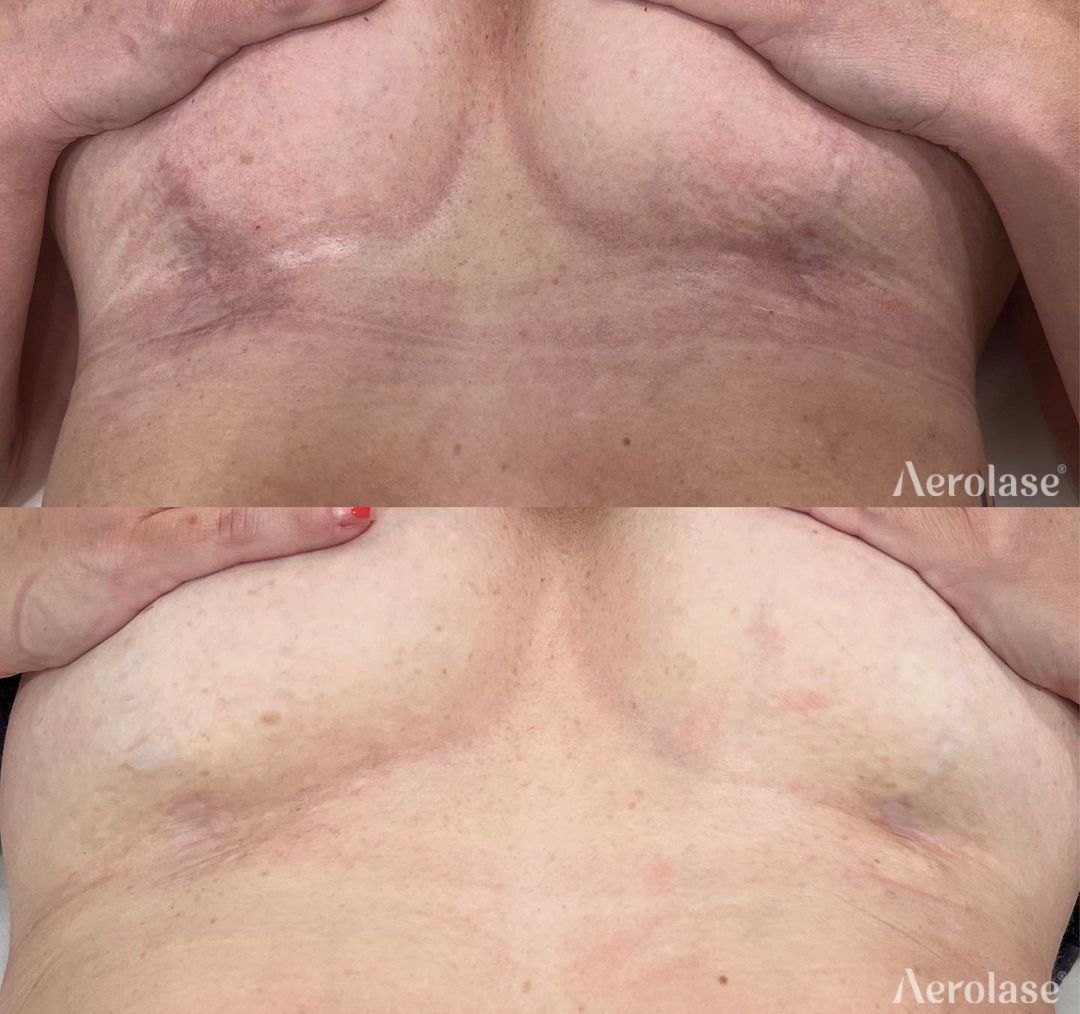
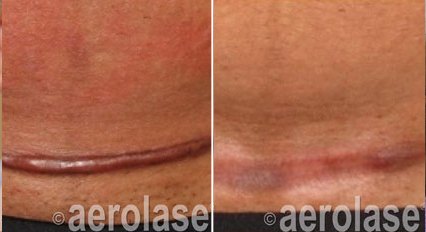
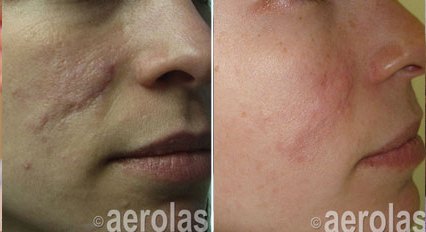
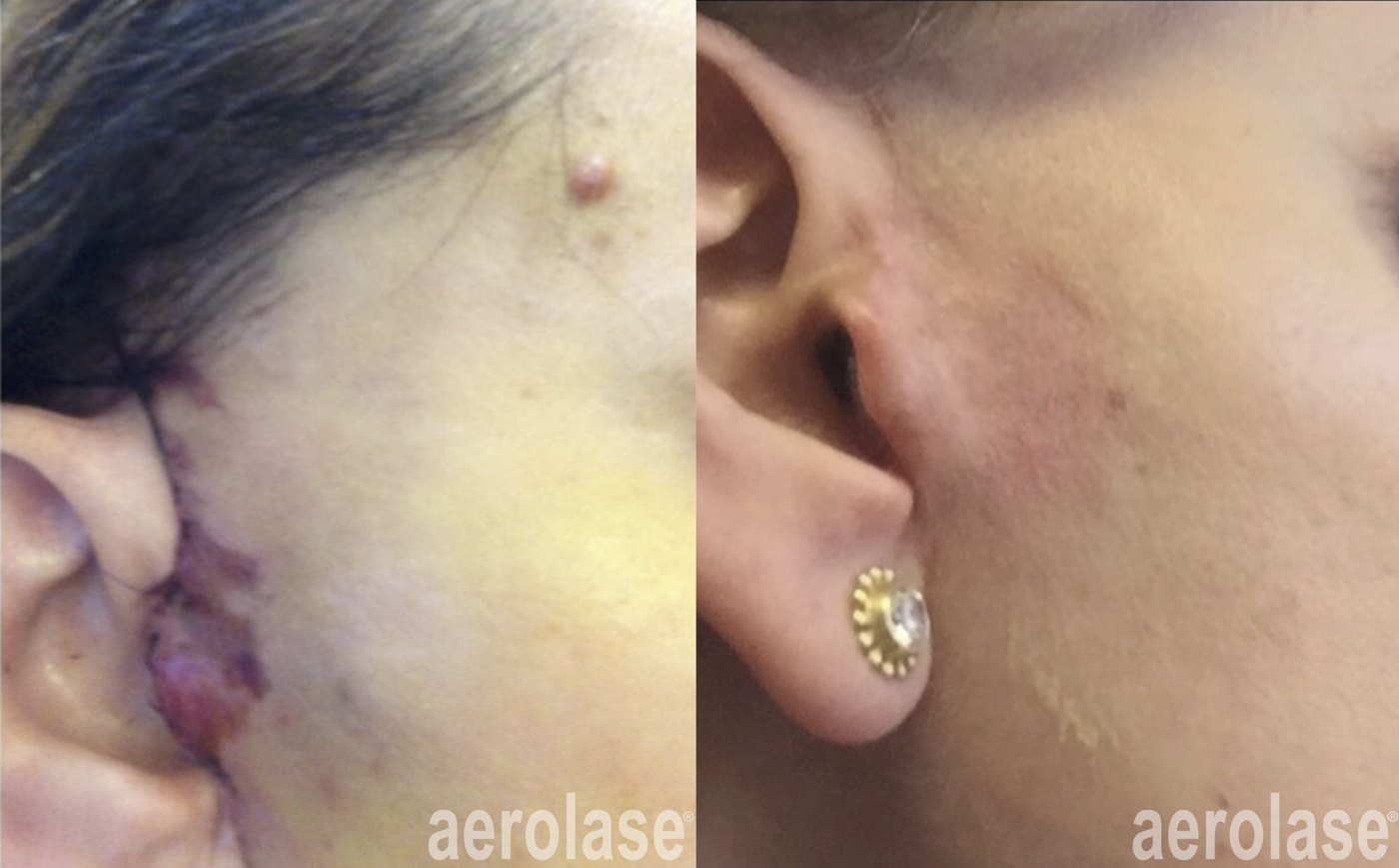
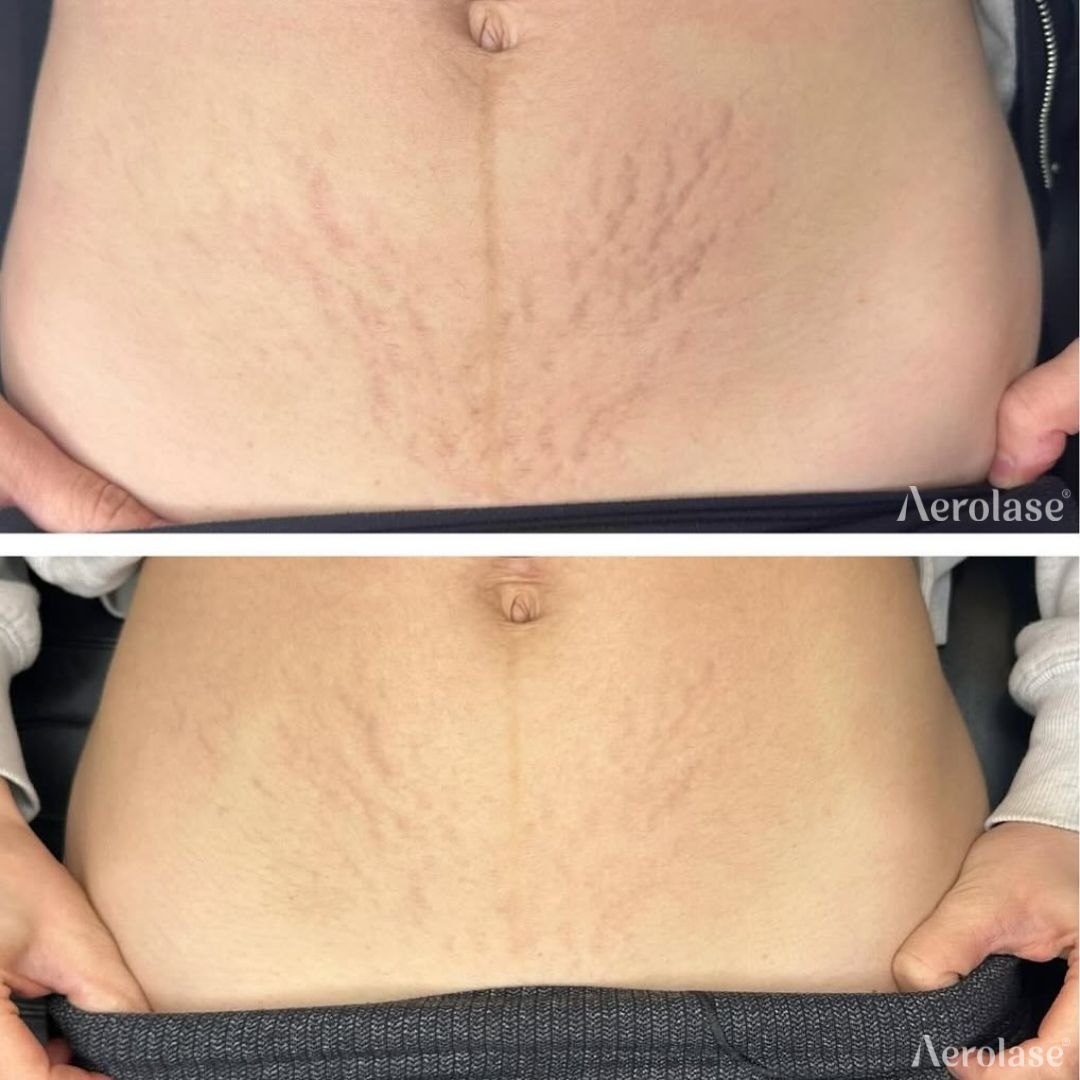
More Neo Elite results. The full set, covering every condition we use this laser for, is on our Aerolase before and after page.
Sessions needed vary by person, severity and skin type. Individual results vary and nothing here is a guarantee of outcome. We do not diagnose from a photograph; anything that has changed in size, shape or colour, or that you have not had looked at, needs a proper assessment before any laser is pointed at it.
Acne Scar FAQ, 16 Questions Toronto Patients Ask
What is the best treatment for acne scars in Toronto?
Depends on scar type. For ice pick, TCA CROSS (referred out). For boxcar, Morpheus 8 RF microneedling. For rolling, subcision then Morpheus 8. For pigment, Aerolase Neo + topicals. Most patients have a mix and need a sequenced multi-modality protocol over 6-12 months.
How many sessions of Morpheus 8 will I need for acne scars?
The minimum effective protocol is 3 sessions, 6 weeks apart. Severe cases benefit from a 4th session. We reassess at each visit.
Can acne scars be completely removed?
Realistic expectation: 60-80% improvement in visible scarring for motivated patients on a comprehensive protocol. Complete removal is rare. Our written treatment plans always set 70% as the target, never 100%.
How much does acne scar treatment cost in Toronto?
A complete 12-month multi-modality protocol at Bar Beauty runs $5,500-$7,500. Less comprehensive plans for milder scarring run $2,000-$3,500. Annual maintenance year 2+ is approximately $1,400-$2,000.
What is the best laser for acne scars?
Morpheus 8 RF microneedling outperforms classic laser in our hands and across most published comparative trials, especially in darker skin types. Fractional CO2 retains a role for severe textural scarring in lighter skin types.
What is TCA CROSS and is it painful?
TCA CROSS uses a wooden applicator dipped in 70-100% trichloroacetic acid placed into individual ice pick scars. Stings briefly, then frost within 30 seconds, then crusting for 5-7 days. Highly effective for ice pick where nothing else works. We do not perform TCA CROSS at Bar Beauty; when your scars call for it we refer you to a scar-revision specialist.
Should I do microneedling or Morpheus 8?
Microneedling (SkinPen) is gentler, cheaper, and adequate for mild rolling and superficial textural irregularity, expect to do 6 sessions. Morpheus 8 RF microneedling outperforms for moderate boxcar and tethered scars, only 3 sessions needed. See our Morpheus 8 vs SkinPen comparison.
Is subcision worth it?
For tethered rolling scars, yes, it is foundational. No resurfacing modality fully addresses a tethered scar without releasing the tether first. Subcision before Morpheus or microneedling dramatically improves final result.
Can I do acne scar treatment in winter?
Winter is ideal, lower UV exposure reduces post-treatment PIH risk. We schedule most aggressive protocols for October-March.
How long does it take to see results?
Visible texture improvement begins 6-8 weeks after each resurfacing session, with progressive remodelling for 3-6 months. Full assessment is at 12 months, not at 12 weeks.
Is Aerolase good for acne scars?
Aerolase Neo Elite is excellent for the pigment and erythema components of scarring, the red and brown discolouration that makes scars more visible. It is not the right tool for textural depth (Morpheus 8 is). The two combine well.
Can I treat back and chest acne scars?
Yes, Morpheus 8 Body and microneedling work on back and chest. Larger surface area and slower healing, so protocols are longer, but the approach is the same.
Should I be on isotretinoin while doing scar treatment?
No, we typically wait 6-12 months post-isotretinoin before laser or aggressive resurfacing because wound-healing is altered. Microneedling can sometimes start at 6 months; Morpheus or fractional laser at 12 months. Always coordinate with your prescribing physician.
What about chemical peels for acne scars?
Light-to-medium peels (Noon 20, Noon 30, salicylic) are adjunctive, useful for texture and pigment. Not primary modality for depressed scars but excellent as part of a stacked protocol.
Does Bar Beauty see patients from across the GTA?
Yes, Toronto, Mississauga, Etobicoke, Vaughan, Markham, North York, Scarborough, and Brampton. CityPlace location at 46 Fort York Blvd, two blocks from Spadina-Fort York station.
How do I book an acne scar consultation at Bar Beauty?
Via our contact page or online booking. Complimentary 45-minute consultation includes scar mapping with high-resolution photographs, type classification, and a written multi-modality treatment plan with pricing.
Book Your Acne Scar Consultation in Toronto
Bar Beauty Medical · 46 Fort York Blvd, CityPlace, Toronto · serving Toronto, Mississauga, Etobicoke, Vaughan, Markham, North York, Scarborough, and Brampton. Complimentary 45-minute consultation with scar mapping and a written multi-modality plan covering microneedling, Morpheus 8, subcision, and Aerolase, with an outside referral for TCA CROSS when ice-pick scars need it. Book your consultation →
Multi-modality acne scar protocol, planned and priced in writing before you commit. Last updated May 2026.
Common Mistakes Patients Make With acne scar treatment
We see the same handful of avoidable mistakes derail otherwise excellent results. Most of these are not the patient’s fault, they are the predictable downstream effects of confusing online information, low-quality consultations elsewhere, and the natural urge to chase the lowest sticker price. Knowing the traps in advance saves time, money, and (in some cases) skin.
Mistake 1: Choosing a clinic based on price alone
The Toronto acne scars market includes everything from injector apprentices working out of basement suites to physician-led medical practices. The cheapest quote in your inbox is almost always a junior provider working with the lowest-margin product, often diluted, often without an emergency plan if a complication arises. We routinely correct work from these clinics, it is more expensive to dissolve, revise, or rebuild a result than it is to get it right the first time. Ask who is performing the treatment, what their formal training is, what the medical director’s credentials are, and what the complication protocol looks like.
Mistake 2: Skipping the consultation or treating consultations as sales calls
A real medical consultation is a 30 to 60 minute structured conversation that includes medical history, photo documentation, skin analysis, and a written plan. If you are booked into a consultation that is really a 10-minute upsell on a discounted package, you are not in a medical environment. At Bar Beauty Medical, complimentary consultations are conducted by the same clinician who would perform your treatment, never a sales coordinator working off a commission sheet.
Mistake 3: Chasing a single dramatic session instead of a plan
Most regenerative and resurfacing modalities, including acne scars, are designed to be staged over a series. Patients who insist on a single make-me-look-great-for-the-wedding session typically under-treat the actual concern and overspend on add-ons that paper over the result. We build 3 to 6 month roadmaps with milestone photography so progress is measurable rather than felt.
Mistake 4: Ignoring at-home skincare between visits
In-clinic work is roughly 40% of the outcome. The other 60% is what happens at home: SPF50+ daily, prescription-strength topicals where appropriate, barrier repair, sleep, hydration, and avoidance of self-prescribed actives that compete with your treatment plan. We send every patient home with a printed regimen and a list of products to pause for 7 to 14 days around treatment.
Mistake 5: Booking immediately before a major event
Even no-downtime treatments can produce 24 to 72 hours of pinkness, swelling, or pinpoint bruising. We never recommend a first-time acne scars session within 14 days of a wedding, photo shoot, public speaking engagement, or international travel. Build a buffer.
Pre-Treatment Skincare Routine: The 14-Day Runway
What you do in the two weeks before your acne scars appointment has an outsized impact on comfort, downtime, and final result. We give every patient a written 14-day runway protocol. Here is the short version.
Days 14 to 8 before treatment
- Continue your normal routine including retinoids, vitamin C, and exfoliating acids unless your clinician advises otherwise.
- Increase daily SPF to a mineral SPF50+ even on overcast Toronto days. Pre-treatment sun exposure is the single biggest predictor of post-treatment hyperpigmentation.
- Hydrate aggressively, 2 to 3 litres of water per day. Well-hydrated skin tolerates energy-based treatments significantly better.
- Stop any new actives, do not introduce a brand-new product within 14 days of treatment. Your skin needs a known baseline.
Days 7 to 3 before treatment
- Pause retinoids and exfoliating acids (AHA, BHA, glycolic, lactic) unless instructed otherwise.
- Avoid waxing, threading, depilatory creams, and aggressive facials in the treatment area.
- If you bruise easily, begin oral arnica montana and bromelain (we provide dosing). Stop fish oil, vitamin E, ibuprofen, and aspirin if cleared by your physician.
- Limit alcohol, alcohol dilates capillaries and worsens bruising and swelling.
Days 2 to 0 before treatment
- Eat a full meal within 2 hours of your appointment. Low blood sugar dramatically increases the risk of a vasovagal response.
- Arrive with clean, makeup-free skin. We will cleanse again in clinic but starting clean saves time.
- Wear a button-front or zip-front top so you do not pull anything over your face on the way out.
- Hydrate again, aim for 1 litre of water in the 4 hours before your appointment.
Post-Treatment Photography Tips: How to Track Your Own Progress
One of the most under-used tools in aesthetic medicine is consistent at-home photography. Patients who photograph themselves weekly are dramatically more satisfied with their results because they can see the change, not just feel it. Memory is a terrible witness with your own face, we forget what we looked like 8 weeks ago within days. Here is the Bar Beauty photo protocol we share with every patient.
Lighting matters more than the camera
Use the same north-facing window or the same overhead light, at roughly the same time of day, every time. Avoid mixed light (window plus overhead lamp), which throws color casts and shadows that mimic or hide pigment, redness, and texture. Phone cameras are fine; lighting is not.
Standardize the three angles
Front (straight on, chin parallel to floor), left 45-degree (rotate head a quarter turn), right 45-degree (mirror). Use a small piece of tape on the floor to mark your foot position so you stand in the same spot every time. Hair pulled back. No makeup. Neutral expression.
Capture weekly, not daily
Daily photos magnify normal fluctuations (sleep, hydration, salt intake) and obscure real trends. A weekly photo on the same day each week (Sunday morning is the most common) is far more informative.
Bring the album to follow-ups
At your 8-week and 12-week reviews, we go through your timeline together. This is the moment where the work becomes obvious and where we adjust the plan for the next phase if needed.
Insurance, HSA, and Tax Specifics for Ontario Patients
acne scar treatment is, in almost all cases, a cosmetic medical procedure and is not covered by OHIP. There are, however, several legitimate ways to reduce the out-of-pocket cost that most patients do not know about.
Health Spending Accounts (HSA)
If you are a Canadian-controlled private corporation shareholder, an incorporated professional, or an employee of a company that offers an HSA top-up to its group benefits, certain medically-necessary components of your treatment may be reimbursable. This typically includes physician consultation fees, prescription topicals (tretinoin, hydroquinone, tranexamic acid), and treatments with a documented medical indication. We provide itemized receipts coded for HSA submission on request.
Medical Expense Tax Credit (METC)
The federal Medical Expense Tax Credit allows you to claim eligible medical expenses that exceed the lesser of 3% of net income or a fixed annual threshold. Most purely cosmetic procedures do not qualify, but the consultation portion, prescription medications, and any procedure performed for a documented medical reason may. Discuss with your accountant and ask us for receipts broken down by line item.
Group benefits
A growing number of Toronto employers (especially in tech, finance, and law) offer wellness or lifestyle spending accounts that can be applied to medical aesthetics. Check your benefits booklet under lifestyle spending or wellness account and ask your HR team what documentation they require. Our team will format receipts to match.
Payment plans
For larger treatment plans, Affirm financing is available, including promotional rates for qualifying plans. This is a soft credit check that does not affect your credit score.
How Bar Beauty Compares to Three More Toronto Clinics
Toronto’s medical aesthetics market is crowded and the marketing is loud. Here is an honest, factual comparison of how Bar Beauty Medical differs from three additional well-known downtown clinics on the specific dimensions that matter for acne scars.
Versus a high-volume Yorkville chain
High-volume Yorkville locations are optimized for throughput, 15-minute appointment slots, multiple injectors rotating through rooms, and a heavy upsell on bundled packages. Bar Beauty Medical books 45 to 60 minute appointments with the same clinician for the entire treatment arc. You will not be passed between three different providers. The trade-off is that we have fewer same-day openings; we book most new patients 7 to 14 days out.
Versus a King West med-spa with no medical director on site
Several Toronto med-spas operate under a delegated medical directive with a physician who is rarely (or never) physically present. Bar Beauty Medical is physician-led with a medical director on premises during treatment hours, which means real-time decision-making on complications and protocol adjustments. Ask any clinic you are considering whether their medical director is physically present and how complications are escalated.
Versus a high-end Bloor-Yorkville plastic surgery practice
Surgical practices that also offer injectables tend to price 25 to 40 percent above the Toronto median and route patients toward surgery for problems that can be solved non-surgically. Bar Beauty Medical is non-surgical by design, we will tell you honestly when a surgical consult is the right answer, but we are not financially incentivized to push you in that direction. For most acne scars patients under 55, non-surgical options produce excellent results at materially lower cost and downtime.
Booking Your Consultation at Bar Beauty Medical
Every acne scars journey at Bar Beauty Medical begins with a complimentary 30 to 45 minute consultation. You will meet the clinician who will perform your treatment, review your medical history, have your skin analyzed under medical-grade lighting, and leave with a written, itemized plan and quote. There is never any obligation to book on the day. Most patients take the plan home, sleep on it, and book within 48 hours.
To book, call our CityPlace clinic at 46 Fort York Blvd, Toronto, use our online booking, or send a contact form. We respond to all inquiries within one business day, often the same day. We see patients from across the GTA, Mississauga, Etobicoke, Vaughan, Markham, Richmond Hill, North York, Scarborough, Oakville, and Brampton, as well as out-of-town visitors from across Canada and the US.
Acne scar removal in Toronto: what is realistic and what is not
People search for acne scar “removal,” but the honest clinical word is revision. No treatment lifts a depressed scar back to perfectly smooth skin. What a well-sequenced plan does is remodel the scar and rebuild collagen so it is shallower, softer, and far less visible, typically a 60 to 80 percent improvement for motivated patients on a multi-modality protocol. The scar’s age is not the obstacle most people assume it is: a two-year-old or ten-year-old scar still responds to subcision and Morpheus 8 RF microneedling, because the underlying problem is the same tethered, collagen-poor depression. The thing that actually predicts a poor result is using one device on every scar type, or expecting a single session to do the work of a planned course.
Back, chest and shoulder acne scars
Acne scarring is not only a facial problem. Truncal acne leaves boxcar, rolling and hypertrophic scars on the back, chest and shoulders, and they respond to the same tools we use on the face: microneedling and Morpheus 8 for atrophic scars, and intralesional steroid or Aerolase for raised and red scars. The skin on the trunk is thicker and heals more slowly, so protocols run a little longer and sessions are spaced a bit further apart, but the approach and the realistic improvement are comparable.
What an acne scar plan costs at Bar Beauty
The cost depends entirely on which scar types dominate and how many sessions your skin needs, which is why we price each treatment rather than quoting one number for everyone. Live per-session and package pricing for microneedling, Morpheus 8, Aerolase Neo Elite and our other scar tools is on the price list and in Jane App booking. At the complimentary consultation we map your scars, classify them, and put the full protocol cost in writing before anything is booked. A focused single-type plan is a fraction of a full multi-modal protocol, and we tell you which one your skin actually calls for.
Can acne scars be removed 100 percent?
No, and any clinic promising total removal is overselling. The realistic and well-documented target is 60 to 80 percent improvement in visible scarring across a planned 6-to-12-month protocol. Our written plans always set roughly 70 percent as the goal, never 100.
Can you fade a scar that is two years old or older?
Yes. Older atrophic acne scars respond to subcision and Morpheus 8 much like newer ones, because the structural problem under the scar has not changed. Pigment left behind by old acne (the brown or red marks) responds well to the Aerolase Neo Elite and topicals.
Does acne scar removal actually work?
Scar revision works when the plan matches the scar type. Microneedling and Morpheus 8 remodel atrophic scars, subcision releases tethered rolling scars, an outside referral for TCA CROSS rebuilds ice-pick scars, and Aerolase clears the pigment and redness that make scars look worse. The failures we see are almost always single-device plans sold for mixed scarring, which is exactly what our multi-modality approach is built to avoid.
How soon can I start scar treatment after my acne clears?
If you were on isotretinoin, we typically wait 6 to 12 months after you finish before laser or aggressive resurfacing, because wound healing is altered; microneedling can sometimes begin at the 6-month mark. If your acne was controlled with topicals or antibiotics, we can usually start once the skin is calm and breakouts are settled. We always coordinate timing with your prescribing physician.
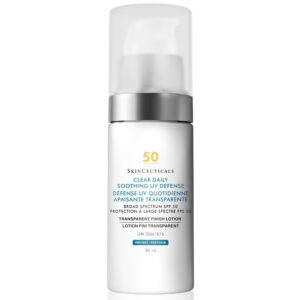
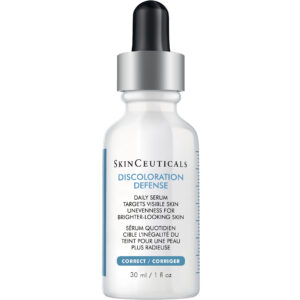
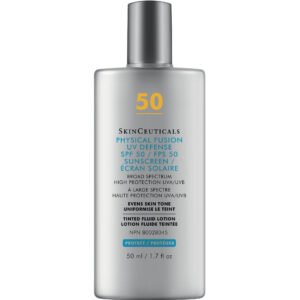
Recommended aftercare and skincare
The medical grade products our team uses to protect and extend your results. Shipped express across Canada, free over 150 dollars.
Ready to look into it properly?
Our consultation is free. We will look at your skin, give you an honest recommendation, and say so if a different treatment would suit you better.
Or call 416 923 1200 · 46 Fort York Blvd, CityPlace, Toronto
Package Pricing
A course usually costs less per session than booking one at a time. These are live package prices from our booking system, valid one year from purchase.
| Package | Sessions | Price | Per session |
|---|---|---|---|
| Acne Scar Revision | 3 | $1,080 | $360 |
| Acne scar revision( medium) | 3 | $1,080 | $360 |
| Aerolase NeoClear Acne Scarring (4 medium) + Microneedling (2 Sessions) | 4 | $1,950 | $488 |
| Acne scar revision (large) | 6 | $2,700 | $450 |
| Acne scar revision (medium) | 6 | $2,160 | $360 |
| Aerolase NeoClear Acne Scar Revision ( small ) | 6 | $1,440 | $240 |
Full list on our price list. Free consult before you commit to a course, call (416) 923-1200.
Questions about this treatment?
Ask us anything before you book. Consultations are free, and we will tell you honestly if a treatment is not right for you.