


Hyperpigmentation in Toronto for sun damage, post-acne marks, and uneven tone. We layer Aerolase laser (safe for all skin tones, including darker complexions) with targeted chemical peels and at-home brightening protocols.
Before paying for pigment treatment, work out which kind you have, because one of the three common types often resolves without any treatment at all. Post-inflammatory hyperpigmentation, the mark left after a spot or injury, usually fades on its own over three to twelve months with daily sun protection. People spend a lot on lasering marks that were already going.
- Post-inflammatory hyperpigmentation: flat brown marks after acne or injury. Often self-resolving with strict SPF. Treatment speeds it up, it does not usually change the endpoint.
- Sun damage and solar lentigines: discrete brown spots from cumulative UV. These do not fade on their own and respond well to laser. Aerolase NeoSkin $350, condition-specific Neo Elite protocols $450.
- Melasma: symmetrical patches, hormonally driven, with a vascular component underneath. Needs a different approach entirely and relapses without maintenance.
- Area-based pricing: small $300, medium or full face $450, large $600. A single spot is $50.
- The non-negotiable: daily broad spectrum SPF. Every pigment treatment fails without it, and that is not a sales line, it is the mechanism.
- Darker skin needs gentler settings. Aggressive treatment on deeper skin types causes the exact pigmentation you came in to fix. This is why we skin type before we treat.
Bar Beauty Medical, 46 Fort York Blvd, CityPlace, Toronto. Prices in Canadian dollars from our live booking system, verified 18 August 2026.
Hyperpigmentation is the umbrella term for any patch of skin that becomes darker than the surrounding tone, caused by excess melanin production from the melanocytes in your skin. It shows up as sun spots, post-inflammatory hyperpigmentation (PIH from acne, eczema, or trauma), age spots, freckles, and hormonal pigmentation. The cause matters because it dictates the protocol, sun damage clears differently than PIH, which clears differently than melasma.
How we treat hyperpigmentation at Bar Beauty
Our standard hyperpigmentation protocol pairs in-office Aerolase NeoSkin laser sessions with medical-grade chemical peels and a structured at-home topical routine. The Aerolase 1064nm wavelength bypasses surface melanin and targets the deeper pigment-producing cells without thermal damage to surrounding skin, making it one of the few lasers safe across Fitzpatrick I through VI skin types. That matters in a Toronto practice where we see every skin tone.
The four pigment categories we treat
Sun damage / solar lentigines, clearly defined dark spots, usually on cheeks, hands, decolletage. Respond well to 3 to 6 Aerolase sessions plus daily SPF 50.
Post-inflammatory hyperpigmentation (PIH), the brown marks that linger after acne, ingrown hairs, or scratches. Most common on Fitzpatrick III to VI skin. Responds best to a combination of Aerolase, salicylic acid peels, and topical tyrosinase inhibitors at home.
Melasma, see our dedicated melasma treatment page. Different mechanism, different protocol, harder to fully clear.
Age spots / lentigos, same family as sun damage but typically deeper and older. May need 6 to 8 sessions for complete clearance.
The at-home routine that doubles your in-office results
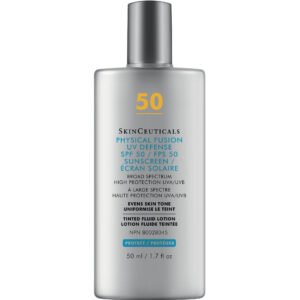
In-office laser handles 60% of the work. The other 40% is daily topical discipline. We send every patient home with a personalized routine built around SkinCeuticals CE Ferulic (vitamin C antioxidant in the morning), tyrosinase-inhibiting brightening serums (alpha arbutin, kojic acid, tranexamic acid), prescription-strength retinoids at night, and SkinCeuticals Physical Fusion UV Defense SPF 50 every single morning. Skip the SPF and you skip the results. Sun exposure is the single most aggressive driver of pigment recurrence.
Sessions, timeline, and realistic expectations
Most patients see real fading by session three of an Aerolase course. A complete protocol runs four to six in-office sessions spaced four weeks apart, with simultaneous at-home treatment running for a minimum of 12 weeks. Stubborn cases or deep pigmentation may need eight or more sessions. We map the plan at consultation, set expectations honestly, and adjust based on response.
What we never do
We don’t run harsh aggressive lasers at all. There is no PDL, no ablative CO2 and no non-fractional Q-switched device in this clinic, and we would not use one on Fitzpatrick III to VI skin. Those devices have caused more pigment problems than they’ve solved in patients with melanin-rich skin. Aerolase’s mechanism is fundamentally safer for our diverse Toronto patient base. If you’ve been told elsewhere that “lasers don’t work on dark skin”, they were using the wrong laser. Aerolase is the right one.
Combining hyperpigmentation work with other concerns
Patients often have hyperpigmentation alongside other concerns. We commonly stack: microneedling for tone and texture, Aerolase NeoClear for active acne if breakouts are still occurring, and PRP microneedling for amplified collagen and tone work. Your protocol is built around your skin, not a one-size template.
Book your free consultation
Speak with a licensed Bar Beauty injector or laser tech. We will assess your skin, walk through options, and give you an honest plan with no upsell.
46 Fort York Blvd, Toronto · 416-923-1200 · Open 7 days
What hyperpigmentation actually is
Hyperpigmentation is a broad category covering several distinct conditions that all share the visible feature of darker patches or spots on the skin. The pigment is melanin, produced by melanocytes in the basal layer of the epidermis. When melanocytes are overactive (due to UV exposure, hormones, inflammation, drugs, or genetics), they produce excess melanin that deposits in the epidermis (epidermal pigment) or drops into the deeper dermis (dermal pigment, much harder to treat). Successful management requires correctly identifying the subtype, identifying and modifying triggers, and matching treatment to the subtype.
Hyperpigmentation subtypes
Solar lentigines (sunspots, age spots, liver spots)
Discrete brown spots on chronically sun-exposed areas (face, hands, decolletage). Most common in patients over 40 with cumulative UV exposure. Respond well to IPL, BBL, Q-switched laser, cryotherapy, hydroquinone, and SPF. This is the one pigment subtype where our InMode Lumecca IPL is often the fastest route, on Fitzpatrick I to III and case by case at IV with a test patch. It is not offered at V or VI, and never for melasma.
Post-inflammatory hyperpigmentation (PIH)
Darkening that develops at sites of prior inflammation: acne, eczema, friction, injury, even ingrown hairs. Common in Fitzpatrick III through VI. Responds to gentle topicals (azelaic acid, niacinamide, tranexamic acid), prescription hydroquinone short courses, gentle peels, and time. Aggressive treatment often worsens it.
Melasma
Hormonally and UV-driven symmetric facial pigmentation, almost exclusively in women, often appearing in pregnancy or with hormonal contraceptive use. Requires careful treatment; aggressive laser worsens melasma. See our dedicated melasma page for the full protocol.
Drug-induced pigmentation
Minocycline, amiodarone, certain chemotherapies, antimalarials, and other medications can cause distinctive pigmentation patterns. Identification of the offending drug and discontinuation (with prescribing physician guidance) is essential before cosmetic treatment.
Berloque dermatitis and phytophotodermatitis
Pigmentation from contact with photosensitizing plants (lime juice on skin in sun, parsnip, fig leaves) followed by UV exposure. Often presents in unusual streaky patterns. Treatment is removal of the offending exposure plus standard PIH management.
Cafe au lait macules and congenital pigmentation
Present from birth or early childhood. Generally not cosmetic priority; some respond to Q-switched laser. Dermatology consultation appropriate.
Ochronosis
Paradoxical darkening from prolonged hydroquinone overuse, especially OTC unregulated formulations. Treatment-resistant; primarily prevented by appropriate hydroquinone use under medical supervision.
Matched treatment by subtype
| Subtype | First-line treatment | Avoid |
|---|---|---|
| Sunspots (solar lentigines) | IPL or BBL, Q-switched laser, hydroquinone | N/A; respond to most modalities |
| PIH (post-acne) | Azelaic acid, niacinamide, tranexamic acid topical, gentle peels | Aggressive lasers, harsh peels |
| Melasma | Hydroquinone, tranexamic acid topical and oral, Aerolase low-fluence, tinted SPF | IPL, high-energy lasers |
| Drug-induced | Identify and stop the drug (with prescriber) | Treating without addressing the cause |
| Ochronosis | Stop hydroquinone; refer to dermatology | More hydroquinone |
The Bar Beauty hyperpigmentation protocol
Initial consultation includes Fitzpatrick typing, Wood lamp evaluation of pigment depth, dermatoscope assessment for irregular pigment (rule out atypical nevus or early melanoma needing dermatology referral), trigger interview, and a structured photographic baseline. Topical prescription regimen is matched to subtype. Daily tinted mineral SPF with iron oxide is foundational for all subtypes. Device-based treatment is selected by type: BBL or IPL for sunspots, Aerolase Neo Elite at conservative fluence for melasma and PIH-prone skin, microneedling with cysteamine for resistant cases. Reassessment at 8 weeks with comparison photography. Full protocol typically runs 12 to 24 weeks.
Red flags: cheap or aggressive hyperpigmentation treatment
Aggressive laser packages advertised at $99 to $199 per session in Toronto are a red flag for hyperpigmentation patients, particularly those with Fitzpatrick III through VI skin. Inappropriate device choice or excessive fluence can cause post-inflammatory hyperpigmentation that lasts months and is harder to treat than the original presenting pigment. Cheap unregulated skin-lightening creams from grey-market sources may contain mercury, high-dose unregulated hydroquinone, or super-potent topical steroids. These cause permanent skin damage including ochronosis and steroid-induced atrophy.
Paying for hyperpigmentation treatment
Cosmetic treatment is generally not HSA-eligible. Prescription topicals (hydroquinone, tretinoin, triple combination) are partially covered under Ontario Drug Benefit and most private extended health. Dermatologist consultations are OHIP-covered. Device cosmetic treatments are out of pocket.
Affirm financing
For larger treatment plans, Affirm financing is available so you can split the cost into monthly payments. You can review your options at consultation; checking your rate does not affect your treatment plan.
The role of skincare in hyperpigmentation
Device-based treatment without daily skincare gives lesser outcomes. Foundational skincare for any hyperpigmentation patient: tinted mineral SPF 30+ with iron oxide daily, gentle non-foaming cleanser, niacinamide 5% serum morning, vitamin C or alpha arbutin serum morning, prescription pigment suppressor (hydroquinone or compounded triple cream) or non-prescription tranexamic acid or cysteamine in the evening, retinoid (prescription tretinoin or OTC retinaldehyde) for cell turnover (introduced slowly), moisturizer to barrier-support, and lip SPF balm. Patients who adhere to this regimen consistently see device-based treatment results sooner and more reliably.
Pigmentation treated with the Neo Elite
Read this first. These photographs come from Aerolase Corp., the company that makes the Neo Elite. Each was taken at the practice credited underneath it. They are not our patients and we are not claiming them as our results. We show them because they are the clearest published record of what this device does, and we run the same machine at our CityPlace clinic. Our own patient photographs go up as we build a consented library.
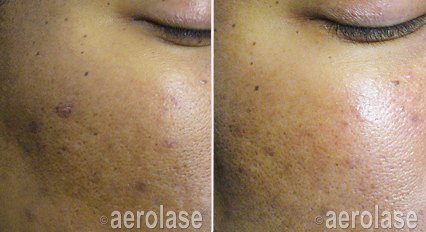
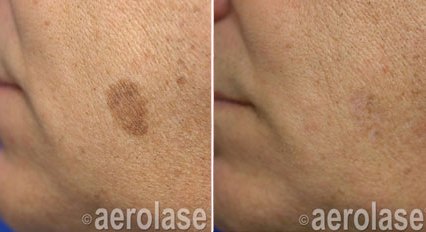
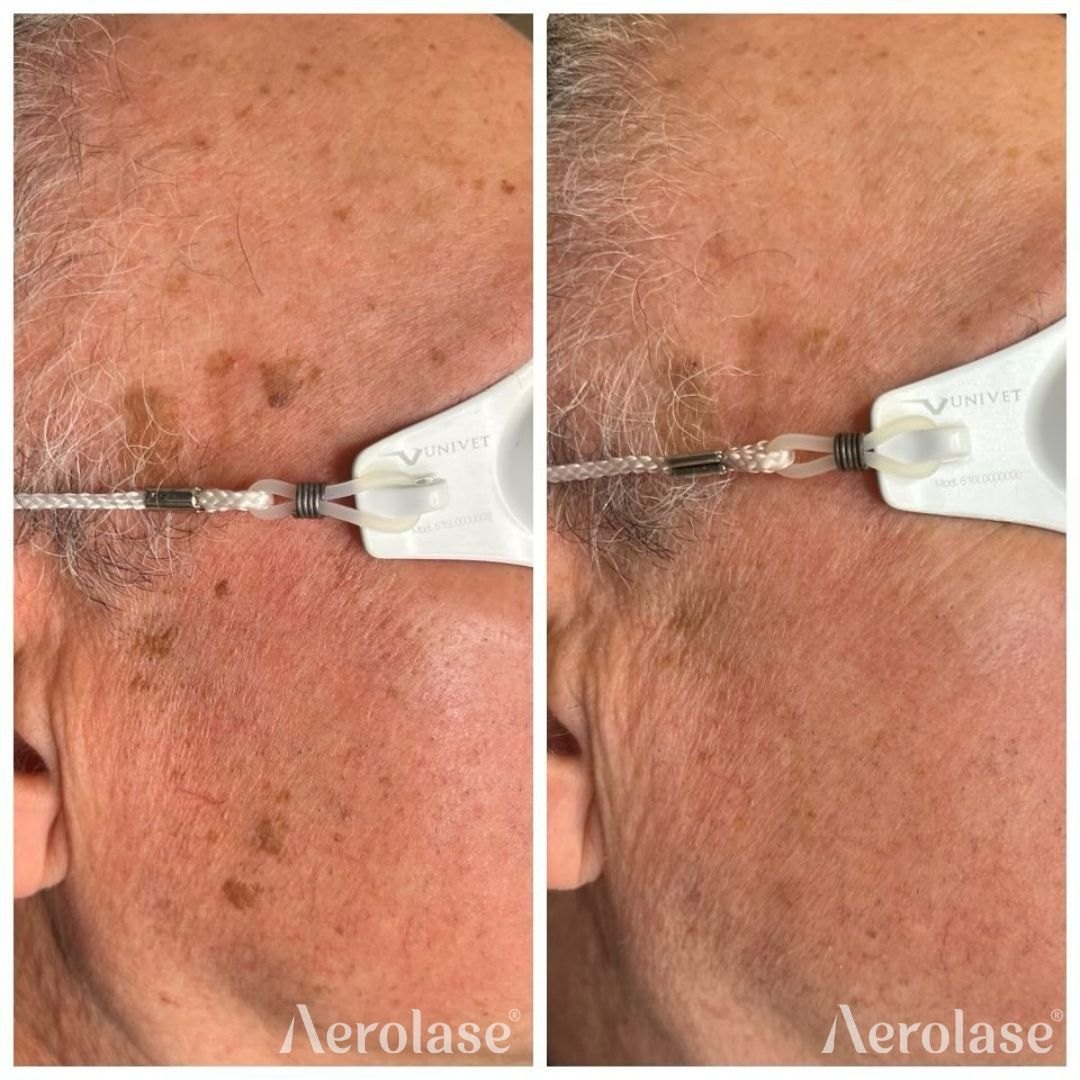
More Neo Elite results. The full set, covering every condition we use this laser for, is on our Aerolase before and after page.
Sessions needed vary by person, severity and skin type. Individual results vary and nothing here is a guarantee of outcome. We do not diagnose from a photograph; anything that has changed in size, shape or colour, or that you have not had looked at, needs a proper assessment before any laser is pointed at it.
Frequently asked questions about hyperpigmentation
Can hyperpigmentation be cured permanently?
Sunspots can be effectively cleared with treatment plus ongoing sun protection. Melasma is managed not cured. PIH typically resolves with treatment and time but can recur with new inflammation.
Which is faster: topical or laser?
Lasers and IPL clear individual sunspots in 1 to 2 sessions. Topicals work over weeks to months. For melasma, slow gentle topicals beat aggressive lasers.
Is hydroquinone safe?
Prescription hydroquinone 4% is safe in 12 to 16 week courses with rest periods. Long-term continuous use risks ochronosis. OTC unregulated hydroquinone from grey sources can be unsafe.
What over-the-counter products help?
Niacinamide, azelaic acid, vitamin C, alpha arbutin, tranexamic acid, kojic acid, and licorice extract have evidence supporting use. Slower than prescription but well-tolerated.
Does sunscreen alone help?
Daily tinted mineral SPF alone produces measurable improvement in mild hyperpigmentation. It is the foundation; all other treatment builds on it.
Is laser safe for dark skin?
Device choice matters. Aerolase 1064 nm Nd:YAG is safe across Fitzpatrick I through VI. IPL and BBL are higher risk for darker skin. Q-switched laser at appropriate settings can work for select pigment in darker skin under experienced hands.
Can men get hyperpigmentation?
Yes, particularly sunspots from cumulative UV exposure and PIH from acne or shaving irritation.
How long does treatment take?
8 to 12 weeks for initial topical response, 12 to 24 weeks for full protocol clearance. Maintenance is lifelong for melasma; intermittent for sunspot and PIH patients.
What if I am pregnant?
Pregnant patients should avoid hydroquinone, tretinoin, and oral tranexamic acid. Azelaic acid and niacinamide are generally pregnancy-safe. Discuss with your OB.
Can chemical peels treat hyperpigmentation?
Low-strength mandelic, glycolic, lactic peels can help PIH and sunspots. Aggressive TCA or phenol peels are higher risk for PIH worsening.
Will my hyperpigmentation come back?
Likely yes if you stop sun protection and the original trigger persists. Maintenance is part of any successful pigmentation plan.
What is the difference between hyperpigmentation and skin cancer?
Skin cancer can present with irregular pigmentation. We assess any concerning lesion at consultation with dermatoscope and refer to dermatology when indicated. Asymmetry, irregular borders, multiple colours, large diameter, or evolution over time warrant evaluation.
Hyperpigmentation types and matched treatment
Hyperpigmentation is a broad category that includes several distinct conditions, and treatment that works for one type can worsen another. Sun-induced lentigines (sunspots, age spots) respond well to IPL, BBL, Q-switched laser, and topical hydroquinone. Post-inflammatory hyperpigmentation from acne or trauma responds best to gentle approaches: azelaic acid, niacinamide, tranexamic acid topical, and a careful low-dose retinoid. Melasma is hormonally and heat-driven and responds poorly to aggressive laser (which can worsen it) but well to topical tranexamic acid, hydroquinone, oral tranexamic acid under physician supervision, and gentle treatments like Aerolase Neo Elite at melasma-appropriate settings. Ochronosis (a rare darkening from overuse of hydroquinone) is treatment-resistant and primarily preventable. Drug-induced pigmentation (from minocycline, amiodarone, certain chemotherapies) needs identification and discontinuation of the offending drug before any cosmetic treatment.
The Bar Beauty hyperpigmentation protocol
Initial consultation with Fitzpatrick typing and dermatoscope assessment to differentiate the pigmentation subtype. Topical prescription regimen (compounded triple cream or commercial tranexamic acid serum). Daily tinted mineral SPF with iron oxide. Treatment course selected by type: BBL for sunspots, Aerolase for melasma, microneedling with cysteamine for resistant cases. Reassessment at 8 weeks. The whole protocol typically runs 12 to 24 weeks. Aggressive at-home regimens stacked with weekly clinic treatments produce the worst outcomes, especially in Fitzpatrick IV through VI skin.
The Wood lamp evaluation: why we use it
A Wood lamp (long-wave UV-A filtered through a Wood glass) at 365 nm allows clinical differentiation of pigment depth. Epidermal pigment fluoresces more brightly under Wood lamp, indicating it is in the upper layers and generally more responsive to topical and superficial device treatments. Dermal pigment shows less Wood lamp enhancement and is much more resistant to treatment. Mixed epidermal-dermal pigment is common in melasma and PIH. This simple in-office assessment changes the treatment recommendation: an epidermal-dominant melasma may respond well to topicals alone, while a dermal-dominant pattern may need device-based options and longer time horizons. We perform Wood lamp evaluation at every hyperpigmentation consultation as part of the assessment.
Dermatoscope: ruling out skin cancer
Any new, changing, asymmetric, multi-coloured, or otherwise concerning pigmented lesion gets dermatoscope evaluation. We are trained to recognize patterns that warrant dermatology referral. We are not dermatologists and we do not biopsy in-clinic. We are honest about our scope: cosmetic pigmentation evaluation in the absence of concerning features for malignancy. Anything concerning, we refer.
Skincare integration for Fitzpatrick IV-VI patients
Darker skin tones have a particular vulnerability to post-inflammatory hyperpigmentation. The skincare and treatment philosophy for Fitzpatrick IV-VI patients is fundamentally different from lighter skin types: gentler protocols, longer intervals between sessions, more conservative energy settings, more emphasis on barrier preservation, more cautious retinoid introduction. We adjust our approach based on skin type, not just on the visible target. This is one of the most common reasons patients tell us they preferred our consultation over those at other clinics.
The Toronto-specific factors that influence hyperpigmentation
Toronto patient demographics and environment create some specific hyperpigmentation key patterns. The high proportion of patients with Fitzpatrick III through VI skin (South Asian, East Asian, Caribbean, African, Middle Eastern, Hispanic, and Mediterranean ancestry) shifts our typical case mix toward melasma and PIH rather than the predominantly sunspot-driven case mix you would see in lighter-skinned populations. The Toronto winter UV index is low but reflective snow exposure during outdoor activities is meaningful for at-risk patients. The summer peak UV index of 7 to 9 in July and August requires aggressive daily SPF particularly during the high-risk 10 am to 4 pm window. Air pollution in the dense downtown core contributes to oxidative stress that worsens hyperpigmentation; topical antioxidants (vitamin C, vitamin E, ferulic acid) help mitigate. Indoor heat in winter dries the skin and impairs barrier function, indirectly worsening pigmentation in some patients. These local factors inform our seasonal protocol adjustments.
What to bring to your hyperpigmentation consultation
Come with a clean face with no makeup, a list of your current skincare products and prescription medications, photographs of how your skin looked at its worst, and any prior treatment history including products tried and outcomes. The consultation runs 30 to 45 minutes and there is no obligation to book treatment at the visit.
Book a hyperpigmentation consultation at Bar Beauty Medical
Bar Beauty Medical is at 46 Fort York Blvd in downtown Toronto. Hyperpigmentation consultations include Fitzpatrick assessment, Wood lamp evaluation of pigment depth, dermatoscope screening of any concerning lesions, trigger interview, and a written multi-modal treatment plan combining topical, device, and lifestyle interventions with transparent pricing. Book online or call 416-923-1200.
Protocol Deep-Dive: Step-by-Step Technique
Most pages describe what a treatment accomplishes; this section describes exactly how we perform the comprehensive hyperpigmentation treatment combining lasers, peels, and topical regimens so that prospective clients understand the rigour behind the price. Bar Beauty operates under a written clinical protocol that every nurse on our team follows identically.
Stage One: Consultation and Photographic Baseline
Every Hyperpigmentation client begins with a 20-minute consultation that includes medical history review, medication reconciliation (with particular attention to blood thinners, isotretinoin exposure within the past six months, recent dental work, and immunomodulators), Fitzpatrick skin typing, and goal articulation. Photographic baselines are captured on the Salient Skin Analyzer using the same lighting, head positioning, and lens distance every visit. This standardised imaging is what makes meaningful before-and-after comparison possible at three, six, and twelve months.
Stage Two: Pre-Treatment Preparation
Skin is double-cleansed with a low-pH gentle cleanser followed by a chlorhexidine or alcohol-based antiseptic depending on the indication. For sensitive areas, a compounded 23/7 lidocaine-tetracaine topical anaesthetic is applied for 25-30 minutes under occlusion. Vitals are taken and consent is reconfirmed. The treatment plan is reviewed verbally one final time and the client is given the option to modify or cancel without penalty.
Stage Three: The Hyperpigmentation Procedure Itself
Treatment is delivered in anatomically mapped zones using parameters titrated to the client’s tissue characteristics and goals. Throughout the procedure the injector or operator monitors for any signs of adverse reaction. Procedure time varies by indication but typical sessions run 30-75 minutes depending on the scope of treatment requested.
Stage Four: Immediate Post-Treatment Assessment
Before the client leaves we capture post-treatment photography, review written aftercare instructions, confirm the next appointment, and provide direct text-message access to the nurse for any concerns in the first 72 hours.
Current pricing for every treatment is published on our (see current price list).
How Hyperpigmentation Compares Against the Surgical Alternative
For clients researching whether a non-surgical treatment can achieve what surgery achieves, the honest answer is: sometimes yes, often partially, occasionally no. The surgical alternative most commonly considered for this indication is deep chemical peel resurfacing or surgical dermabrasion. Understanding the comparison is essential before deciding which path is right.
How Long Results Last
Duration depends on the type of pigment and on your triggers. Sun-damage spots can clear durably with strict SPF. Melasma is a chronic, relapsing condition, so laser and topicals lighten it but do not cure it, and most patients relapse within 3 to 6 months without ongoing maintenance and daily sun protection.
Reversibility and Adjustability
This is the single most consistent reason clients choose non-surgical: results can be modified, reduced, or stopped entirely without permanent consequence. Surgical results cannot be undone without a second surgery. For clients in their first decade of aesthetic engagement we routinely recommend the non-surgical path first specifically because it preserves optionality.
Year 1, Year 2, and Year 3 Maintenance Cost Framework
Most prospective clients only consider the first-treatment cost. A more useful planning lens is the three-year total cost of ownership, which reflects how aesthetic outcomes actually behave over time.
Year 1: Initiation and Optimisation
The first year for Hyperpigmentation typically requires the largest investment as the initial result is built and refined. Expect the bulk of treatments to happen in the first 6-9 months as we titrate to your optimal outcome. Year 1 budget envelope for most clients on this protocol falls in the $1,800-4,800 range depending on starting baseline, treatment area, and combination protocols selected.
Year 2: Maintenance and Refinement
Year 2 cost typically drops to 40-60 percent of Year 1 as the focus shifts from building the result to maintaining it. Most clients on this protocol budget $900-2,400 for Year 2, with the variability driven by individual metabolism, lifestyle factors (sun exposure, smoking, sleep, stress), and the addition or removal of adjunctive treatments.
Year 3 and Beyond: Steady-State
By Year 3 most clients have settled into a predictable maintenance cadence that delivers consistent outcomes at a predictable annual budget. Year 3+ typical budget is $800-2,200 annually.
Reversal and Correction Scenarios
Because comprehensive hyperpigmentation treatment combining lasers, peels, and topical regimens relies on the body’s own healing and remodelling response rather than a foreign implant, there is nothing to dissolve or extract. The scenarios we manage are different: post-inflammatory hyperpigmentation in higher Fitzpatrick types (treated with hydroquinone, tranexamic acid, and strict photoprotection over 8-16 weeks), persistent erythema beyond expected timelines (treated with Aerolase vascular settings and topical timolol if warranted), and texture irregularities (treated with adjusted depth and density in subsequent sessions). The vast majority of side effects are self-limiting and resolve without intervention.
Before-and-After Photography: What to Expect and How to Read It
Photographic outcomes for Hyperpigmentation are documented at standardised intervals: immediately pre-treatment, immediately post-treatment, 2-week follow-up, 6-week follow-up, 3-month, 6-month, and 12-month. The single most common mistake clients make when reviewing other clinics’ before-and-afters is not accounting for lighting, head position, and lens distortion. A photo taken under overhead fluorescent lighting at week zero compared against ring-light frontal photography at week eight can produce a dramatic apparent change driven entirely by photographic technique.
What Genuine Standardised Photography Shows
At Bar Beauty all outcome photography uses identical lighting (5500K balanced LED panels at fixed angles), identical lens (50mm equivalent), identical distance (90 cm), identical background, and identical head positioning aided by the Salient imaging system. This allows us to measure actual tissue and pigment changes rather than photographic artefact. Clients are provided with their full photographic series on request.
Realistic Visible Change Timelines
The first visible change for most Hyperpigmentation protocols appears between 2 weeks and 6 weeks post-treatment. Peak visible change typically lands at the 8-16 week mark, with continued subtle remodelling for several months thereafter. Clients who evaluate their outcome at week one are evaluating swelling and inflammation rather than the actual treatment result.
What Determines Best Candidacy
Not every prospective client is a strong candidate for Hyperpigmentation. The factors that most reliably predict an excellent outcome are listed below, ranked in approximate order of importance.
Realistic and Specific Goals
Clients who can articulate a specific, realistic goal (“I want to look refreshed and less tired in 3D headshots for my professional profile”) consistently report higher satisfaction than clients with vague goals (“I just want to look better”). During consultation we work explicitly on goal specification because it improves the outcome.
Baseline Tissue Quality and Health Factors
Non-smokers, clients with consistent sun protection habits, clients with stable weight, and clients who sleep 7+ hours nightly consistently achieve better and more durable outcomes than clients with the opposite profile. Lifestyle modification recommendations are part of every consultation because they multiply treatment efficacy.
Willingness to Commit to the Full Protocol
Clients who complete the full recommended protocol (including take-home regimens, attendance at follow-ups, and adherence to aftercare) achieve outcomes that are measurably superior to clients who treat the recommended plan as optional. The data on this is unambiguous and is part of why we structure pricing around multi-session packages.
Realistic Budget Across the Three-Year Horizon
Clients who budget only for Year 1 are often disappointed when the maintenance phase begins. The candidates who report the highest long-term satisfaction are those who entered with a three-year budget envelope already understood and accepted.
Honest Medical and Medication History
Undisclosed isotretinoin use, anticoagulant therapy, recent dental work, immunosuppression, autoimmune flares, pregnancy or breastfeeding plans, and certain supplements all materially change the risk profile of Hyperpigmentation. Complete honesty during consultation is the single most important safety factor.
Recommended aftercare and skincare
The medical grade products our team uses to protect and extend your results. Shipped express across Canada, free over 150 dollars.
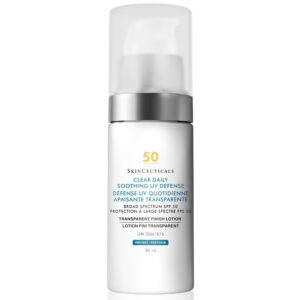
The pigment routine we actually use
In clinic lasers clear the pigment. These keep it from coming back between sessions.
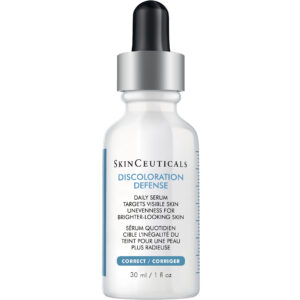 DISCOLORATION DEFENSE 30 ML$160.00
 PHYTO A+ BRIGHTENING TREATMENT 30 ML$150.00
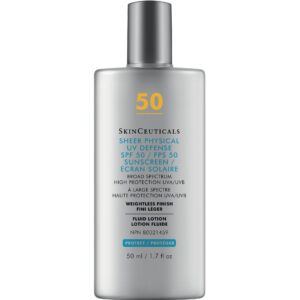 SHEER PHYSICAL UV DEFENCE SPF 50 50 ML$66.00
Stocked in clinic and shipped across Canada. Free express shipping over $150, or free pickup at 46 Fort York Blvd.
When the pigment is dermal or mixed, energy matters more than topicals. Aerolase for melasma covers when we use the laser and when we hold back.
If you have seen Rejuran recommended for skin quality, read why it is not licensed in Canada and what is.
Ready to look into it properly?
Our consultation is free. We will look at your skin, give you an honest recommendation, and say so if a different treatment would suit you better.
Or call 416 923 1200 · 46 Fort York Blvd, CityPlace, Toronto
Questions about this treatment?
Ask us anything before you book. Consultations are free, and we will tell you honestly if a treatment is not right for you.