Written by: Basil Russo, Founder · Reviewed by: Dr. John David Henneberry-Fudge, MD, FRCPC · Last updated: August 19, 2026
Bar Beauty Medical · 46 Fort York Blvd, Toronto, ON M5V 3Z3 · 222+ verified 5-star Google reviews
When people walk into our consult room at Bar Beauty Medical and learn that the Medical Director of our clinic is a Royal College-certified psychiatrist, the reaction follows the same arc almost every time. A pause. A small head tilt. And then some version of the question, “wait, is that normal?”
No. It isn’t. And that’s the entire point.
This is the long-form explanation of why we made that choice, what it actually changes in our daily clinical practice, and why I believe more medical aesthetics clinics in Canada will end up doing something similar in the next five years, not because regulators will require it, but because the patient population we serve is changing faster than the industry’s self-policing has kept up with.
The Medical Director here is a psychiatrist rather than a dermatologist or a surgeon, and the reason is patient selection rather than skin. Pooled prevalence of body dysmorphic disorder runs about 9.2 per cent in cosmetic dermatology populations and 13.2 per cent in cosmetic surgery populations, against 1.7 to 2.4 per cent in the general adult population. The patterns below are what a consult listens for, and none of them means anything on its own.
| What comes up in the consult | The ordinary explanation | What changes when several appear together |
|---|---|---|
| Filler placed and dissolved repeatedly across several clinics in the past twelve to twenty-four months | Poor work that is being corrected, which is common and reasonable | The repetition is not producing satisfaction. It is the loop rather than the number of appointments |
| Comparison photography of a celebrity, where the request needs surgery the patient will not accept | A clear visual brief, which usually helps an injector | The request stays impossible after the anatomy has been explained, and the brief does not adjust |
| Preoccupation with a feature that does not register on standardised cross-polarised clinical photography | Very early change that a camera has not caught yet | The distress is out of proportion to anything the imaging or a trained observer can find |
| The stated complaint moves during the consultation, lips to nose to chin to jawline | Someone thinking out loud about a longer plan | The list keeps growing rather than resolving into a priority |
| A history of corrective procedures, all of them described as unsatisfactory | A run of bad luck with providers | Nothing has ever landed, including work that looked technically sound |
A positive screen on the BDDQ, which goes into intake for first-time injectable patients in higher-risk categories, is not a refusal. It buys a longer consultation and longer-form questions about motivation and history. Where the picture warrants it we defer, suggest a different form of care first, or decline with a referral letter the patient can keep or send to their primary care provider. Consultations are free and run thirty to forty-five minutes.
The default model in commercial medical aesthetics
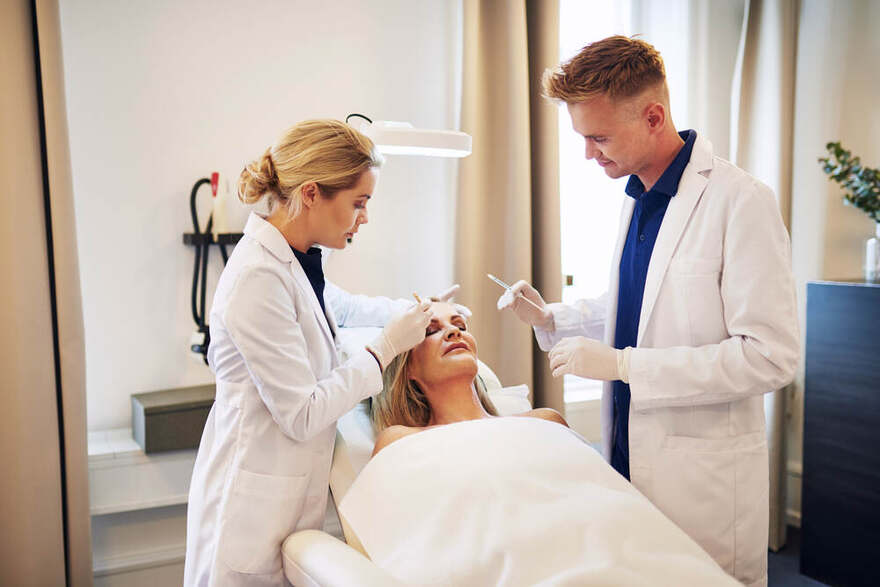
If you scan the websites of fifty Toronto med-spas, you will find roughly five organizational templates for medical oversight. The most common: a family physician or emergency physician acts as the medical director of record, signs off on the regulatory paperwork required by the College of Physicians and Surgeons of Ontario and the College of Nurses of Ontario, and conducts a periodic chart review that may or may not exceed what is strictly required. The injectors, usually registered nurses, occasionally nurse practitioners, occasionally aesthetic physicians, perform the actual work. The medical director is, in the most charitable reading, a quality-and-compliance officer. In the less charitable reading, a name on a wall.
This model is not illegal. It is not, on its face, dangerous. The procedures performed at the average Toronto med-spa, neurotoxin injections, hyaluronic acid filler, hair removal laser, microneedling, carry a small but real risk profile, and most of the injectors performing them are competent technicians who have done thousands of procedures without serious incident. The system works most of the time for most of the patients.
The system breaks down on a specific axis: patient selection. The technical execution of a Botox treatment is one variable. The decision about whether a given patient should receive that treatment is an entirely different variable, and it is the variable our industry has been most reluctant to discuss.
What the literature actually says about who walks into a cosmetic clinic
Body Dysmorphic Disorder is not an obscure psychiatric condition. It is in the DSM-5. It is well-described in the peer-reviewed literature going back decades. Its core feature is a preoccupation with one or more perceived defects in physical appearance that are either not observable to others or appear slight to others. The condition causes clinically significant distress and functional impairment. It tends to be chronic. It responds, in general terms, to cognitive behavioral therapy and serotonergic medication. It does not respond, in general terms, to changing the appearance the patient is preoccupied with.
That last sentence is the one that should make medical aesthetics clinics pay attention.
The prevalence of BDD in the general adult population is estimated, depending on the methodology and the study, at somewhere between 1.7 and 2.4 percent. The prevalence of BDD in cosmetic patient populations is dramatically higher. Veale and colleagues, in a 2016 systematic review and meta-analysis published in The British Journal of Dermatology, found pooled prevalence of BDD in cosmetic dermatology patient populations of 9.2 percent. Pooled prevalence in cosmetic surgery populations: 13.2 percent. Pooled prevalence in rhinoplasty patient populations specifically: above 20 percent. Other studies, Crerand and colleagues in Plastic and Reconstructive Surgery, Conrado and colleagues in the Journal of the American Academy of Dermatology, have replicated this finding in different populations and different countries.
Stated plainly: roughly one in ten to one in five patients walking through the door of a cosmetic clinic meet diagnostic criteria for a psychiatric condition that, by clinical consensus, is contraindicated for the very procedure they are requesting. And outside of academic medicine and a small number of specialized clinics, virtually nobody in commercial medical aesthetics screens for it.
The clinical guidance from the literature is consistent and has been for two decades: patients with active BDD who undergo cosmetic procedures do not generally feel better after the procedure. A small subset feel temporarily relieved. The majority either feel no change, feel worse, develop preoccupation with new body areas, or request repeat procedures in escalating frequency. A meaningful minority become litigious or, in the most documented cases, threatening toward the providers who treated them. Cosmetic intervention in active BDD does not treat the underlying disorder. It feeds it.
What this looks like in our consult room
The clinical signatures of BDD in a cosmetic consult are not subtle once you know what to listen for. They are subtle enough that an injector trained only on technique will miss them, which is the entire problem with the standard industry model.
The patient who has had filler injected and dissolved repeatedly at multiple clinics over the past twelve to twenty-four months. The patient who arrives with extensive comparison photography of celebrities they want to look like, where the request is technically impossible without surgical intervention they cannot accept. The patient who is preoccupied with a feature that is not visible to a trained clinical observer and does not register on standardized clinical photography under cross-polarized light. The patient whose stated complaint shifts during the consultation, we begin discussing lips, end discussing nose, with chin and jawline added in the final ten minutes. The patient who reports a history of multiple corrective procedures and remains, by their own description, dissatisfied with all of them.
None of these patterns are by themselves diagnostic. Any one of them in isolation can have an entirely benign explanation. Clusters of them in the same patient, with the right affective signature, warrant a different conversation than the one a typical injectable consult is structured to have.
At Bar Beauty Medical, for first-time injectable patients in specific high-risk categories, lip filler, repeat full-face volumization, anything that is rhinoplasty-adjacent, we administer a brief validated self-report screen, most commonly the BDDQ (Body Dysmorphic Disorder Questionnaire), as part of our intake paperwork. A positive screen does not mean we refuse to treat. It means we extend the consultation, ask longer-form questions about the patient’s motivations and history, and where the picture warrants it, we defer treatment, suggest the patient pursue an unrelated form of care first, or in clear-cut cases, decline the procedure entirely with a referral letter we can hand to the patient or send to their primary care provider.
This is the part of running a medical practice that does not appear in any of the marketing material. We turn patients away. We do it more than people would expect. We do it because the alternative is taking money from a patient who is going to feel worse after we treat them, and that is not a business we are willing to run.
Why a psychiatrist and not a dermatologist
This is the question I am asked most often by other clinic owners, and it has a straightforward answer.
Dermatology training is unmatched for skin, hair, nails, and the diagnostic differential for cutaneous disease. If our clinic were focused on medical dermatology, cysts, eczema, psoriasis, suspicious lesions, a dermatologist medical director would be the right choice and not even a close call. We are not that kind of practice. We are an injectable, energy device, and skin health practice where the technical work is largely performed by very experienced registered nurse injectors, and the variable that most determines whether a patient ends up satisfied with the result a year later is the variable a psychiatrist is professionally trained to assess.
Plastic surgeons bring extraordinary structural understanding of the face and body. We refer to plastic surgeons regularly, when a patient is asking for something that should be done surgically, we say so and we name names. Plastic surgery training is not, primarily, training in patient psychiatric assessment. Family medicine and emergency medicine are excellent generalist trainings; neither is specifically optimized for the patient population we see.
Psychiatry training is. The Royal College of Physicians and Surgeons of Canada Psychiatry residency is a five-year postgraduate program that includes specific training in mood and anxiety disorders, somatic symptom and related disorders (which is the diagnostic chapter BDD lives in), suicidality assessment, eating disorders, and the clinical interview as a primary diagnostic tool. The skill set the patient population we serve actually needs at the decision-to-treat moment is much closer to that than to dermatology or surgery.
What this changes that you can see, and what it changes that you can’t
The visible changes are small. Our intake form has more questions than the form at the median Toronto med-spa. Our first consultations run longer than the median, typically thirty to forty-five minutes versus the industry-average fifteen to twenty. We document patient motivations and stated goals in their chart in language that would not look out of place in a psychiatric assessment, because it informs the clinical decision being made. We use cross-polarized standardized clinical photography to anchor what is objectively present on the skin against what the patient is reporting they see. We bring up the option of declining or deferring treatment as a real option, not a script item.
The invisible change is the more important one. The composition of our practice, over time, shifts. The patients we are not able to help, with the framing of compassion, not judgment, either self-select out of our clinic during the consultation or are referred onward to care that is more appropriate for what they actually need. The patients who do receive treatment are, on average, more likely to be the patients for whom the treatment will accomplish what they wanted. Our retention is high. Our complaint rate is low. Our review average, which we are happy to be measured by, currently sits at 5.0 of 5.0 across more than 221 verified Google reviews.
Some of that is technical execution by an excellent injector team. Most of it, I would argue privately to anyone who runs a similar business, is patient selection.
What I think will change in the next five years
The Canadian medical aesthetics regulatory environment is going to tighten. There is no version of the next five years in which it does not. The provincial colleges are already paying more attention. The plaintiffs’ bar is paying more attention. The major beauty media has begun publishing the kind of long-form pieces that change consumer awareness, which in turn changes consumer demand for clinics that screen for what they should be screening for.
The clinics that will do well in that environment are the ones that built the screening capacity in before they were required to. The clinics that built business models around volume of procedures performed, without much attention to who the procedures were performed on, are going to find the next half-decade harder than the last one.
None of this means our model is the only correct one. There are excellent dermatologist-led clinics in this city. There are excellent plastic-surgeon-led clinics in this city. There are excellent nurse-injector-owned clinics with thoughtful generalist medical direction. The point is not that we have the right answer. The point is that the question of who is making the call about whether a given patient should be treated is a clinical question, not a marketing question, and it deserves the kind of considered answer most clinics have not given it.
We gave ours that answer by putting a psychiatrist in the role. It has changed how we operate. It has changed which patients leave our clinic with treatment booked and which leave with a referral letter instead. We think both of those outcomes, when matched correctly to the patient in front of us, are good ones.
If you are a patient who has read this far
You probably want to ask a follow-up question. The most useful one to start with is: at the clinic you are considering, who decides whether a given patient should be treated, and what is the basis for that decision? If the answer is “the injector decides, and the basis is what the patient asks for,” you have your answer. If the answer is more thoughtful than that, you have a different answer. Neither answer is automatically disqualifying. Both are useful information.
At Bar Beauty Medical, the answer is: every first-time injectable patient is screened on intake, every consult that produces a positive screen gets a longer second look from a clinician trained to recognize what the screen is flagging, and the right to defer or decline treatment is real and gets exercised. If you would like to walk through this in person, our consultations are complimentary and run thirty to forty-five minutes. You can book at barbeautymedical.janeapp.com or call 416-923-1200.
If you are a journalist who has read this far
We are available for on-the-record commentary on BDD in cosmetic patient populations, the regulatory gap in Canadian medical aesthetics, patient selection ethics, the rising profile of psychiatry in aesthetic medicine, and related stories. Contact info@barbeauty.ca or 416-923-1200 (EST). Dr. Fudge is generally available for background but does not typically offer on-the-record clinical commentary; I can speak to the practice-level decisions and Dr. Fudge can be confirmed on background as the Medical Director of record.
, Basil Russo
Founder, Bar Beauty Medical
barbeauty.ca
Editorial note
This is an opinion essay by the founder of Bar Beauty Medical. The clinical statements about BDD prevalence in cosmetic populations cite Veale et al. (Br J Dermatol, 2016), Crerand et al. (Plast Reconstr Surg), and Conrado et al. (J Am Acad Dermatol). The reference to the Royal College of Physicians and Surgeons of Canada Psychiatry training pathway reflects the published curriculum. Bar Beauty Medical’s Medical Director’s CPSO registration and specialty certification are publicly verifiable at register.cpso.on.ca.
Ready to look into it properly?
Our consultation is free. We will look at your skin, give you an honest recommendation, and say so if a different treatment would suit you better.
Or call 416 923 1200 · 46 Fort York Blvd, CityPlace, Toronto
Questions about this treatment?
Ask us anything before you book. Consultations are free, and we will tell you honestly if a treatment is not right for you.