



PRP Hair Restoration in Toronto, for Men and Women: the honest version
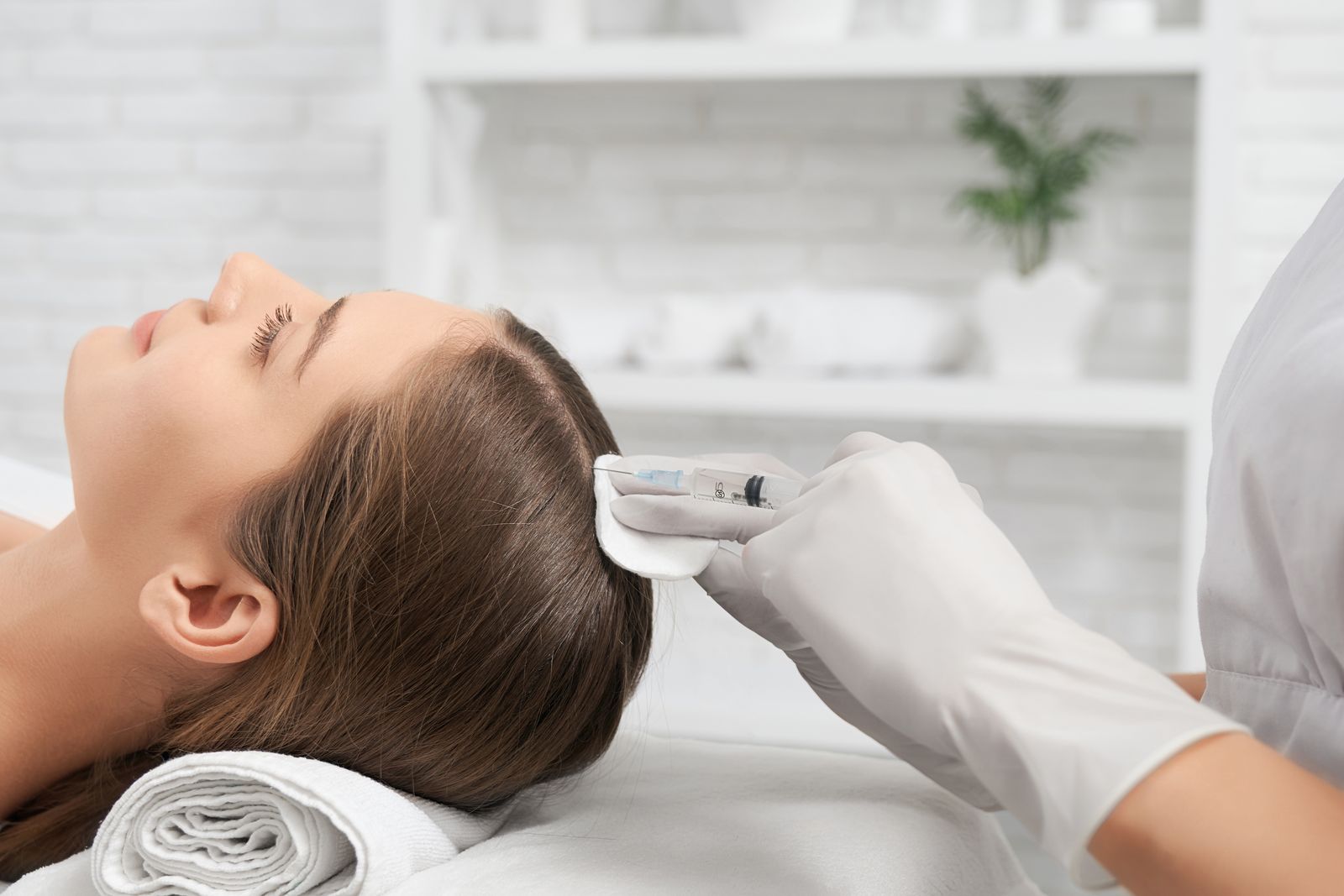
If you’ve been researching PRP for hair loss in Toronto, you’ve probably read a dozen clinic pages that all sound the same. Natural, drug-free, autologous growth factors regrow your hair. Some of that’s true. Some of it’s marketing. So here’s our honest breakdown of what PRP hair restoration actually does, who responds well to it, who doesn’t, what it costs with us, and how to spot the discount clinics that’ll draw your blood, charge you a low price, and leave you with nothing visible to show for it.
What PRP hair restoration actually is
PRP (Platelet-Rich Plasma) for hair loss is an injection treatment that uses your own blood-derived growth factors to stimulate dormant or shrinking hair follicles. We draw your blood, spin it on our Salient PRP system to isolate the platelet-rich layer, and inject that concentrate into the scalp at many points across the area of thinning. The growth factors (PDGF, VEGF, IGF-1, TGF-beta, EGF) signal follicular cells to extend the growth phase, thicken the hair shaft, and recruit the cells that support new growth.
Done correctly, PRP can produce measurable increases in hair count, density, and shaft diameter that show up on scalp imaging over a few months. Done incorrectly, it produces a sore scalp and a bill.
What PRP for hair does
- Slows progressive thinning in androgenetic (pattern) hair loss
- Nudges dormant follicles back toward the growth phase
- Thickens existing thinning hair (shaft diameter)
- Improves density in patients who respond
- Works for both men and women
- Pairs well with finasteride, minoxidil, and nutritional support for a compounding effect
What PRP for hair does not do
- It does not regrow hair on a fully bald scalp; that needs a transplant
- It does not work in late-stage (Norwood 6 to 7) pattern baldness
- It does not work in scarring alopecia such as lichen planopilaris
- It does not produce visible results before about month three; patience is required
- It does not hold permanently if you stop; maintenance is part of the plan
Honestly, if a clinic promises PRP will “regrow your hairline” or “reverse baldness,” they’re misrepresenting the science. PRP is a maintenance and improvement treatment for the hair you still have. It’s not a transplant substitute. We’ll tell you at consult which group you fall into, even when the answer isn’t the one you were hoping for.
Who PRP hair restoration works best for
The strong candidate
- Early to moderate pattern hair loss (Norwood 2 to 4 in men, Ludwig I to II in women)
- Thinning at the crown, temples, or part line
- Hair loss that is relatively recent rather than decades old
- Visible thinning hair rather than fully bald scalp
- Realistic about timelines and willing to commit to the full plan
- Open to combining with finasteride, minoxidil, or nutritional support
The patient we often turn away
- Fully bald scalp with no follicles left to stimulate
- Late-stage (Norwood 6 to 7) pattern baldness
- Active scarring alopecia, which we refer to dermatology first
- Alopecia areata in an active flare
- An expectation of a transplant result without surgery
- An active scalp infection or flare of seborrheic dermatitis
Honest screening up front is the difference between a clinic that produces results and one that produces refund requests. If PRP isn’t going to help you, we’ll say so before you’ve spent a dollar.
The Bar Beauty Medical PRP hair protocol
The consultation
We assess your scalp and the pattern of thinning, take a careful history including your family hair-loss pattern and current treatments, and tell you honestly whether PRP is likely to help. We document the baseline so we can show you the change later. The consultation is free.
The blood draw
We draw blood from a forearm vein; larger treatment areas need a little more, targeted areas need less.
The spin
Your blood is processed in a Health Canada licensed centrifuge system using single-use, sterile kits opened in front of you.
The injection
Topical numbing cream is applied before we begin. We then place a grid of microinjections across the target area at the depth where the follicle roots sit. A cooling option is available to keep you comfortable.
The recovery
Mild scalp tenderness for about 24 hours, with any pinpoint bleeding settling quickly. You can wash your hair the next morning. Avoid swimming, saunas, and direct sun for 48 hours.
The PRP hair timeline, month by month
Months 1 to 2
No visible change. You may notice slightly more shedding for the first couple of weeks, the “shedding wave,” which is a sign that dormant follicles are cycling. It is expected, not a setback.
Month 3
First measurable changes on scalp imaging: finer hairs beginning to mature and a slight increase in shaft diameter. Most patients do not yet see a mirror difference.
Months 4 to 5
Most responders start to notice it: thinning areas look denser, hair feels thicker, and less scalp shows under bright light.
Month 6
Peak result from the initial series, with imaging usually showing a meaningful improvement in density and shaft diameter for responders. Photographs in the same lighting as baseline are usually clearly different.
Months 9 to 12
Without maintenance, gains gradually regress. With maintenance sessions, they hold and often keep improving.
PRP hair restoration cost in Toronto, and what it includes
We publish our prices and we do not negotiate at the chair. Our current PRP hair restoration pricing, including the targeted and fuller-scalp options, is posted live on the price list and in our Jane App booking system. Pricing scales with the size of the area treated and the volume of concentrate used, so the consult is where we confirm the exact plan and number of sessions. Your price includes the consultation, blood draw, processing, topical numbing, the injection itself, and a follow-up review. Take-home topicals and supplements are optional and quoted separately.
Live pricing always wins over any number you read online, so check the price list before you book.
Is PRP for hair covered by OHIP or insurance?
For pattern hair loss, generally no. OHIP does not cover PRP hair restoration, and most private cosmetic benefits do not either. Where there is a documented medical alopecia diagnosis, some extended health plans and Health Spending Accounts will partially reimburse; we provide an itemised invoice with the appropriate notes so you can submit it, though approval depends entirely on your carrier and plan. Always confirm with your benefits provider before you book.
Affirm financing
For larger treatment plans, Affirm financing is available so you can split the cost into monthly payments. You can review your options at the consultation, and checking your rate does not affect your plan. Affirm is the only third-party financing we offer.
Red flags: what cheap PRP hair restoration in Toronto usually means
The “clinic” label is loosely used at the discount end of this market, and the procedure is often misrepresented. If you are quoted a price that looks too good to be true, one or more of the following is usually true.
Single-spin “PRP”
Real PRP for hair needs a proper spin protocol to concentrate platelets well above baseline. A single weak spin produces a much thinner concentrate with far less growth-factor payload. It looks identical from your side; the result is not.
Too little volume or coverage
A proper scalp treatment puts a meaningful volume of concentrate across many injection points. Discount clinics often inject a fraction of that across far fewer points, which isn’t enough to produce a real response. You leave thinking you got the treatment. You got a fraction of it.
The wrong injection depth
The follicle roots sit a few millimetres below the surface. Injections that are too shallow deposit the PRP where it cannot reach the follicle. Some clinics inject shallow to reduce discomfort, and the result is no response.
Blood drawn or scalp injected by someone who is not allowed to
Drawing blood and injecting the scalp are both controlled acts in Ontario. Only nurses, nurse practitioners, and physicians can legally perform them. A “trichologist” without medical licensure cannot.
No baseline or follow-up imaging
If a clinic does not photograph and measure your scalp before treatment and again a few months later, you have no way to verify whether it worked. We document the baseline because we want to show you the change.
PRP plus medical therapy, and the GLP-1 shedding question
The honest consensus among Toronto hair-restoration providers is that PRP works best as part of a plan, not alone. For many patients, PRP combined with oral finasteride (in men) or topical minoxidil (in both sexes) produces a noticeably better result than PRP by itself, and we will recommend the medical combination unless it is contraindicated. We also see patients on GLP-1 medications such as semaglutide and tirzepatide reporting accelerated shedding a few months in; PRP can help mitigate that, but the nutritional and stress drivers need to be addressed too. We discuss all of this openly at consult.
PRP hair vs other Toronto hair-loss treatments
PRP vs hair transplant
Different categories. A transplant surgically moves follicles from a donor zone to a thin zone, producing a permanent change in the hairline. PRP stimulates the follicles you still have. Some patients do both, a transplant for the hairline and PRP for ongoing density.
PRP vs minoxidil
Different mechanisms. Minoxidil improves blood flow to follicles and extends the growth phase; PRP brings the growth-factor signalling. They work better together than either does alone.
PRP vs finasteride
Different mechanisms. Finasteride blocks the hormone (DHT) that drives pattern loss; PRP stimulates follicular activity. The combination is a common standard of care for moderate male pattern loss.
PRP vs low-level laser caps
Different evidence base. PRP has stronger published evidence; red-light caps have moderate evidence for mild thinning and can be used for ongoing maintenance.
PRP hair restoration FAQ
How much does PRP for hair cost in Toronto?
Our current pricing, by treatment area, is posted live on the price list and in Jane. Pricing scales with the area treated and the volume used, which we confirm at the free consult.
Does PRP actually regrow hair?
In the right candidate, PRP can thicken existing thinning hair and improve density that shows up on scalp imaging. It does not regrow hair on a fully bald scalp, and it works best alongside medical therapy. The honest answer depends on your stage of hair loss, which is what the consult is for.
How many PRP sessions do I need for hair loss?
Most patients do an initial series, commonly four sessions spaced about four to six weeks apart, followed by maintenance sessions to hold the result. Your exact plan is set at consult.
How long do PRP hair results last?
Without maintenance, results begin to regress around 9 to 12 months. With maintenance sessions, the gains hold and often keep improving.
Does PRP for hair loss hurt?
With topical numbing, most patients find the scalp injections very tolerable, and a cooling option helps.
Does PRP work for women’s hair loss?
Yes. Female pattern thinning (Ludwig I to II) responds well, particularly alongside topical minoxidil.
Can I combine PRP with finasteride and minoxidil?
Yes, and we usually recommend it. The combination tends to outperform PRP alone.
Is PRP hair restoration safe?
When performed by a regulated health professional using sterile single-use equipment, yes. You cannot be allergic to your own blood.
Can I drive home after a PRP hair session?
Yes. There is no sedation. Avoid swimming and saunas for 48 hours.
Is PRP hair restoration covered by OHIP?
No. Some extended health plans and Health Spending Accounts partially reimburse with a documented alopecia diagnosis; we provide an itemised invoice for submission.
A few honest things worth knowing first
- Before-and-afters online are someone’s best case. They are useful as inspiration, not a contract. Your stage of hair loss matters more than someone else’s result.
- One session is rarely the whole story. Hair restoration is a multi-month process. Patients who expect a one-and-done miracle leave more frustrated than patients who understand the realistic arc.
- PRP works best in a plan. The patients with the best results pair PRP with the right medical therapy and stick with maintenance.
- Photos beat memory. We document the baseline so the change at month three and month six is something you can actually see.
How our PRP hair restoration differs from a typical Toronto clinic
Toronto’s market is crowded. On paper, most clinics offer the same overlapping treatments, so the real difference is in the protocol. Our new-patient consults aren’t rushed. You get a real scalp assessment, documented baseline imaging, a written plan, and an honest talk about alternatives, including when the right answer is a transplant or medical therapy instead of PRP. Every regenerative protocol runs under the standing oversight of our medical director, and if something needs a clinician after hours, you can reach one.
Book a PRP hair restoration consultation at Bar Beauty Medical
Want to skip the marketing and have a real conversation about what PRP can, and can’t, do for your hair? We’re here for it. The consult is free, with no obligation to treat that day. We document your baseline, give you an honest plan and transparent pricing, and tell you when a different approach is the better answer. We’re at 46 Fort York Blvd in CityPlace, Toronto, with free on-site parking, and we see clients from across downtown and the wider GTA.
Book online on Jane or call 416-923-1200.
Recommended aftercare and skincare
The medical grade products our team uses to protect and extend your results. Shipped express across Canada, free over 150 dollars.
&url=https://barbeauty.ca/product/hale-derma-spray-2oz/&media=https://barbeauty.ca/wp-content/uploads/2026/05/hale-derma-60ml-1024x1024.png)

