


Aerolase Neo Elite vs IPL: Side-by-Side Comparison
| Factor | Aerolase Neo Elite | IPL (Intense Pulsed Light) |
|---|---|---|
| Technology | 1064 nm Nd:YAG laser, 650 microsecond pulse | Broadband filtered xenon flash lamp |
| Fitzpatrick safety range | I through VI (all skin tones) | I to III, case by case at IV with a test patch |
| Risk for melanin-rich skin | Safe, low PIH risk in trained hands | Second-degree burns, blistering and PIH are documented from Fitzpatrick IV upward. We do not offer it at V or VI |
| Targets | Rosacea, melasma, acne, hair, pigment, fine lines | Sun spots, redness, surface vascular lesions |
| Sessions for full course | 3 to 6 sessions, 2 to 4 weeks apart | 4 to 6 sessions, 4 to 6 weeks apart |
| Downtime | None to mild redness for 2 to 4 hours | Redness 24 to 48 hours, possible crusting |
| Tan-skin compatibility | Works on tanned skin | Must avoid for 4 weeks before and after |
From our team: Bar Beauty Medical built its skin programme on the Aerolase Neo Elite first, because IPL excludes much of Toronto’s South Asian, East Asian, Middle Eastern, Latino and Black population on safety grounds and Aerolase treats all six Fitzpatrick types. As of August 2026 we also run the InMode Lumecca IPL. That does not soften the safety argument on this page. It means the choice below is now made per patient and per phototype at a consultation, instead of being made for you by whichever machine we happened to own.
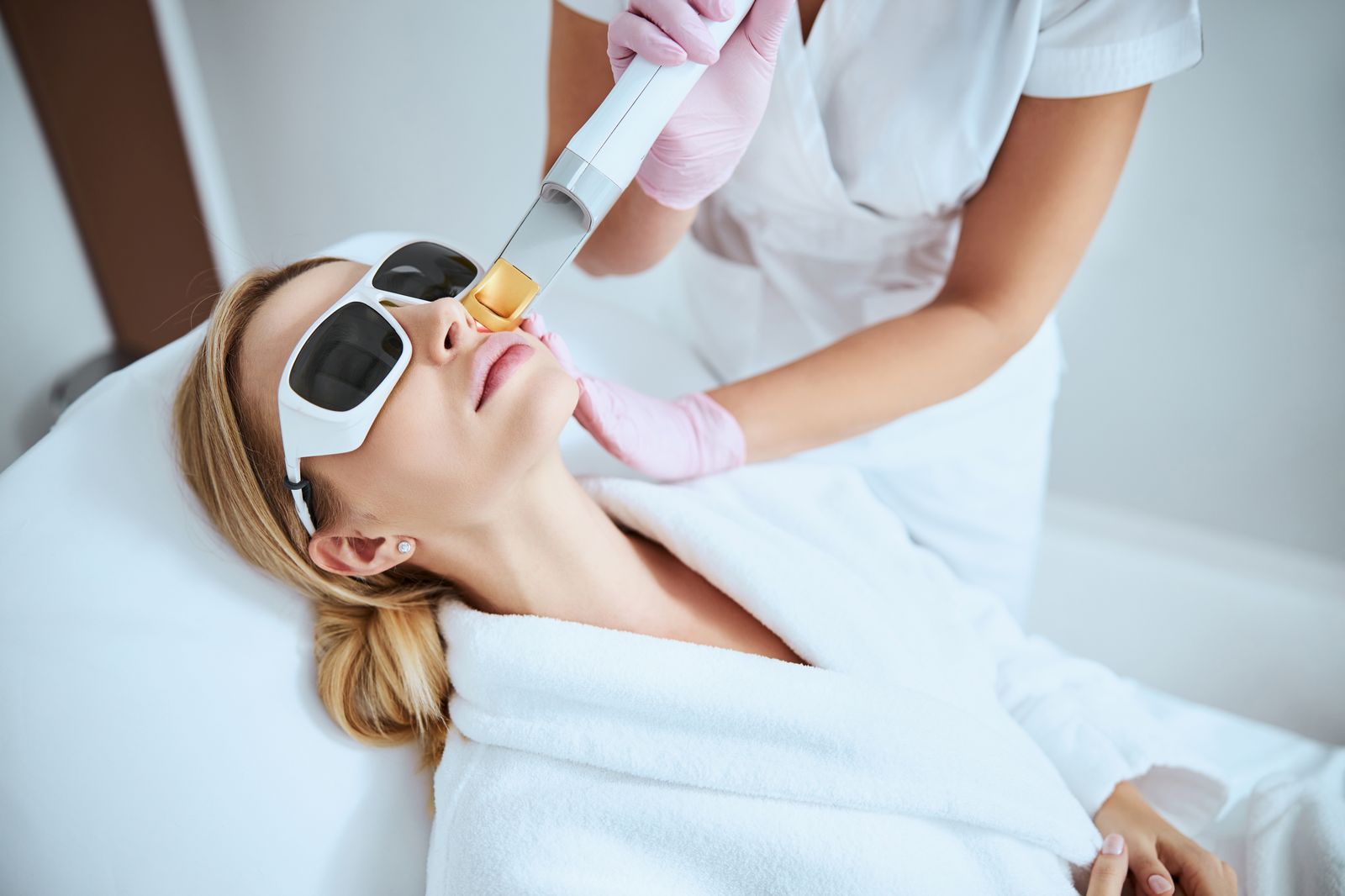
IPL is not a laser. It is a filtered xenon flash lamp emitting a broad band of light from roughly 500 to 1200 nm, and almost every practical difference on this page follows from that one fact rather than from brand, clinic or price. The Aerolase Neo Elite emits a single wavelength at 1064 nm. Here is what changes because of it.
| What is different about the light | What that does in the skin | What it means for you |
|---|---|---|
| A broad band instead of one wavelength | Much of the output sits in the 500 to 600 nm range, which surface melanin absorbs heavily. A single 1064 nm wavelength passes through that layer instead of being caught by it | The output has to be filtered for each indication, and filtering never fully removes the portion that surface pigment absorbs on the way down |
| Filter cartridges rather than a fixed output | The machine is reconfigured per indication, which is what makes it versatile and also what makes the operator’s choice load-bearing | You are relying on the right cartridge being chosen for your skin, not only for your complaint |
| A long pulse, typically 10 to 50 milliseconds against 650 microseconds | Warming of the tissue around a target tracks with how long the pulse lasts. A long one heats the target and its neighbours. A short one is finished before the heat has anywhere to travel | The difference in how it feels, whether topical anaesthetic comes into it, and how long the flush lasts afterwards |
| Energy that stops nearer the surface | IPL works at roughly 1 to 2 mm, so it reaches surface pigment and surface vessels. 1064 nm reaches deeper structures including dermal vasculature and sebaceous glands | Complaints that live below the surface, active acne and deeper vessels among them, were never really an IPL job to begin with |
| A category name against a model name | IPL describes a whole family of machines built by different manufacturers to very different specifications. Neo Elite is one named model from one manufacturer | Being told a clinic has IPL tells you almost nothing about the machine you will be lying under. Being told the model name tells you everything, because you can look it up |
This is not an argument that IPL is a poor machine. On the very fairest skin, with discrete sun spots, no tan and no history of melasma, it clears faster, and we will say so at a consultation. We run one now, the InMode Lumecca, so this is a comparison between two devices in our own treatment rooms rather than a case against a machine we do not have. Hair removal is the single category where the comparison genuinely flips, and it flips on hair colour and skin type rather than on either machine being better.
If you only read one thing: Aerolase vs IPL in 2026
Aerolase Neo (1064 nm Nd:YAG, 650-microsecond pulse) and IPL (Intense Pulsed Light, roughly 500 to 1200 nm broadband) are not equivalent tools. IPL is a surface device that is unsafe on Fitzpatrick IV to VI. Aerolase is a depth device that is safe across all six Fitzpatrick types. If you have brown or Black skin, melasma, active acne, rosacea or a tan, Aerolase is the right device and IPL is functionally contraindicated. If you have very fair skin, simple sun spots and no pigment risk, IPL can produce excellent results faster and slightly cheaper per session, with 1 to 3 days of redness or scabbing. This is the head-to-head most clinics will not write, because most clinics own one of the two and have to argue for it.
Updated August 2026: we now run both. The IPL in our treatment rooms is the InMode Lumecca, a xenon flashlamp filtered to 515 to 1200 nm, with a narrower 580 to 1200 nm filter for skin that carries more baseline melanin. Owning both changes nothing in the physics below. It changes who makes the decision and when. The limits are unchanged and we hold to them: Lumecca is offered on Fitzpatrick I to III, case by case at IV with a test patch, not at V or VI, and we do not use it for melasma. On this page, when you read that Aerolase is the safer choice for a given profile, that is now us recommending against our own IPL.
Wavelength: The Single Most Important Difference
IPL emits a broadband light spectrum from roughly 500 to 1200 nm. The 500 to 600 nm portion, which carries much of the energy, is heavily absorbed by surface melanin. That is the core problem for darker skin: the same energy meant to break up sun spots also burns the surrounding pigmented skin.
Aerolase Neo emits a single wavelength of 1064 nm. At this depth-penetrating wavelength, melanin absorption drops sharply compared with the 500 to 600 nm range. The energy passes through epidermal melanin and is selectively absorbed by deeper targets: melanosome clusters, dermal vasculature, sebaceous glands and hair follicles.
| Property | IPL | Aerolase Neo |
|---|---|---|
| Wavelength type | Broadband (500 to 1200 nm) | Single (1064 nm) |
| Surface melanin absorption | High | Minimal |
| Depth penetration | 1 to 2 mm | 4 to 6 mm |
| Targets | Surface pigment, surface vessels | Pigment, vasculature, sebaceous glands, follicles |
| Filter cartridges needed | Multiple (per indication) | One device, all indications |
Pulse Duration: A Much Shorter Pulse Means Far Less Surrounding Heat
IPL devices typically pulse in the range of 10 to 50 milliseconds. Aerolase pulses at 650 microseconds, roughly a hundred times shorter.
Why it matters: thermal damage to surrounding skin is proportional to pulse duration. A long pulse heats the target and the surrounding tissue. A short pulse heats the target while surrounding tissue stays cool, a principle called thermal relaxation time.
The clinical consequence: with IPL on darker skin, the surrounding pigmented skin cannot dissipate heat before the pulse ends, which leads to burns, blisters and worsened pigmentation. With Aerolase, the pulse is fast enough that surrounding skin barely registers it.
Fitzpatrick Safety Side-By-Side
| Fitzpatrick Type | IPL Safe? | Aerolase Safe? |
|---|---|---|
| I, Very fair | Yes | Yes |
| II, Fair | Yes | Yes |
| III, Medium | Yes with caution; avoid tan | Yes |
| IV, Olive | Not advised; high burn risk | Yes |
| V, Brown | Not safe | Yes |
| VI, Deeply pigmented | Not safe | Yes |
This single table removes a large share of Toronto’s population from IPL consideration on safety grounds. Aerolase removes that gate.
Indication-By-Indication Comparison
Sun Spots and Solar Lentigines
IPL on Fitzpatrick I to III with discrete sun spots is fast and effective, 1 to 3 sessions, with scabbing over the spot for 5 to 7 days. Aerolase clears the same lesions in 3 to 5 sessions with no scabbing. If you are fair-skinned and do not mind scabby spots for a week, IPL wins on speed. Otherwise Aerolase.
Melasma
IPL is contraindicated and often worsens melasma. Aerolase is one of the few defensible laser options for melasma. Not a contest.
Active Acne
IPL has a modest anti-inflammatory effect but does not target sebaceous glands. Aerolase targets the acne-causing bacteria, sebaceous glands and inflammation at once, and works on Fitzpatrick IV to VI where acne and post-inflammatory pigment most commonly co-occur. Aerolase wins decisively for acne.
Rosacea and Persistent Redness
IPL with appropriate filters reduces diffuse redness on Fitzpatrick I to III. Aerolase reduces redness and deeper vessels safely across I to VI. For mixed populations, Aerolase. For very fair patients with diffuse cheek redness only and no darker risk factors, IPL is reasonable.
Hair Removal
This is the one major category where the comparison flips. IPL hair removal works well on Fitzpatrick I to III with dark hair. For Fitzpatrick IV to VI, only Nd:YAG-based lasers (including Aerolase) are safe. For very fair skin with very dark hair, dedicated diode or Alexandrite lasers usually outperform IPL.
Post-Inflammatory Hyperpigmentation
IPL frequently worsens post-inflammatory hyperpigmentation. Aerolase is the appropriate tool. Not close.
Vascular Lesions (Telangiectasia, Cherry Angiomas)
IPL handles surface vessels on fair skin. Aerolase handles surface and deeper vessels across all Fitzpatrick types. For darker skin or deeper lesions, Aerolase.
Downtime, Pain and Anaesthetic
| Factor | IPL | Aerolase Neo |
|---|---|---|
| Pain level (1 to 10) | 4 to 6 (snapping, hot) | 2 to 4 (warm taps) |
| Anaesthetic required | Sometimes topical | None |
| Visible redness | 30 minutes to 24 hours | 0 to 60 minutes |
| Scabbing on treated spots | 5 to 7 days (sun spots) | None |
| Makeup same day | Usually no | Yes |
| Return to work | Same day with concealer | Immediately |
| Sun exposure restriction after | 4 to 6 weeks strict | 2 weeks, SPF 50 |
Cost in Toronto (2026)
IPL appears cheaper per session. For Fitzpatrick I to II patients with sun spots only, it usually is. For everyone else, the real cost of IPL includes risk-adjusted correction of post-inflammatory pigment, which can cost more than the original treatment. Aerolase at Bar Beauty is priced per session: NeoSkin facials $300 to $600 by area, pigment, rosacea and vascular work $300 to $600, and a single targeted spot $50. Lumecca arrived recently and is not in our online booking system yet, so we do not publish a per-session figure for it. Your Lumecca pricing is confirmed at the free consultation, before anything is booked. The consultation includes a skin analysis, a $150 value, at no charge.
The Hidden Cost of IPL on the Wrong Skin Type
When IPL is misapplied to Fitzpatrick IV to VI patients, the visible consequences are hypopigmented “ghost spots” where the device fired on pigment, post-inflammatory pigment that can take 6 to 18 months to fade, and persistent darkening of treated patches. Correction usually requires Aerolase or fractional non-ablative laser, topical pigment management and strict SPF for many months. The original IPL spend plus correction often makes the cheaper option the more expensive one.
When IPL Still Makes Sense
To be fair, IPL is the right call when all of the following are true:
- Fitzpatrick I to II only, no tan, no melasma history
- Discrete, well-defined sun spots, not melasma or post-inflammatory pigment
- You can take 5 to 7 days of scabbing
- You want fewer sessions and faster clearance
- No UV exposure planned for 4 to 6 weeks
For nearly any other profile, Aerolase is the better tool in 2026. When your profile does match that list, you no longer have to go elsewhere for the IPL half of it. That is what the InMode Lumecca is here for.
Aerolase Across the GTA
Bar Beauty Medical’s CityPlace location serves patients from Toronto, Mississauga, Brampton, Vaughan, Markham, Richmond Hill, Oakville and Etobicoke.
Frequently Asked Questions
Is Aerolase basically the same as IPL?
No. They are fundamentally different devices. IPL is broadband surface light that is unsafe on darker skin. Aerolase is single-wavelength 1064 nm light that is safe across all Fitzpatrick types.
Which is more painful, IPL or Aerolase?
IPL is more painful. Patients describe IPL as a hot rubber-band snap and Aerolase as a quick warm tap. Aerolase requires no anaesthetic; some IPL sessions do.
Which has more downtime?
IPL has 1 to 7 days depending on indication. Aerolase has essentially none.
Which is safer on dark skin?
Aerolase, decisively. IPL is not advised on Fitzpatrick IV and not safe on V to VI.
Which works on melasma?
Aerolase. IPL often worsens melasma.
Which is cheaper?
Per session, IPL is usually cheaper. After accounting for correction costs on darker skin types, Aerolase is cheaper for most patients.
Can I switch from IPL to Aerolase?
Yes, and many of our patients do after a poor IPL experience. We start conservatively.
How many sessions do I need with each?
IPL: 3 to 6 depending on indication. Aerolase: 4 to 6 for most indications, 6 to 8 for melasma.
Can I get IPL at Bar Beauty?
Yes. We run the InMode Lumecca IPL. It is offered on Fitzpatrick I to III, case by case at IV with a test patch, and it is not offered at V or VI. We also do not use it for melasma. Our patient population skews Fitzpatrick III to VI, so the Aerolase Neo Elite at 1064 nm is still the device most people here are treated with. Which one you get is decided at the consultation by your phototype, your recent sun exposure and what is actually on your skin.
What if my last clinic told me IPL was safe for me but I am Fitzpatrick IV?
Get a second opinion. The standard of care for Fitzpatrick IV to VI is Nd:YAG-based devices like Aerolase, not IPL.
Deeper Look: How Aerolase Treats Where IPL Cannot
When you understand the mechanism, you can predict whether a device will solve your concern. Aerolase Neo Elite is a 1064 nm Nd:YAG laser firing in 650-microsecond pulses, fast enough that surface melanin does not absorb the energy the way it does with IPL’s longer, broadband pulse. That single difference, single wavelength plus an ultra-short pulse, is what lets Aerolase reach deeper targets safely on skin tones IPL cannot treat. The skin’s repair cascade then runs its normal course over the following weeks and months, which is why both devices are series treatments rather than one-and-done.
How Bar Beauty Chooses Between Devices for You
At your consult we map your Fitzpatrick type and your actual concern, then recommend the right tool. We carry an Nd:YAG and an IPL on purpose, which means the recommendation is not decided by what happens to be in the room. If a modality we do not own suits you better, a pulsed dye laser for a port wine stain for example, we will say so and refer. A clinic that only recommends the one device it owns is giving you a sales answer, not a clinical one, and a clinic that owns two and pretends both suit everyone is doing the same thing with more equipment.
How to Vet a Toronto Provider in Ten Minutes
Ask three questions. One: “What Fitzpatrick type am I, and is this device safe for it?” Two: “What is your protocol if I have a delayed reaction at week two?” Three: “If this device is not right for me, what would you recommend instead?” If they cannot answer the first or name an alternative for the third, keep looking.
Insurance, HSA and Tax for Ontario Patients
Aerolase is, in most cases, a cosmetic procedure not covered by OHIP. Medical-indication treatments (active acne, rosacea, melasma, vascular lesions) may be reimbursable under a Health Spending Account or eligible for the federal Medical Expense Tax Credit when documented by a regulated provider. We provide itemised receipts; eligibility depends on your situation. For larger plans, Affirm financing is available with a soft credit check.
Book a Free Consultation
Free consult including Fitzpatrick mapping, indication assessment and an honest device recommendation. Book online or call 416-923-1200. We see patients from across the GTA.
See also: our full guide to Aerolase laser treatment in Toronto.
Melasma is the strongest case for choosing 1064 nm over IPL, and it has its own guide: Aerolase for melasma.
Questions about this treatment?
Ask us anything before you book. Consultations are free, and we will tell you honestly if a treatment is not right for you.