


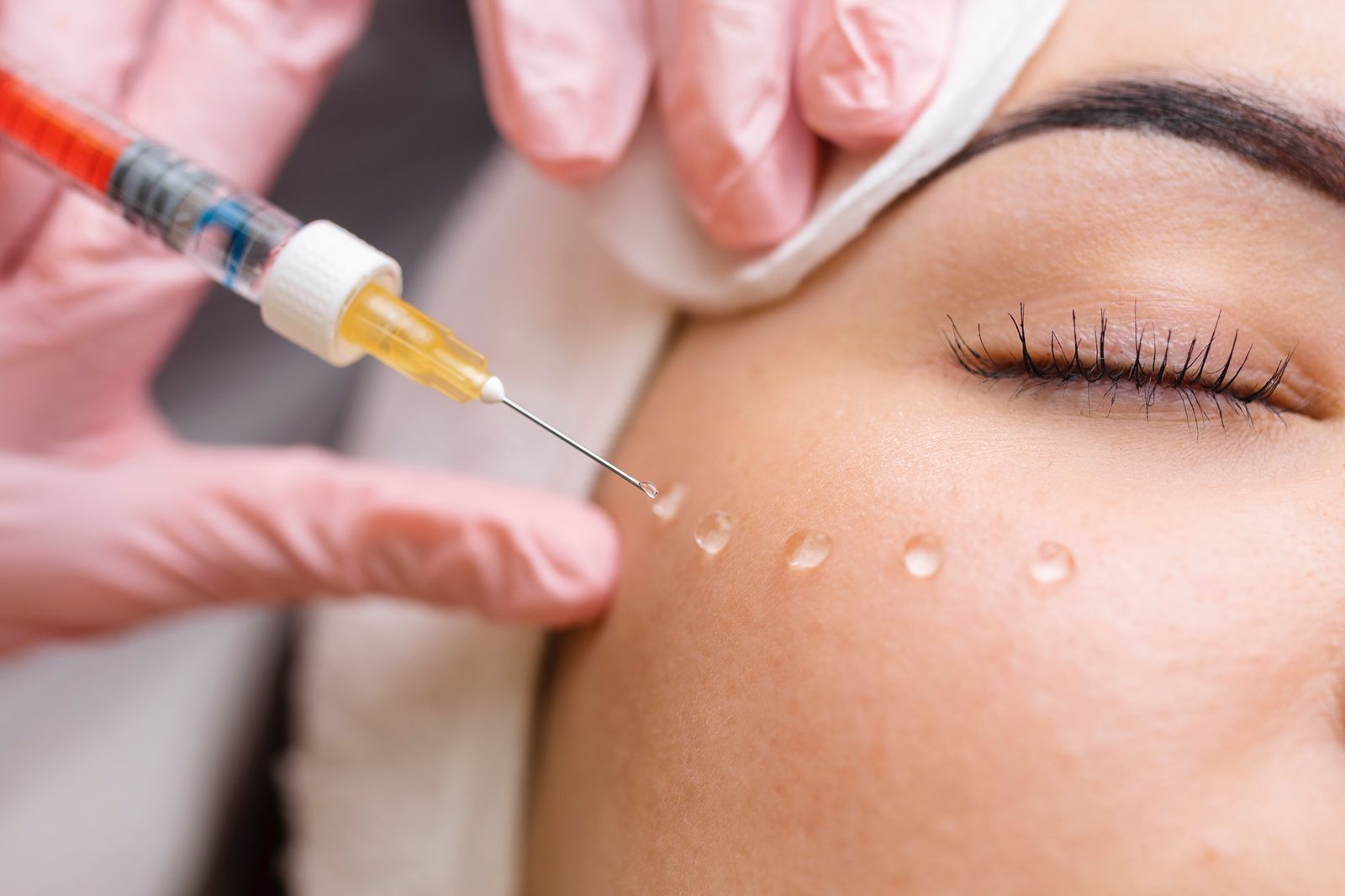
Sculptra is the slow burn of biostimulators. Unlike HA fillers that show results the same day, Sculptra builds your own collagen over 3-6 months. Here’s the honest timeline.
The reason Sculptra feels like it is not working is that the visible timeline and the biological one are months apart. Everything you can see in the first fortnight is either dilution fluid or nothing at all, while the part that produces the result is happening where you cannot look. Lining the two up is the difference between finishing a course and abandoning it after one vial.
| Point in the course | What you can see | What is actually happening underneath |
|---|---|---|
| First 24 to 48 hours | Mild fullness that looks like a filler result | That is the fluid the freeze-dried powder was reconstituted and diluted in. None of it is the result and all of it resorbs. |
| Week 1 | You look the way you did before the appointment, which is where most people decide it failed | The fluid has gone. Macrophages have started responding to the poly-L-lactic acid microparticles, and nothing about that stage is visible from the outside. |
| Weeks 2 to 6 | Skin feels firmer under your fingers before it looks any different in a photograph | Fresh type I and type III collagen is being laid down around the particles. Volume from it starts registering at about week 6. |
| Weeks 16 to 20 | The real change from the first vial, usually described by other people before you notice it | Peak collagen expression. This is the point a first session should be judged at, and week 1 is not. |
| Months 6 to 24 | Slow continued improvement with no further appointments | The collagen scaffold keeps developing after the particles themselves have gone. |
Massage five minutes, five times a day, for five days after each session. It is the most skipped instruction on this treatment and it is what keeps product evenly distributed. Sculptra cannot be dissolved the way hyaluronic acid can, which is why the judging point matters as much as the injection does.
The Sculptra timeline
| Time after session | What you’ll notice |
|---|---|
| Day 0-3 | Mild swelling that mimics filler results (this is temporary water, not the real result) |
| Week 1 | Swelling resolves. You may think “did it not work?” |
| Weeks 2-6 | Skin starts subtly looking firmer. Most people don’t notice it themselves yet. |
| Months 2-4 | Real volume building. Cheekbones lift. Skin looks more youthful. |
| Months 4-6 | Full results from session 1. Often when 2nd session is scheduled. |
| Months 6-24 | Continued improvement as collagen continues to develop. |
Why most patients need 2-3 sessions
A single Sculptra session deposits poly-L-lactic acid that tells your body “build collagen here.” Your body responds gradually. Most Toronto patients see optimal results after a series of 2-3 sessions spaced 6 weeks apart.
How to know it’s working
- Skin feels firmer to the touch in the treated areas.
- Cheek hollows fill out naturally.
- You stop seeing your bone structure as sharply (good thing, it means soft tissue is rebuilding).
- Friends start asking if you’ve been sleeping well or just got back from vacation.
Common patient mistakes
- Expecting same-day filler results. Sculptra is not filler. If you want instant volume, you want HA filler instead.
- Skipping massages. The 5-5-5 rule: massage 5 minutes, 5 times a day, for 5 days after treatment. Critical for preventing nodules.
- Stopping after session 1 because “nothing is happening.” Most Sculptra patients underestimate their session 1 result because it’s so gradual.
Sculptra vs HA fillers
Sculptra builds your own collagen, lasts 2+ years, and looks more natural over time. HA filler is instant volume that lasts 6-18 months. Many of our patients combine both: HA for immediate plumping where they want it, Sculptra for long-term skin quality and architecture.
Cost at Bar Beauty Medical Toronto
Sculptra at our Fort York clinic starts at $900 per vial. Most patients use 1-2 vials per session and complete 2-3 sessions total. See our full Sculptra page.
FAQ
How long does Sculptra last?
The manufacturer’s pivotal study, filed with the US regulator, reported results persisting to 25 months. Health Canada approved Sculptra here in 2008. Many patients see effects for longer because the collagen architecture remains.
Is Sculptra reversible?
Not the way HA fillers are. The collagen-building cascade is hard to reverse. This is why proper injector selection matters more with Sculptra than with HA.
Can I do Sculptra and Botox together?
Yes, very common pairing. Botox softens dynamic lines while Sculptra rebuilds structure.
Book a Sculptra consultation at Bar Beauty Medical Toronto to see if you’re a candidate.
Sculptra is one of the most misunderstood injectables in Toronto because it does not behave like a filler. A patient walking out of our CityPlace treatment room at 46 Fort York Blvd after a Sculptra session sees almost nothing in the mirror. That is exactly the point. Sculptra is a biostimulator made of poly-L-lactic acid microparticles, the same biocompatible polymer used in dissolvable surgical sutures since the 1960s. It does not lift, it does not plump on contact, and it does not give an Instagram-friendly walked-out-glowing result. What it does over the following 90 to 180 days is provoke your own fibroblasts to lay down new type I and type III collagen scaffolding. The mirror result at week 16 is structural. It looks like you, slept well, for three years.
The most common question we field on the Sculptra consultation is the timeline. Patients who have only ever had hyaluronic acid filler are used to instant gratification. Sculptra rewards patience instead. This guide walks through the week-by-week timeline our injectors observe, what the histology literature predicts, what to expect after vials one, two, and three, and the seven failure modes we see in patients transferring care from other GTA clinics. It also covers the Health Spending Account documentation we can provide, which is a matter of paperwork rather than a discount.
What Sculptra actually does (the unfiltered explanation)
Sculptra is the brand name for injectable poly-L-lactic acid, abbreviated PLLA. Health Canada approved it in 2008 for the correction of facial volume loss. The mechanism has nothing in common with hyaluronic acid fillers like Stylage. A Stylage syringe occupies physical space the moment it is deposited. A Sculptra vial deposits microparticles that the body recognizes as a controlled foreign material and walls off with fresh collagen over the following 12 to 24 weeks.
The mechanism, step by step
The injector reconstitutes the freeze-dried PLLA powder with bacteriostatic water 24 to 72 hours before the treatment so the particles fully suspend. We then dilute further with lidocaine for patient comfort. The product is deposited in the deep dermis or subdermal plane using a 25G or 27G cannula in a fanning pattern across the temples, midface, jawline, or buttocks. Immediately post-injection the area looks slightly swollen from the dilution fluid; this fluid resorbs within 24 to 48 hours and the area appears to return to baseline. Under the surface, macrophages begin the slow biostimulatory cascade that produces visible collagen-driven volume by week 6, with peak expression at week 16 to 20.
What it does not do
Sculptra does not provide same-day volume. Sculptra does not work for fine lines under the eyes, lip enhancement, or any movement-driven wrinkle (those are HA filler and neurotoxin indications respectively). Sculptra cannot be reversed with hyaluronidase because it is not a hyaluronic acid product. Once collagen has formed, you live with the result for the 24 to 36 months it lasts. This irreversibility is why injector experience matters so much.
Current pricing for every treatment is published on our (see current price list).
Red flags: When to walk out of the consult
Toronto has more than 600 medical aesthetic clinics in the GTA core, and standards vary dramatically. Our injectors have catalogued the warning signs that almost always predict a bad outcome. If you spot any of the following during your consult, leave and book elsewhere.
- No medical history form. If the clinic does not collect a written intake covering autoimmune disease, anticoagulants, recent vaccinations, and prior aesthetic procedures, they are skipping a Health Canada compliance step.
- Pricing posted “per syringe” with no unit count. Reputable clinics quote per Health Canada-regulated unit (Botox, Dysport, Nuceiva) or per millilitre of cross-linked hyaluronic acid.
- The injector cannot name the lot number. Every vial of neurotoxin and HA filler carries a lot and expiry. You can ask to see it. If the answer is vague, the product chain of custody is suspect.
- Pressure to add a second treatment same-day. Upselling Morpheus8 on top of a filler consult, before the skin has healed and before consent is properly documented, is not how a careful clinic works.
- No emergency hyaluronidase on site. Any clinic doing HA filler must stock hyaluronidase to reverse a vascular occlusion within minutes. Ask. Watch the answer.
- No physician medical director listed publicly. Ontario regulation requires nurse injectors to work under a delegated medical directive from an MD. The MD’s name should appear on the clinic website.
Week-by-week Sculptra timeline at a glance
| Time after injection | What you see in the mirror | What is happening biologically |
|---|---|---|
| Day 0-2 | Mild swelling from dilution fluid; small bruise risk. | PLLA microparticles suspended in the deep dermis; fluid begins resorbing. |
| Day 3-7 | Face returns to baseline; many patients panic and call asking if the treatment failed. | Macrophage recruitment begins around PLLA particles. |
| Week 2-4 | No visible change. Continue daily massage 5-5-5 protocol. | Fibroblast activation; early type III collagen deposition. |
| Week 6-8 | First subtle volume return appreciable in raking light. | Type III collagen matrix maturing; type I collagen synthesis begins. |
| Week 10-14 | Friends notice you look rested. | Collagen remodelling and crosslinking. |
| Week 16-20 | Peak result visible; photograph review with injector. | Mature type I collagen scaffolding fully expressed. |
| Month 18-36 | Gradual softening; book maintenance vial. | Slow collagen turnover; PLLA fully metabolized. |
Paying for treatment: HSA, OHIP, and CRA rules
Aesthetic treatment in Ontario is rarely covered by OHIP because most procedures are classified as elective and cosmetic rather than medically necessary. That said, there are five legitimate paths to reduce the out-of-pocket cost, and we walk every patient through them at consultation.
Health Spending Accounts (HSA)
If you are self-employed, incorporated, or work for an employer offering a flexible HSA, you can often submit aesthetic-medicine receipts where the treatment has a documented medical indication, for example, hyperhidrosis Botox, scar revision Morpheus8, or migraine-related neurotoxin. The receipt must be issued by a regulated health professional (RN, NP, or MD) and itemized with the CPT-equivalent code. We provide HSA-compatible receipts on request.
OHIP coverage (rare but real)
OHIP will cover neurotoxin for documented severe primary axillary hyperhidrosis, chronic migraine (with a neurologist referral and failed first-line therapy), cervical dystonia, and blepharospasm. OHIP does not cover any cosmetic indication. We can refer you to a covering specialist if you suspect a billable diagnosis.
CRA medical expense tax credit
The Canada Revenue Agency permits a medical-expense tax credit (METC) for procedures performed by an authorized medical practitioner where there is a medical (not cosmetic) purpose. Keep itemized receipts, the practitioner’s licence number, and a note of medical indication. Speak to your accountant, METC interpretation has tightened since the 2023 federal budget.
Affirm financing
For larger treatment plans, Affirm financing is available so you can split the cost into monthly payments. You can review your options at consultation; checking your rate does not affect your treatment plan.
Frequently asked questions
How many Sculptra vials will I need in total?
Most Toronto patients between ages 38 and 58 require two to four vials in the initial series. We base the recommendation on temporal hollowing depth, midface volume loss, and your BMI trajectory. We confirm at the week 8 review whether a third or fourth vial is appropriate; over-treating is the most common mistake and the hardest to reverse.
Is Sculptra safer than hyaluronic acid filler?
Different safety profile rather than safer. Sculptra carries a lower risk of vascular occlusion because it is deposited deeper and in lower volumes per pass, but it carries a higher risk of late-onset nodules if injected too superficially or insufficiently diluted. Both products are safe in trained hands; Sculptra requires a longer injector learning curve.
Can Sculptra be reversed if I do not like the result?
No. Unlike hyaluronic acid filler, Sculptra results cannot be dissolved with hyaluronidase. Once collagen scaffolding forms, you live with the volume for 24 to 36 months until natural turnover dissipates it. This is why we strongly recommend a single-vial trial before committing to a multi-vial series.
What is the famous 5-5-5 massage protocol?
Five minutes, five times per day, for five days post-injection. The patient performs firm circular massage over the treated area to evenly distribute PLLA particles and reduce nodule risk. We demonstrate the technique in clinic and provide a printed handout.
How much does Sculptra cost in Toronto for a complete series?
BarBeauty 2026 pricing is $900 per vial reconstituted, with package savings on two-vial ($1,700) and three-vial ($2,475) bundles. Most patients invest $1,700 to $2,700 for a complete initial series, then $900 every 18 to 24 months for maintenance.
Will Sculptra make my face look puffy or overdone?
Not when correctly dosed. The slow build means there is no day-zero pillow-face. Patients return to a normal mirror appearance within 48 hours and then experience gradual, almost imperceptible improvement. This is the most natural-looking volume restoration available in the GTA today.
Can I combine Sculptra with Botox or fillers?
Yes, and most of our patients do. We typically sequence Sculptra first to build the foundational structure, then layer HA filler in the lips or tear troughs four weeks later, with neurotoxin maintained on its usual three-to-four-month cycle. The combination is synergistic when planned properly.
What is the downtime after a Sculptra session?
Twenty-four hours of mild swelling and possible pinpoint bruising; you can return to a desk job the same afternoon. We ask patients to avoid heavy cardio, alcohol, and saunas for 48 hours, and to perform the 5-5-5 massage protocol for 5 days.
Does Sculptra work for the buttocks?
Yes, off-label but well-documented for mild to moderate buttock volume loss, gluteal hip dip correction, and post-weight-loss skin laxity. Buttock Sculptra requires significantly more vials (typically 6 to 10 per side) and is priced separately from facial treatment.
Is Sculptra covered by OHIP or extended health benefits?
Not under OHIP. Most extended benefit plans do not cover Sculptra because it is classified as cosmetic. Some HSA (Health Spending Account) plans will reimburse a portion when the receipt is itemized; we provide HSA-compatible documentation on request.
How long do Sculptra results last in my 40s versus 50s?
Average duration is 24 to 36 months at any age. Patients in their 40s tend toward the longer end of that range because intrinsic collagen synthesis is still robust. Patients over 55 may see results closer to 24 months and often benefit from annual single-vial maintenance rather than the every-two-year cadence.
Ready to look into it properly?
Our consultation is free. We will look at your skin, give you an honest recommendation, and say so if a different treatment would suit you better.
Or call 416 923 1200 · 46 Fort York Blvd, CityPlace, Toronto
Questions about this treatment?
Ask us anything before you book. Consultations are free, and we will tell you honestly if a treatment is not right for you.