


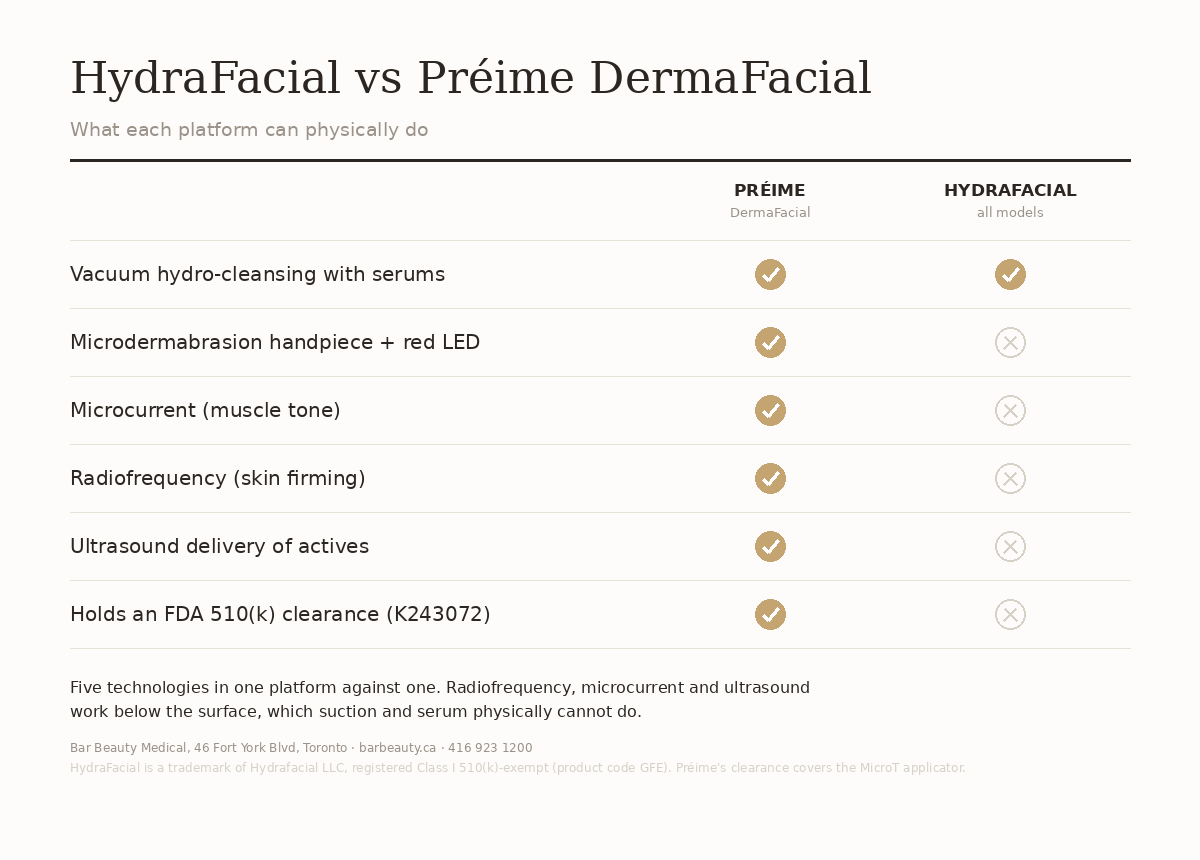
Short answer: the Préime DermaFacial does more, running five technologies against HydraFacial’s one. HydraFacial has more published evidence, though not by much and not of great quality. Neither is proven better than the other, because no study has ever compared them. Here is the whole picture, including the parts that do not flatter the machine we just bought.
No study has ever compared these two devices, so anyone telling you which one performs better is guessing. What is knowable is what each machine physically does: the Préime runs five technologies including radiofrequency and ultrasound, and a hydro facial runs suction and solution on the surface and inside the pore. Choose on the problem you are bringing in, not on the brand.
- Book a hydro facial (the HydraFacial category) if you want reliable cleansing and hydration, you have an event in a few days, you like a predictable and well established protocol, or this is your first facial.
- Book a Préime DermaFacial if you want more than surface work in one appointment, you are addressing firmness and texture alongside congestion, standard facials have stopped doing much for you, or you would rather consolidate several treatments into one longer visit.
- Book neither if your main concern is deeper pigmentation, active inflamed or cystic acne, significant laxity or scarring. Those are usually better handled by a laser, by microneedling or by an injectable, and a good clinic will say so instead of selling you a facial.
- Expect a different clock either way. Hydro facial results run about a week, which is why they get booked before events. Radiofrequency and microcurrent work over a course of sessions. Neither is permanent.
Before you book either one, ask the clinic three things: what the machine physically does to your skin, what exactly its FDA clearance covers, and whether they can name an actual study rather than a brochure. For the record, we do not own a HydraFacial. We run Hydrabrasion, and the Préime has not arrived in our clinic yet.
The quick comparison
| Préime DermaFacial | HydraFacial | |
|---|---|---|
| Manufacturer | Ema Aesthetics, Dublin. Sold via Sinclair | BeautyHealth, United States |
| Technologies | Five: vacuum hydro-cleanse, microdermabrasion, microcurrent, radiofrequency, ultrasound | One: Vortex-Fusion vacuum and solution, run over three steps |
| Reaches below the surface? | Yes, via radiofrequency and ultrasound | No. Works on the surface and inside pores |
| US FDA status | MicroT applicator holds 510(k) clearance K243072. Other four technologies not covered | No 510(k). Class I, 510(k)-exempt, product code GFE, “powered dermabrasion brush” |
| Health Canada | Class II licence 113700, July 2025 | Available in Canada |
| Published trials | No peer-reviewed publications. Unpublished manufacturer studies, n=42 and n=60, using objective imaging | About three. Small, none blinded, at least one with a company employee among the authors |
| Devices worldwide | New market entrant. Fewer than five clinics in Canada | Roughly 35,000 installed |
| Session length | 30 to 90 minutes | Around 30 to 50 minutes |
What a HydraFacial actually does
HydraFacial runs three steps: cleanse and peel, extract and hydrate, then fuse and protect. All three use the same underlying mechanism, a spiral tip that combines vacuum suction with a solution feed.
It is genuinely good at what it does. Pores get cleared, dead surface cells come away, skin is left hydrated and looks noticeably better for about a week. There is a reason it became the most recognised facial in the world.
Its limit is physics rather than quality. Suction and liquid act on the surface of the skin and inside the pore. They do not heat tissue in the dermis and they do not carry active ingredients meaningfully past the skin barrier, because neither is possible without a different form of energy.
What the Préime adds
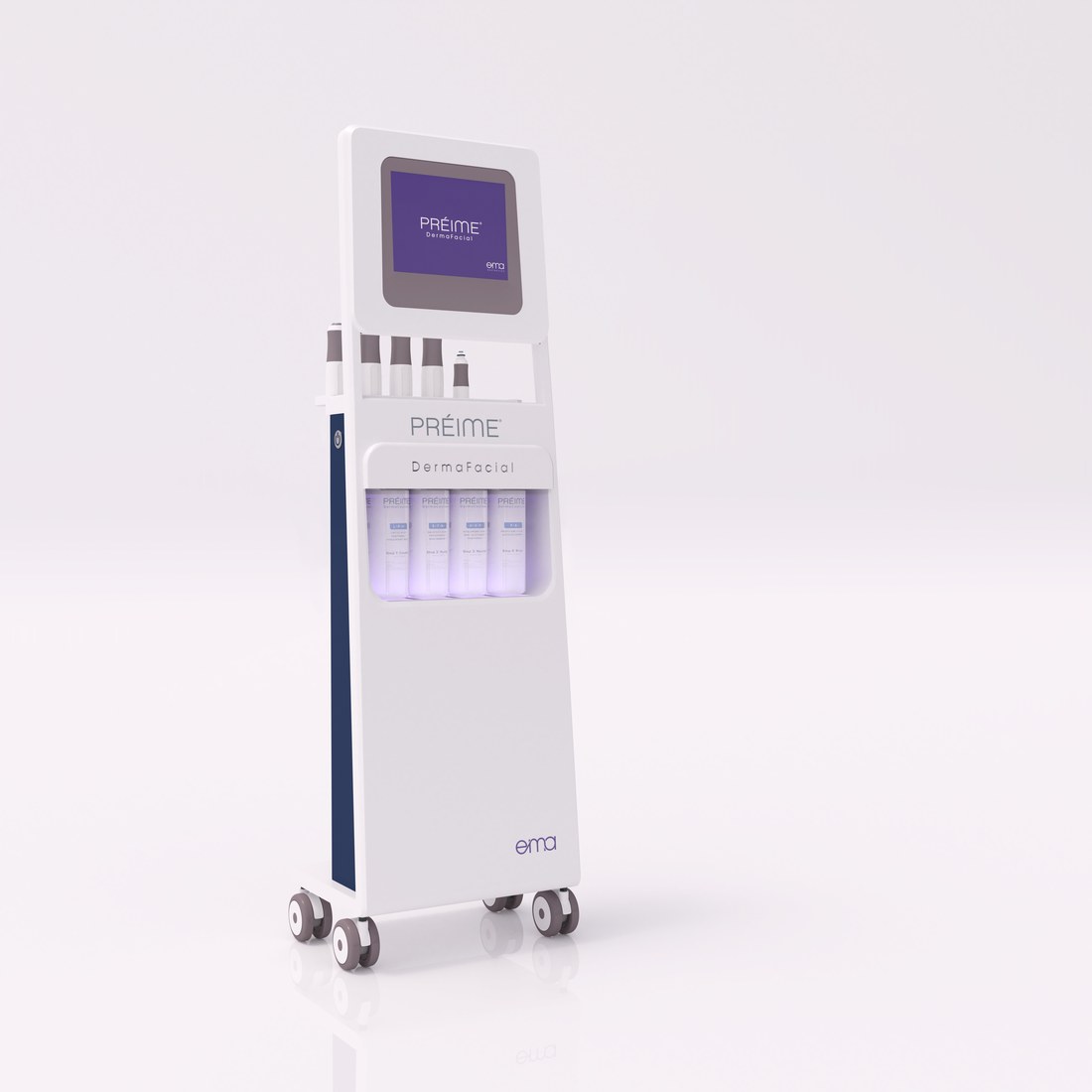
Two things that a hydro facial cannot do at all.
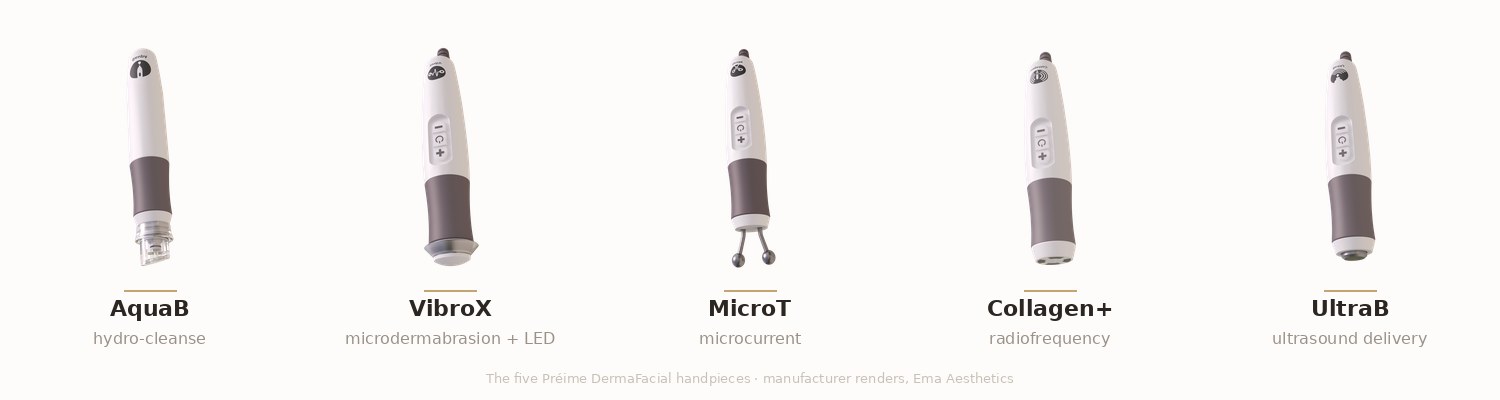
Radiofrequency (Collagen+) heats tissue below the surface. Heat is what drives a firming response. No amount of suction achieves that.
Ultrasound (UltraB) is used to move actives past the barrier. A topical serum applied to intact skin largely stays where you put it. Ultrasound changes that.
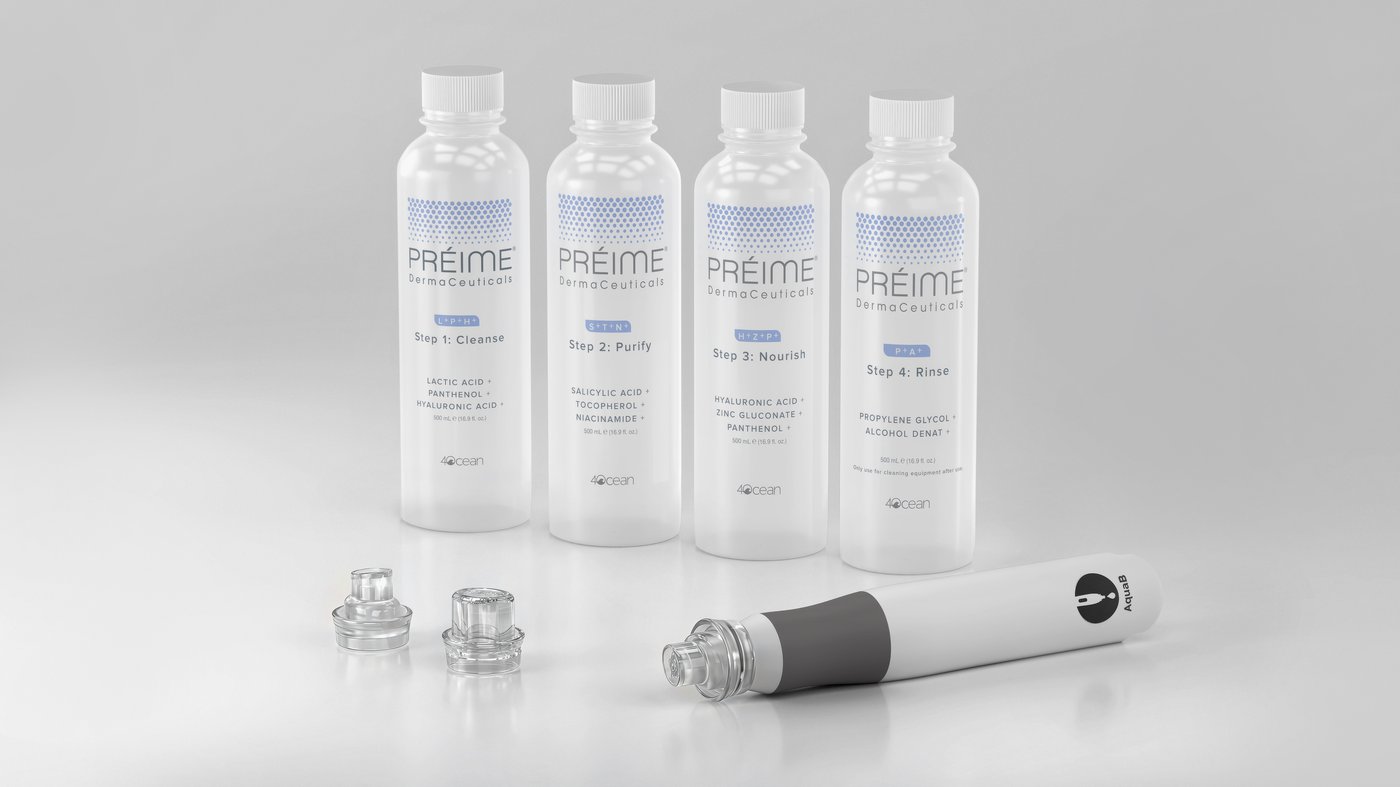
It also runs microdermabrasion with red LED and microcurrent, and its AquaB handpiece does the vacuum cleanse and hydration that overlaps with what HydraFacial does. So the Préime includes the HydraFacial category of work and adds four more layers on top.
What the evidence actually shows
This is where the comparison gets uncomfortable for both devices.
HydraFacial has a small number of published papers. Not many, none blinded, and at least one carries a co-author employed by the company. That is thin by medical standards. It is also more than almost every device released since, which tells you something about the category rather than about HydraFacial.
Préime has nothing peer-reviewed. A literature search returns no published trials for the device. Unpublished manufacturer-associated data does exist, including two open-label studies by Dr Pablo Naranjo in Madrid using objective Antera 3D imaging rather than opinion, individual handpiece testing, and three abstracts accepted for IMCAS Paris, presented January 2026. That is real work, and it is also uncontrolled, unblinded and industry-linked. We break all of it down properly on the Préime DermaFacial page.
No study has compared the two. Not one. So anyone telling you which is clinically superior is guessing, including us.
What you are actually choosing between is a device with a long track record and thin evidence, and a device with more capability and no published evidence. Both of those are defensible positions. Neither is “clinically proven” in the sense a patient hears that phrase.
The regulatory surprise
Here is the fact that reframes this whole comparison, and almost nobody in the industry mentions it.
HydraFacial holds no FDA 510(k) clearance. It is registered as a Class I device, 510(k) exempt, under product code GFE, which is defined as “powered dermabrasion brush.” That places it in the same regulatory category as a rotating cleansing brush.
That is not an accusation and it does not mean the device is unsafe. Class I is a legitimate classification and plenty of good products sit there. But when 35,000 clinics describe a treatment as FDA cleared, patients reasonably assume something was reviewed and cleared. For this device, it was not.
The Préime, by contrast, holds an actual Class II 510(k) clearance, K243072, on its microcurrent applicator. One applicator out of five, and we said as much above. But it is a higher regulatory bar than the category leader has cleared.
Side by side: every point of difference
The table above covers the headline. This is the detail, feature by feature, so you can see exactly where the two diverge rather than taking anyone’s word for it.
| HydraFacial | Préime DermaFacial | |
|---|---|---|
| Manufacturer | BeautyHealth (formerly Edge Systems), USA | Ema Aesthetics, Dublin, Ireland. Distributed by Sinclair |
| Core mechanism | Vortex suction plus serum delivery | Vacuum hydro-cleansing, microdermabrasion, microcurrent, radiofrequency, ultrasound |
| Number of technologies | One | Five |
| Can it firm skin? | No. Suction and serum do not heat tissue | Yes, via radiofrequency |
| Can it drive actives past the barrier? | Limited. Topical application under suction | Yes, via ultrasound |
| Muscle and tone work | No | Yes, via microcurrent |
| Physical resurfacing | Via the spiral tip and acid solution | Via dedicated microdermabrasion handpiece with adjustable vacuum |
| US regulatory status | Class I, 510(k) exempt, product code GFE (powered dermabrasion brush) | MicroT applicator holds 510(k) clearance K243072. Other four not covered |
| Health Canada licence | Licensed | Class II, licence 113700, issued 23 July 2025 |
| Published peer-reviewed studies | A small number, none blinded, at least one with a company-employed co-author | None published. Unpublished manufacturer-associated data only |
| Installed base | Roughly 35,000 devices worldwide | Fewer than five clinics in Canada |
| Body protocols | Limited (back treatment) | Back, buttocks, hands, underarms, scalp |
| Typical Toronto price | $180 to $350 | Comparable platforms $200 to $400 |
| Session frequency | Monthly | Every four weeks, two protocols weekly if wanted |
| Downtime | None to minimal | None to minimal |
| Safe across Fitzpatrick I to VI? | Generally yes, not pigment-dependent | Generally yes. RF and microcurrent are not pigment-dependent. RF avoided in severe melasma |
Before and after
The manufacturer’s clinical images, the documented case detail, and what each one actually shows are on the Préime DermaFacial page. They are the manufacturer’s images, not our patients, because the device has not arrived in our clinic yet. Individual results vary and no outcome is guaranteed.
The honest scorecard
If you score this the way a buyer would rather than the way a marketing department would, it comes out split.
HydraFacial wins on: track record, consistency, operator familiarity, and the fact that some published evidence exists at all. Thirty-five thousand devices means thousands of technicians who have run it thousands of times. That reliability is worth something real, and it is the reason the brand became a verb.
Préime wins on: capability. Five technologies against one is not a marketing distinction, it is a physics distinction. Radiofrequency heats tissue and triggers a firming response. Ultrasound moves molecules through the barrier. Microcurrent stimulates muscle. Suction and serum do none of those three things, and no amount of branding changes that.
Neither wins on: evidence. This is the part the industry does not like to say out loud. One has a handful of small unblinded studies, the other has none published. Anyone claiming either is clinically proven in the way a drug is proven is overstating it.
What we actually run, and why we are being careful here
We do not own a HydraFacial. We run Hydrabrasion, which is the same category of treatment from a different manufacturer, and we have run it daily for years. So we know exactly where the ceiling on a hydro facial sits: it cleans beautifully, it hydrates, skin looks great for about a week, and it does not tighten anything.
That ceiling is the entire reason we bought the Préime. Not because a rep convinced us, but because we kept having the same conversation with clients who wanted firmness and we had to send them to Morpheus8 or Forma, which is a bigger commitment than they were asking for.
We will not tell you we ran a head-to-head trial, because we did not. The Préime is arriving. When we have run it on real faces for a few months we will come back and update this article with what we found, including anything that turns out to be disappointing.
What to ask the clinic before you book either one
These three questions will tell you more than any before-and-after gallery.
What does the machine physically do to my skin? Not the branding, the mechanism. Suction, acid, abrasion, heat, current, ultrasound. If the answer is a list of adjectives rather than a list of mechanisms, keep asking.
What exactly does the FDA clearance cover? Almost everyone says FDA cleared and almost nobody says what for. Clearance is granted for a specific applicator with a specific indication, not for a whole platform. A five-technology device can be entirely legitimate with a clearance covering one of the five, which is normal, but it is not what the customer hears.
Can you name a study? Not “there are clinical studies”, an actual citation. About half the time what turns up is a brochure. That is not a scandal in aesthetics, it is the norm, but you should know it before you pay.
A clinic that can answer all three is being straight with you. Most cannot answer any of them.
Which should you book?
Choose a HydraFacial-style treatment if you want reliable cleansing and hydration, you have an event coming up and want skin looking its best in a few days, you like a predictable and well-established protocol, or you are new to facials and want a straightforward starting point.
Choose a Préime DermaFacial if you want more than surface work in one appointment, you are addressing firmness and texture alongside congestion, standard facials have stopped doing much for you, or you would rather consolidate several treatments into one longer visit.
Choose neither if your main concern is something a facial does not treat. Deeper pigmentation, active acne, significant laxity and scarring are usually better handled by a laser, by microneedling, or by an injectable. A good clinic will tell you that instead of selling you a facial.
How to judge any facial device, not just these two
Three questions. They work on every machine in every clinic.
What does it physically do to my skin? Not the brand name, the mechanism. Suction, acid, abrasion, heat, light, current, ultrasound. Once you know which of those are involved you know roughly what is possible.
What exactly does the clearance cover? Not “is it FDA cleared” but which applicator and for what indication. As shown above, the answers surprise people in both directions.
Can you name a study? Not “there are clinical studies” but a citation. Roughly half the time in this category, what turns up is a brochure.
A clinic that answers all three without getting defensive is a clinic worth trusting. And one more thing worth knowing: “medical grade” is not a regulated term. Nobody governs it. Any product, any clinic, any box can carry the phrase. It tells you nothing at all.
Common questions
Which is better, HydraFacial or Préime DermaFacial?
The Préime does more: five technologies against one, including radiofrequency and ultrasound that a hydro facial physically cannot perform. HydraFacial has the longer track record, roughly 35,000 installed devices, and the only published studies of the two. No study has compared them directly, so “better” depends on whether you want proven consistency or greater capability.
Is HydraFacial FDA approved?
No. It is registered as a Class I, 510(k)-exempt device under product code GFE, powered dermabrasion brush. It holds no 510(k) clearance at all, which surprises most people given how the brand is marketed. That is a classification fact, publicly checkable in the FDA database, not a criticism.
Is the Préime DermaFacial FDA approved?
No. Its MicroT microcurrent applicator holds FDA clearance K243072. The other four technologies are not covered by that clearance. FDA approval is a different and higher standard that applies to a different class of product.
Does either one have clinical studies?
HydraFacial has a small number of published papers, none blinded, at least one with a company-employed co-author. The Préime has none published in peer-reviewed literature, though unpublished manufacturer-associated clinical data exists, including two open-label studies using objective Antera 3D imaging.
Can a HydraFacial tighten skin?
No. Suction and serum delivery do not heat tissue, and heat is what triggers a collagen response. Any tightening you see after a hydro facial is hydration plumping the surface, which is real but temporary. Radiofrequency is what actually firms, and that is one of the five technologies on the Préime.
How much does each cost in Toronto?
HydraFacial typically runs $180 to $350 a session in Toronto. Comparable multi-technology platforms run $200 to $400. Our Préime pricing will be published once the device is installed.
Are they safe for darker skin tones?
Both are broadly appropriate across Fitzpatrick I to VI because neither relies on targeting pigment the way a laser does. Radiofrequency and microcurrent heat or stimulate tissue rather than chasing melanin. The consideration on deeper skin is managing post-treatment inflammation, and the radiofrequency handpiece is avoided where there is severe melasma.
Which one is better for acne?
For congestion, blackheads and oil control they are comparable, since both use suction and a salicylic stage. The Préime adds a dedicated back protocol and microdermabrasion for post-acne texture. Neither is appropriate for active inflamed or cystic acne, where a laser or medical route is better.
Can I switch from HydraFacial to Préime?
Yes, there is no washout period or conflict. Both are non-invasive and neither leaves anything in the skin.
Is Préime DermaFacial available in Canada?
Yes. Health Canada licensed it as a Class II medical device, licence 113700, on 23 July 2025. Fewer than five clinics currently run it, all in Ontario.
Where can I get the Préime DermaFacial in Toronto?
It is arriving at Bar Beauty Medical, 46 Fort York Blvd in CityPlace. Full details are on our Préime DermaFacial page.
Is the Préime DermaFacial better than a HydraFacial?
It does more, running five technologies to HydraFacial’s one, including radiofrequency and ultrasound that a hydro facial cannot perform. On published evidence HydraFacial has a small number of studies and the Préime has none we could find. No study has compared them directly, so nobody can claim superior results with evidence behind it.
Is HydraFacial FDA approved?
No. HydraFacial is registered with the FDA as a Class I, 510(k)-exempt device under product code GFE, “powered dermabrasion brush.” It holds no 510(k) clearance. FDA “approval” is a separate and higher standard again, which neither device has.
Is the Préime available in Canada?
Yes. Health Canada issued Class II medical device licence 113700 on 23 July 2025 and it remains active. At the time of writing fewer than five Canadian clinics offer it, all in Ontario.
Which lasts longer?
Hydro-facial results typically last around a week, which is why they are popular before events. Radiofrequency and microcurrent work on a different timescale and are usually done in a course. Neither is permanent and anyone promising otherwise should be treated with suspicion.
How much do they cost in Toronto?
HydraFacial-style treatments in Toronto generally run between $150 and $350, more with add-on boosters. Our Préime pricing will be published once the device is installed and our team is trained.
Can either be done on darker skin?
Both are broadly suitable across skin types, because neither relies on targeting melanin the way many lasers do. Radiofrequency in particular is not pigment-dependent, which is why it is one of the safer energy types across the Fitzpatrick scale. Settings and technique still matter, and post-treatment inflammation is the main thing to manage on deeper skin tones.
Where we land
We bought the Préime. We are also telling you it has no published trials, that its FDA clearance covers one applicator out of five, and that the device it is most often compared to has more published evidence than it does.
Both of those things are true at once. We bought it because five technologies in one appointment does more for our clients than one technology does, and because radiofrequency and ultrasound reach places suction cannot. That is a mechanism argument, not an evidence argument, and we would rather be clear about which one we are making.
Full detail on the platform is on our Préime DermaFacial page. Consultations at our CityPlace clinic are complimentary and we are happy to talk you out of a treatment if it is not right for you.
Regulatory information verified against the Health Canada Medical Devices Active Licence Listing and the US FDA 510(k) and device classification databases, August 2026. Clinical literature searched via PubMed. Individual results vary and no outcome is guaranteed. General information, not medical advice.
Not sure if this is the right treatment for your skin?
Our consultation is free. We will look at your skin, tell you honestly whether the Préime is what you need, and say so if something else would work better.
Or call 416 923 1200 · 46 Fort York Blvd, CityPlace, Toronto
If the BELA MD is the other machine on your shortlist rather than a HydraFacial, we compared those two separately in BELA MD vs Préime DermaFacial.
Questions about this treatment?
Ask us anything before you book. Consultations are free, and we will tell you honestly if a treatment is not right for you.