


Frown Lines and the Glabella (“11s”) in Toronto
By Basil Russo, Founder, Bar Beauty Medical, 46 Fort York Blvd, CityPlace Toronto. Clinically reviewed by Jasmine Saggu, Registered Nurse at Bar Beauty Medical. Phone 416-923-1200 · Book at barbeautymedical.janeapp.com.
Two vertical lines between your eyebrows. The 11s. The glabellar lines. The reason a resting face can read as angry, stressed, or disapproving when you feel none of those things.
These are among the most psychologically loaded wrinkles on the face. People read them as a mood signal, not just an ageing one. Patients regularly tell us a boss, a partner, or a stranger has asked if they are annoyed when they were not.
We run Bar Beauty Medical on Fort York Blvd in CityPlace, and we have been treating Toronto patients. Glabellar Botox is the single most-requested treatment we do, and one of the highest-satisfaction treatments in non-surgical aesthetics.
Book Your Consult Online → Call 416-923-1200
The 11s are not one pattern. Before a dose is decided we watch you frown hard, because those vertical lines can be produced by three different muscle patterns and each one wants the units distributed differently. A fixed unit count applied to all three is the commonest reason a glabella result reads heavy on one person and undertreated on another.
| What you see when you frown hard | Which muscles are doing it | What it changes about the treatment |
|---|---|---|
| Two parallel vertical lines and nothing else | Corrugator supercilii pulling the brows inward and down, with depressor supercilii | The classic five-point pattern. Most glabella treatments here look like this one |
| A U shape, the two verticals joined at the bottom by a horizontal crease over the nose bridge | Procerus is contributing as well, which is what puts the line across the top of the nose | The procerus point carries more of the dose, or the horizontal crease stays behind after the verticals have softened |
| A wider Pi or M shape spreading out toward the heads of the brows | Medial fibres of orbicularis oculi joining in beyond the corrugators | A wider footprint than five points, so the assessment in animation matters more than the unit count |
We photograph you frowning, raising the brows and fully relaxed, because the pattern is only visible in movement. Men frequently have stronger corrugators and take a higher dose for the same pattern. The forehead is assessed at the same visit, because relaxing the depressors without accounting for the frontalis is how a brow ends up heavy.
What are the 11s and the glabella?
The glabella is the patch of skin between your eyebrows, sitting over a small but powerful muscle stack:
- Corrugator supercilii (paired) pulls the brows medially and down.
- Procerus runs vertically over the nose bridge, pulls the medial brow down, and creates the horizontal line at the top of the nose.
- Depressor supercilii pulls the medial brow down.
- Medial fibres of orbicularis oculi overlap and contribute.
Together they form the depressor complex. Repeated contraction etches the vertical 11s, also called frown lines or furrowed-brow lines, into the dermis. We usually see one of three patterns:
- Pure vertical 11s, two parallel lines, the classic presentation.
- U pattern, connected at the bottom by a procerus-driven horizontal line.
- Pi or M pattern, a wider distribution involving orbicularis fibres.
Each pattern calls for a different dose distribution, which is why a quick assessment in animation matters more than a fixed unit count.
Why do frown lines form?
- Frowning, often unconsciously, from screen squinting, reading without correction, focus habits, and sun glare.
- Genetics. Strong corrugators run in families.
- Photoageing. UV degrades collagen in the overlying skin, so dynamic lines settle into static ones sooner.
- Sleep position. Face-down sleeping deepens lines on one side.
- Stress and mood. Chronic tension produces chronic glabellar contraction. There is a documented bidirectional signal, and relaxing the muscles may subtly improve self-reported mood.
- Uncorrected vision. Near- or far-sightedness drives chronic squinting.
How do you prevent frown lines from getting deeper?
Prevention is about reducing repeated creasing and protecting the collagen under the line.
- Daily mineral SPF. The single most effective anti-ageing habit for this area.
- Correct your vision. Up-to-date glasses or contacts cut the squinting that drives the lines.
- Early, conservative neuromodulator. Treating dynamic 11s before they etch in keeps the static line shallow. This is the real case for starting in your late 20s or 30s if the movement is already visible.
- A retinoid at night to support collagen, prescribed where appropriate by our MD.
- Sleep on your back where you can, to reduce one-sided creasing.
What treatments do we offer for frown lines in Toronto?
Botox, Dysport and Nuceiva, the primary move
Neuromodulator placed into the glabellar complex is the gold standard for the 11s. It is Health Canada approved for moderate-to-severe glabellar lines, which is one of the most-studied indications in cosmetic medicine. A typical glabella treatment uses a 5-point pattern, with higher doses for very strong corrugators, which is common in men.
- Botox is $10 per unit at Bar Beauty Medical. Most glabella treatments sit in the 16 to 24 unit range, and many patients combine the glabella with forehead and crow’s feet in one visit.
- Sessions: every 3 to 4 months.
- Downtime: none.
- Timeline: onset day 3 to 7, peak around day 14, lasts roughly 12 to 16 weeks.
See Frown Line Botox and Forehead Botox for the per-area detail, or compare the products on our Botox vs Dysport vs Xeomin vs Nuceiva guide.
Filler for deep, etched static lines
For a static 11 still visible after Botox has peaked, a small amount of thin hyaluronic acid placed carefully into the etched groove can soften it. We use cannula technique here. The vascular risk in the glabella is real, because the supratrochlear and supraorbital arteries run nearby, so this is a step we take conservatively and only when it is the right call.
- Dermal Fillers, with only a small portion of a syringe typically used for this area. See current per-syringe pricing on the price list.
Microneedling with exosomes or PRP
For the surrounding skin quality, microneedling stimulates collagen and improves the dermal scaffold so the skin over the line holds up better.
- SkinPen microneedling: $400.
- Microneedling with ASCE+ exosomes: $650.
- ASCE+ exosomes added to another treatment rather than microneedling: $350.
Aerolase NeoSkin
Safe across all skin tones, builds collagen, and has no real downtime, which makes it a good fit for skin-quality work around the brows.
- Aerolase NeoSkin Custom Facial: $350.
Chemical peel
For surface texture and mild brightening of the overlying skin.
- Chemical Peel (Noon 20 or Noon 30): $240.
Brow lift surgery, when we refer out
For significant brow descent combined with deep glabellar lines, a surgical brow lift addresses the underlying drop. That is outside what we do, and we refer to a plastic surgeon when it is the right option.
Injectable versus non-injectable for the 11s
Two of these options are injectable and two are not, and they solve different problems. Neuromodulator (Botox, Dysport, Nuceiva) and a touch of HA filler are injectable, and they address the muscle movement and the etched groove directly. Microneedling, Aerolase NeoSkin and chemical peels are non-injectable, and they improve the quality of the skin sitting over the line. The 11s respond best when the injectable relaxes the movement and the non-injectable work supports the skin, rather than either one alone.
What combination approach makes sense?
For a patient in their 30s to 50s with moderate-to-deep 11s, a common plan looks like this:
- Glabellar Botox every 3 to 4 months, often combined with the forehead.
- At home, a prescribed retinoid where appropriate and daily mineral SPF.
- Skin quality, an Aerolase NeoSkin course or microneedling for the etched lines.
- Optional, a small amount of filler in a persistent deep static line, usually assessed about four weeks after Botox.
What results can I expect, and how soon?
- Day 3 to 7: Botox onset.
- Day 14: peak effect.
- Week 12 to 16: time to re-treat.
What you can expect: a clear softening of the dynamic 11s within two weeks, gradual improvement in static lines over months as the skin gets a rest from constant creasing, and a more neutral, relaxed resting expression. The compliment patients hear most is that they look rested.
What you cannot expect: complete erasure of a deeply etched static line from Botox alone, permanent results, or a frozen forehead. We do not dose for a frozen look.
Who is a good candidate, and who is not?
Most healthy adults with visible 11s are good candidates. Treatment is not appropriate in these situations:
- Pregnancy or breastfeeding.
- Neuromuscular disease.
- Known allergy to the neuromodulator.
- Active infection in the treatment area.
- Significant brow ptosis where the forehead is doing the lifting work.
- Body dysmorphic concerns, which our MD screens for.
What does treating frown lines cost in Toronto?
At Bar Beauty Medical, Botox is $10 per unit, so a glabella-only treatment is straightforward to price once we have looked at your pattern and movement. Skin-quality add-ons are priced per treatment, for example SkinPen microneedling at $400, microneedling with ASCE+ exosomes at $650, ASCE+ exosomes added to another treatment at $350, Aerolase NeoSkin at $350, and a chemical peel at $240. We publish every price, with no “starting from” and no quote-on-arrival. Financing through Affirm is available if you would rather split a treatment plan into monthly payments.
Full pricing at barbeauty.ca/price-list.
What happens at your consult?
Intake and medical history. Photos in animation, so we ask you to frown hard, raise your brows, and relax. Pattern identification, vertical 11s versus Pi versus M. A dose discussion and a screen for body dysmorphic concerns. If everything lines up, we can usually treat the same day.
Who treats you?
Registered Nurse Jasmine Saggu handles all neuromodulator. Julia Barabas, our Medical Aesthetician and Glow Specialist, leads Aerolase and skin protocols. Medical oversight comes from Dr. John David Henneberry-Fudge MD FRCPC.
Common questions
Will I look frozen?
Not with our dosing. We relax the depressors enough to soften the lines while keeping a normal brow lift.
How long does frown line Botox last?
Usually 12 to 16 weeks before you would re-treat.
Does it hurt?
Most people rate it 1 to 2 out of 10. The needles are very small.
Will my face look different?
You will look like yourself, just more rested, rather than changed.
Can frown line Botox cause a heavy brow?
It can if the glabella is over-treated without balancing the rest of the forehead. We assess and dose for balance to avoid this.
Will I bruise?
Bruising is possible but uncommon, and it is reduced by following the pre-treatment instructions we send before your visit.
Can men get frown line Botox?
Yes, frequently. Men often have stronger corrugators, so the dose is usually higher.
What is the difference between Dysport and Botox for the 11s?
Both work well. Dysport has a slightly faster onset and a bit more spread. We offer Botox, Dysport and Nuceiva, and the choice is made at your consult based on your anatomy.
Can I do preventative or “baby” Botox in my 20s?
If you already have visible dynamic 11s, yes. Early conservative treatment is common and helps keep the static line shallow.
Will my forehead need treatment too?
Often it is recommended for balance, so the forehead does not over-compensate. We discuss this at your consult.
Is treatment safe for darker skin tones?
Yes for most of what we offer. Neuromodulator is colour-blind, and Aerolase Neo Elite at 1064 nm is safe across all Fitzpatrick types. For energy-based skin work in deeper skin tones we use conservative settings to protect against pigment change.
Can I treat the 11s while breastfeeding?
Generally no for injectables. Most patients return three to six months after weaning. Many facials are fine while nursing.
How do I book?
Online at barbeautymedical.janeapp.com or by phone at 416-923-1200.
Book Your Consult Online → Call 416-923-1200 Meet Our Medical Director →
Bar Beauty Medical · 46 Fort York Blvd, Toronto, ON M5V 3Z3 · 416-923-1200.
How we treat it at Bar Beauty: Botox and medical Botox.
Recommended aftercare and skincare
The medical grade products our team uses to protect and extend your results. Shipped express across Canada, free over 150 dollars.
Ready to look into it properly?
Our consultation is free. We will look at your skin, give you an honest recommendation, and say so if a different treatment would suit you better.
Or call 416 923 1200 · 46 Fort York Blvd, CityPlace, Toronto
Frown lines, before and after
This patient had her forehead, glabella and masseters treated in a single visit at our CityPlace clinic. In both photos she is frowning at full effort. The second was taken at her two week review, which is when a neuromodulator has fully settled.
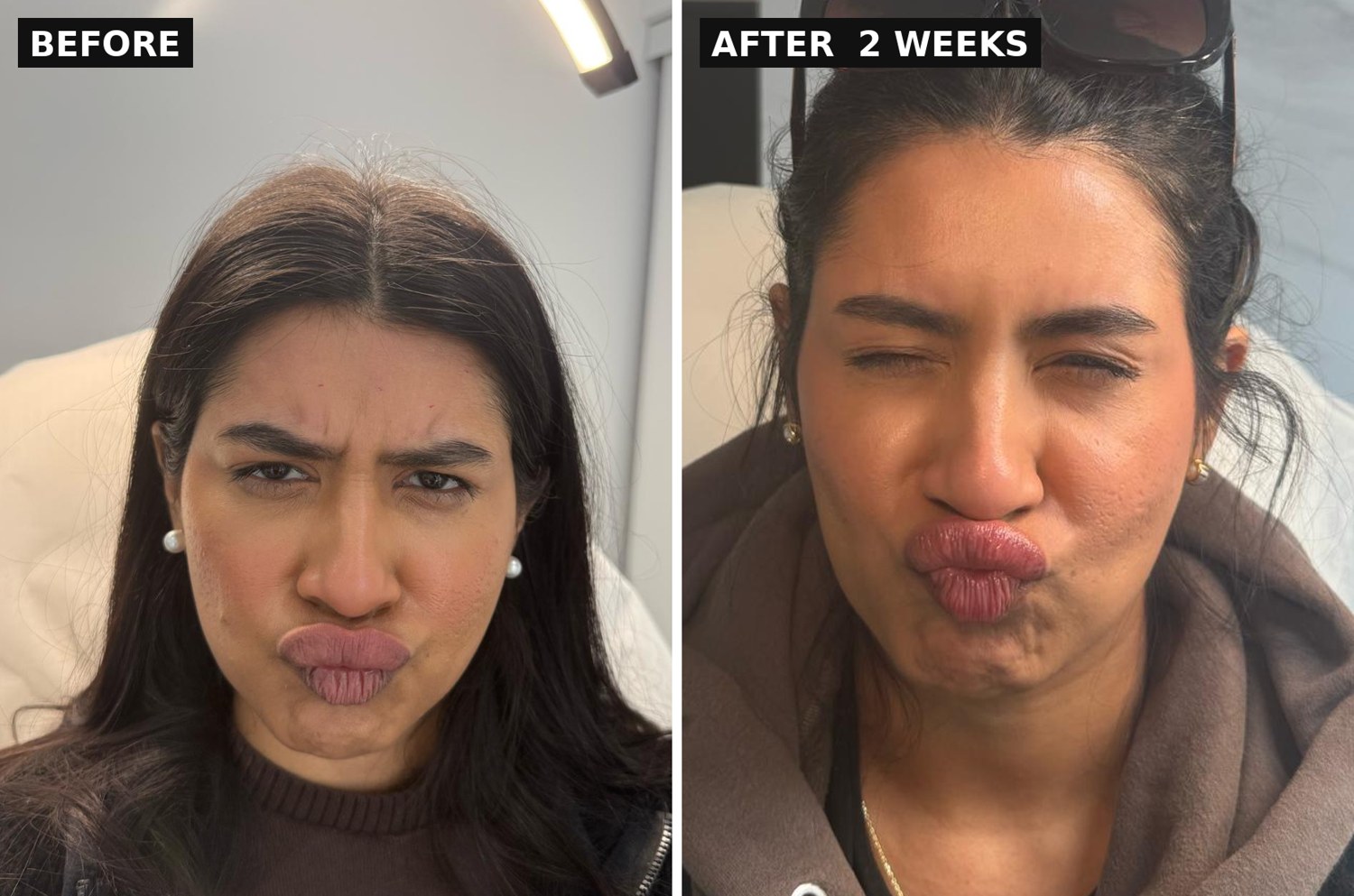
Photographed at two separate visits, so the lighting and framing are not identical. Her masseters were treated in the same session, but that change is not visible here and would not be expected to be: jaw slimming from a neuromodulator takes roughly six to twelve weeks, because the muscle has to reduce in bulk, and it only shows at the jaw angle on a hard clench. Individual results vary. Bar Beauty Medical patient, shared with written consent.
Questions about this treatment?
Ask us anything before you book. Consultations are free, and we will tell you honestly if a treatment is not right for you.