By Basil Russo, Founder, Bar Beauty Medical, 46 Fort York Blvd, CityPlace Toronto.
Morpheus8, also written Morpheus 8, is InMode’s radiofrequency microneedling platform. Both spellings refer to the same device, and this page covers it in full.
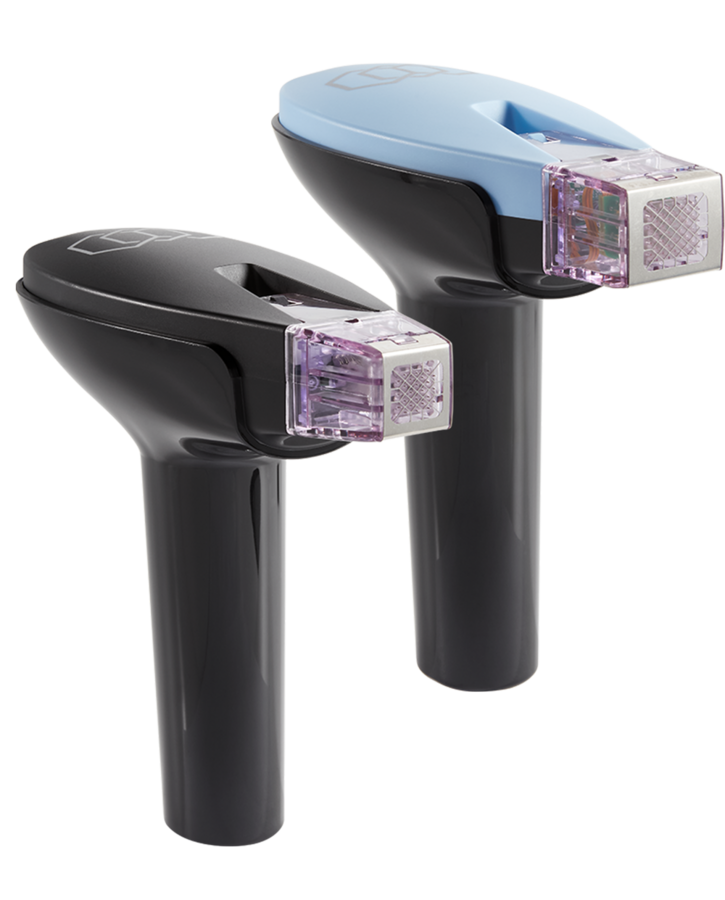
Most Morpheus8 pages online read like a device brochure. This one is going to read like the conversation we would actually have if you sat down in our chair at CityPlace. What it is, what it costs, what it can fix and what it cannot, and the times we tell people not to do it. We do not upsell, we do not run countdown timers, and we will turn you away if Morpheus8 is the wrong tool for what is bothering you.
Book a free consult on Jane · Call the clinic: 416-923-1200
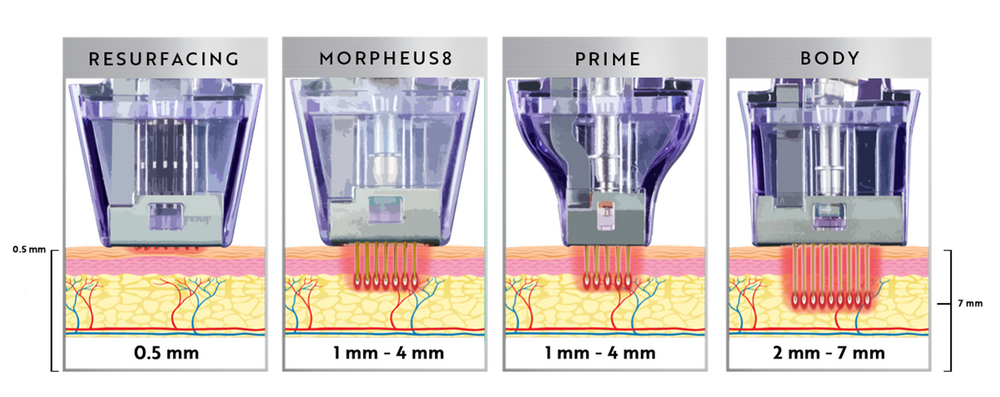
What separates Morpheus 8 from standard microneedling is depth control. The needles deliver radiofrequency energy at a set depth, adjustable through the session, so superficial texture and deeper structural laxity can be treated in the same appointment. That adjustability is the actual technology, not the brand name.
| Area | Price (CAD) | Best for |
|---|---|---|
| Morpheus 8, half face | $600 | A targeted zone rather than full coverage. |
| Morpheus 8, neck | $600 | Neck laxity, texture and early banding. |
| Morpheus 8, half face and neck | $1,000 | Lower face and neck together. |
| Morpheus 8, face | $900 | Full face laxity, texture and acne scarring. |
| Morpheus 8, face and neck | $1,400 | The most common booking for jawline and neck together. |
| Consultation | Free | Depth planning and realistic expectations. |
Bar Beauty Medical, 46 Fort York Blvd, CityPlace, Toronto. Prices in Canadian dollars from our live booking system, verified 18 August 2026. Expect three sessions spaced four to six weeks apart, and remember collagen remodelling continues for three to six months after the last one. The result at week four is not the final result.
What is Morpheus8 and how does it actually work?
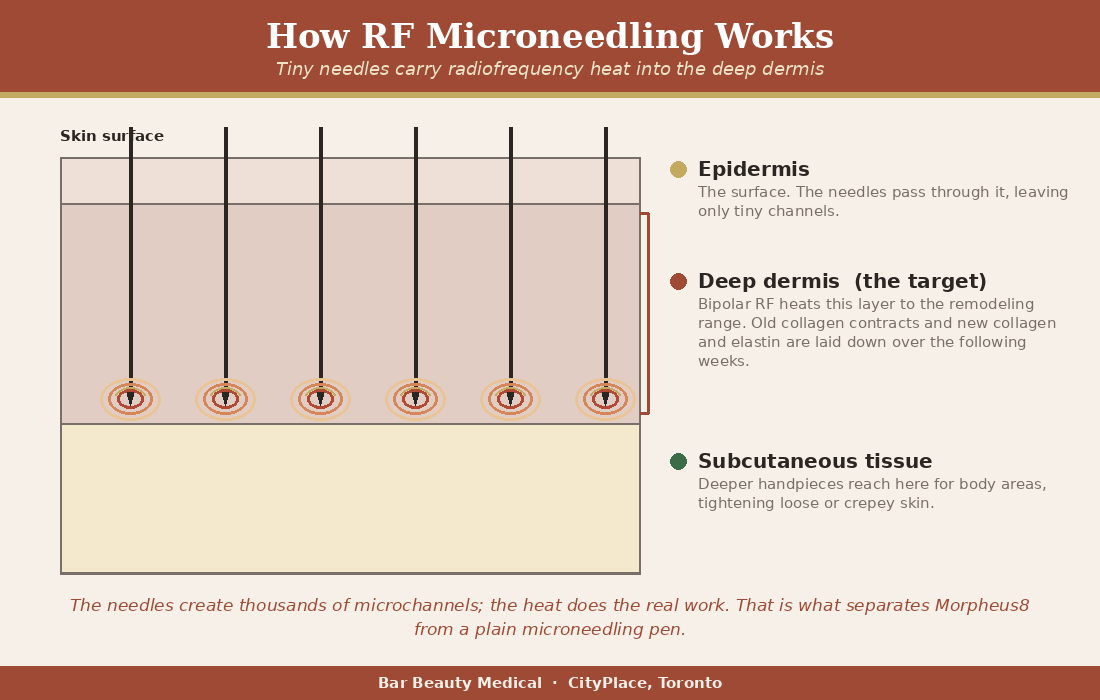
Morpheus8 is radiofrequency microneedling made by InMode and approved by Health Canada. We carry the InMode platform at our CityPlace clinic, including the deeper handpieces for body areas. In plain language, it is two technologies doing one job. A grid of tiny needles passes through the skin to a set depth, and as they go in they deliver bipolar radiofrequency energy from the tip. The needles create thousands of microscopic channels, and the RF heats the tissue around each one in a controlled way.
That heat is the whole point, and it is what separates Morpheus8 from a plain microneedling pen. Heating the deep dermis to the right temperature triggers a remodelling response. Your body reads it as an injury it needs to repair, and over the following weeks it lays down fresh collagen and elastin along the planes we treated. The skin contracts a little, thickens a little, and the texture smooths out. That is why we describe it as remodel, tighten, and resurface in one pass, rather than a surface polish.
Here is the part that matters for your expectations. Morpheus8 is not a same-day result. The redness settles in a few days, but the collagen change builds quietly over eight to twelve weeks and keeps improving for months after a full series. The before and after photos that impress people are almost never one session. They are a series of three, spaced four to six weeks apart, photographed at ninety days. When a clinic shows you a dramatic single-session result and promises tightening overnight, that is not how the technology works, and we will tell you so.
One more thing that makes this device genuinely useful in a city like Toronto. Because the energy is radiofrequency and not light, the heat is colour-blind. Lasers that target pigment can be risky on deeper skin tones. Morpheus8 does not chase melanin, so with conservative settings it is generally a safer tightening and resurfacing option across Fitzpatrick types, including darker skin. We still assess every patient individually, but the physics is on your side here.
See how Morpheus8 compares to our other treatments · Read our plain-language Morpheus8 guide · Meet our Medical Director
What areas can Morpheus8 treat at Bar Beauty?
Morpheus8 is a tightening, remodelling, and resurfacing tool, so we use it where skin has lost firmness, where texture has gone rough, or where scarring needs to be broken up and rebuilt. The areas we treat most at our CityPlace clinic:
- Jawline definition and early jowling along the lower face
- Submental, the area under the chin, where skin has gone soft
- Cheeks and mid face for laxity and texture
- Acne scar revision, where the channels and heat remodel scar tissue
- Crepey neck and the horizontal neck lines that come with screen time
- Abdomen and flanks, where the deeper body handpiece tightens loose skin
- Upper arm laxity, the area people notice in a sleeveless top
- Knees, where skin folds and crepe show up with age
- Peri-oral lines, the fine vertical lines around the mouth
- Stretch marks, where remodelling improves the texture and tone
For the off-face areas, the abdomen, flanks, arms, and knees, we use the deeper body handpiece and quote per zone. Our Morpheus8 Body page goes through those areas, the body recovery week, and how we price them.
We do not treat every request. Morpheus8 is for skin quality and laxity, not for adding volume. If your real problem is a flat cheek or a weak chin, the honest answer is a dermal filler or a collagen biostimulator like Sculptra, not a tightening device. If your concern is mostly redness or brown pigment, a laser like Aerolase is usually the better first move. We map this at the consult and we are blunt about which tool fits. Honest scope is the whole point.
Book a free consult on Jane · Call: 416-923-1200
How much does Morpheus8 cost at Bar Beauty Medical?
Prices below are current Bar Beauty rates. For the full Toronto market breakdown, including how clinics across the city price by area and session count, see our Morpheus 8 cost guide for Toronto.
These are the live numbers from our Jane system, mirrored on our price list. We do not negotiate at the chair, there are no hidden fees, and the consult is free.
Morpheus8 is $900 for the full face and $600 for the neck. Treated together, face plus neck is $1,400. A packaged series of three sessions on the face is $1,800. Most patients need a series rather than a single session, because the collagen change compounds across three treatments.
| What you are treating | Single session | Notes |
|---|---|---|
| Face | $900 | The most common starting point |
| Neck | $600 | Crepey neck and horizontal lines |
| Half face | $600 | A smaller zone, lower face or cheeks |
| Half face and neck | $1,000 | Lower face plus neck together |
| Face and neck | $1,400 | Both areas, one appointment |
| Face, series of 3 | $1,800 packaged | Three sessions, 4 to 6 weeks apart |
Body areas like the abdomen, flanks, and arms use a deeper handpiece and are quoted per area at the consult, because the size of the treatment zone drives the price. See the Morpheus8 Body page for how we handle those zones. You always get a written plan with the exact areas, the number of sessions, and the total price before we touch you. No surprises at the desk.
We take all major credit cards. For plans over $1,500 we can split the cost into two payments, half at your first appointment and half at the second. For larger treatment plans, Affirm financing is available. The consult is always free.
A note on price shopping. Morpheus8 prices in Toronto are all over the map, and some of the cheapest quotes are the least settings, the least depth, and the least experienced hands running the device. Temperature, depth, and the number of passes are what produce a result, and those are the first things that get cut when the price gets cut. We are not the cheapest Morpheus8 in the city and we are fine with that.
View the full price list · See how it compares to other treatments
What does a Morpheus8 appointment at Bar Beauty actually look like?
- You book a free consult through our Jane portal or by calling 416-923-1200. A short intake form means we know your history and medication list before you walk in.
- We do a real assessment. We look at your skin in clinical lighting, map the areas where laxity and texture have actually changed, and take standardized photos so we can measure progress at ninety days.
- You get a written treatment plan. The areas, the number of sessions, and the full price, in your hand, before any decision. You can take it home and think about it. Most people who feel rushed at other clinics notice this is the opposite of that.
- If you decide to proceed, we apply a topical numbing cream and let it sit for about thirty minutes. Morpheus8 needs proper numbing, and we do not rush this step.
- The treatment itself takes about thirty to sixty minutes for the face depending on the areas. You feel pressure and warmth, and the numbing carries most patients through comfortably.
- You leave with an aftercare card. Expect redness and a faint grid texture for a day or two, sometimes pinpoint spots, and we walk you through all of it.
- You get a follow up text within 48 hours, and we book your next session at the right interval and re-photograph as the collagen change becomes visible.
Who actually performs Morpheus8 at Bar Beauty?
Treatments at our clinic are performed by experienced hands working under medical oversight, not by whoever happens to be free.
Jasmine Saggu, RN is our aesthetic nurse injector, with a strong background in obstetrics and gynaecology. She runs neuromodulators, fillers and PRP.
Julia Barabas is our Medical Aesthetician and Glow Specialist. She runs our laser, microneedling, facial, and skin protocols, and she is often the one in the room for a Morpheus8 or a combination skin visit.
Everything runs under the standing orders and oversight of our Medical Director, Dr. John David Henneberry-Fudge, MD FRCPC (CPSO #95972), a Royal College certified physician. His standing orders cover our screening, our aftercare protocol, and our emergency response, and he is reachable on a dedicated line you can call after hours. Aesthetic medicine is still medicine, and we treat it that way.
Book a free consult · Call: 416-923-1200
What should I avoid before and after my appointment?
Before your appointment:
- Skip blood thinning supplements like fish oil, vitamin E, and high dose NSAIDs for about five days, if your physician says it is safe to pause them. This lowers bruising and pinpoint bleeding.
- Skip alcohol for 24 hours before.
- No other active treatments in the area, no laser, peels, or microneedling, for about two weeks beforehand.
- Tell us about any history of cold sores, because needling can trigger an outbreak and we may pre-treat you.
- Eat before you come. We do not want you light-headed during numbing.
After your appointment:
- Expect redness, warmth, and a faint grid pattern for a day or two, and sometimes pinpoint spots. This is normal and it is not a peel.
- Keep the treated area out of unprotected sun for about two weeks, and wear a mineral sunscreen every day. This is the single most important aftercare step.
- No strenuous exercise, hot yoga, or saunas for 24 to 48 hours.
- No facial massage, harsh actives, or makeup over the area for the rest of the day, and reintroduce your routine gently over the next few days.
- Be patient. The tightening and texture change show up over weeks, not the day after.
We hand you a printed aftercare card. Follow it, and text us if anything looks off.
How long does Morpheus 8 last in real Toronto patients?
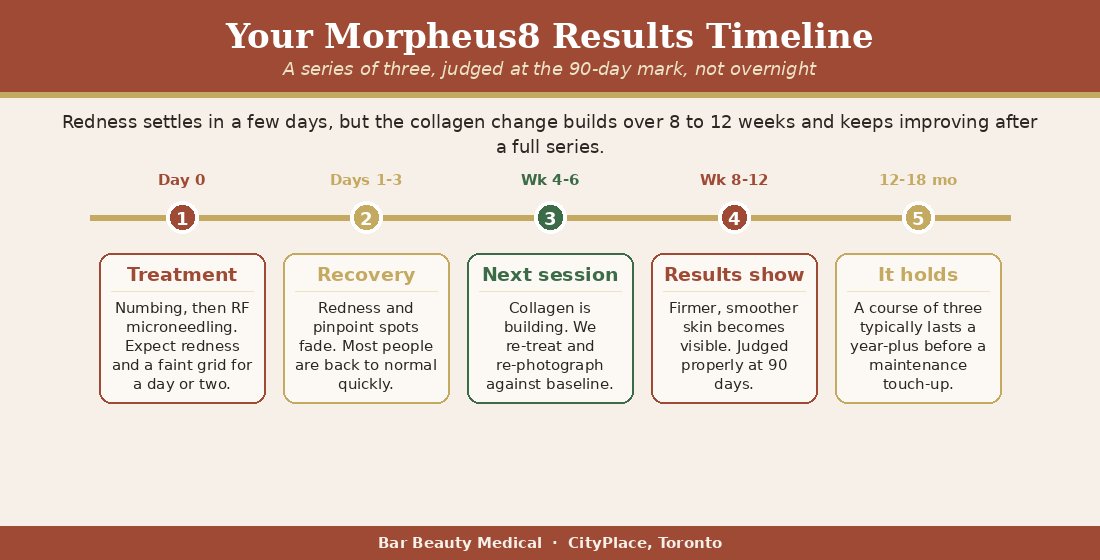
Because Morpheus8 works by building your own collagen, the result is durable rather than instant. Most people see their full result settle in around eight to twelve weeks after a series, and a course of three typically holds for roughly twelve to eighteen months before a maintenance session is worth booking. Skin quality results, the smoother texture and tighter feel, tend to age gracefully rather than falling off a cliff.
Lifestyle matters here, and we are honest about it. Sun, smoking, and big weight swings all age collagen faster, so a patient who protects their skin holds a result longer than someone who does not. We track your photographs over time and tell you the realistic maintenance cadence for your skin, not the manufacturer’s marketing calendar. For most faces that means a single touch-up somewhere around the year mark, not a full series every few months.
Are there reasons not to choose Morpheus8?
Yes, and we say so at consult. Morpheus8 is not for you if any of these apply:
- You are pregnant or actively breastfeeding.
- You have an active skin infection, or an active cold sore outbreak in the treatment area.
- You have an autoimmune condition that is currently flaring.
- You took isotretinoin, Accutane, within the past six months.
- You have a history of keloid or hypertrophic scarring that has not been cleared by your physician.
- You had recent injectable filler in the exact area and we need to time around it.
- You want a dramatic result from a single session, or you want it done before an event next week.
We also screen for body-dysmorphic patterns under Dr. Henneberry-Fudge’s protocol, and we turn away requests when the concern is not something a device can honestly fix. If your real problem is volume loss, we will point you to filler or Sculptra. If it is mostly redness or pigment, we will point you to Aerolase. Sometimes the honest answer at a consult is a good skincare plan and nothing else for now.
Will Morpheus8 make me look obvious or done?
No, and that is one of its quiet advantages. Morpheus8 does not add anything to your face. It does not inflate a cheek or change a feature. It tightens and resurfaces the skin you already have, so the change reads as firmer, smoother, and more rested rather than altered. Nobody looks at a good Morpheus8 result and thinks you had work done. They think you slept well.
The Bar Beauty house style is conservative. We treat to the right depth and temperature for your skin, not the most aggressive settings on the dial, and we build results across a series rather than chasing a dramatic single pass. The compliment our patients hear most is some version of you look rested. That is the goal.
How is Morpheus8 different from the other treatments at Bar Beauty?
| Treatment | What it does | When it shows | How long it lasts |
|---|---|---|---|
| Morpheus8 | RF microneedling to tighten and resurface | 8 to 12 weeks | 12 to 18 months with upkeep |
| Sculptra | Builds your own collagen for deep structure | 3 to 6 months | 18 to 24 months or more |
| Dermal filler | Adds instant volume to a specific area | Same day | 9 to 18 months |
| Botox | Relaxes muscles to soften movement lines | 3 to 14 days | 3 to 4 months |
| Aerolase | Laser for tone, redness, and rejuvenation | 1 to 4 weeks | Maintenance based |
| PRF | Your own platelets for skin quality | 4 to 12 weeks | Maintenance based |
The simplest way to think about it. Filler and Sculptra add or rebuild volume. Botox relaxes movement. Aerolase and PRF work on tone and quality. Morpheus8 is the one that physically tightens and resurfaces the skin itself. They are not competitors, they are different jobs, and most of our long-term patients use two to four of them across a year. We map the sequence at the consult so each treatment has room to show its result before the next one.
How does Morpheus8 compare to Fraxel and other lasers?
This is the comparison patients ask about most, so here is the honest version. Fraxel and similar fractional lasers are excellent at surface texture, sun damage, and fine lines, because they resurface the top layers with light. Morpheus8 reaches deeper, because the needles place the radiofrequency energy in the dermis where remodelling and tightening happen. Different depth, different job.
| Dimension | Morpheus8 | Fractional laser (Fraxel) |
|---|---|---|
| Best for | Tightening, acne scars, deep collagen remodel | Surface texture, sun damage, fine lines |
| Energy type | Bipolar RF delivered through microneedles | Fractional laser light |
| Depth | Subdermal, controlled to the deeper dermis | Mostly surface to mid dermis |
| Downtime | Redness and a grid pattern for a few days, no heavy peeling | Active peeling for several days |
| Darker skin tones, Fitzpatrick IV to VI | Generally safer, because it is not light based | Higher risk of post-inflammatory pigment change |
| Sessions | A series of 3, spaced 4 to 6 weeks apart | Often a series, spaced a few weeks apart |
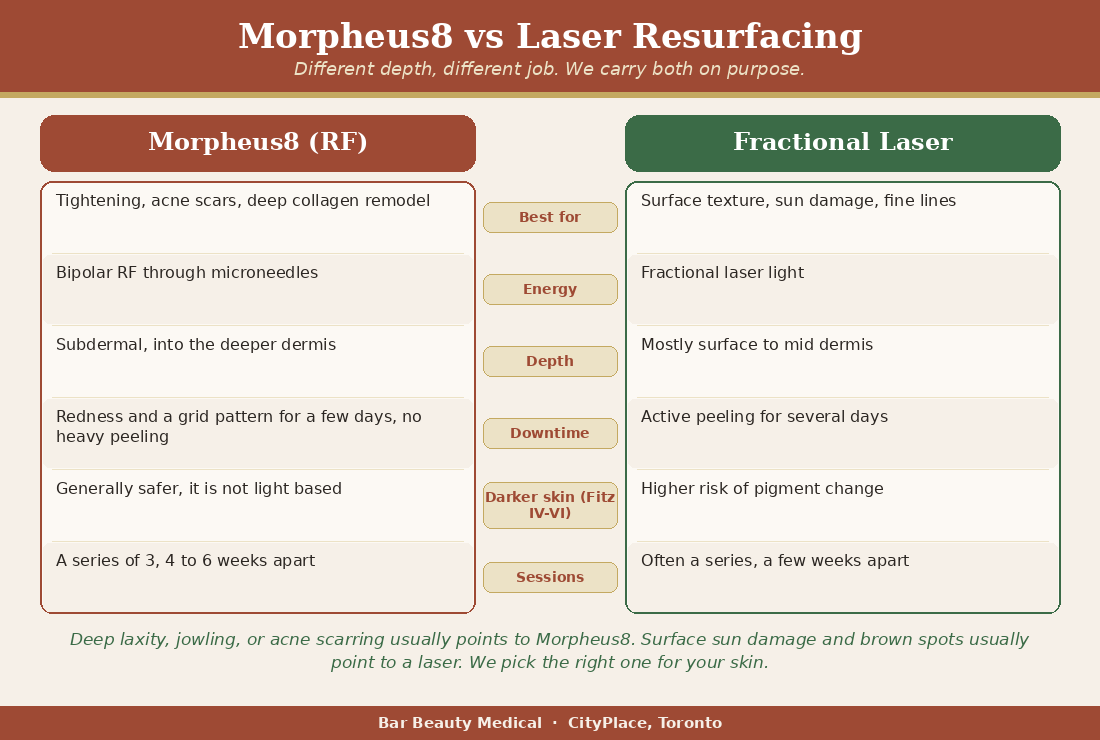
If your main concern is deep laxity, jowling, or acne scarring, Morpheus8 is usually the better tool. If your main concern is surface sun damage and brown spots, a laser is often the better first move, and at our clinic that conversation usually points to Aerolase. We carry both philosophies on purpose so we can pick the right one for your skin instead of selling you the only device in the building.
What the science actually supports about Morpheus 8 RF microneedling
Morpheus8 is FDA and Health Canada cleared for subdermal remodelling, and the mechanism is well understood. Radiofrequency energy delivered through microneedles raises the temperature of the deep dermis into the range that denatures old collagen and triggers new collagen and elastin production. Published work on radiofrequency microneedling shows improvement in skin laxity, texture, and acne scarring, with a strong safety profile across skin types because the effect does not depend on targeting pigment. The same literature is clear that results depend on doing it properly. Depth, energy, and the number of passes are what produce the remodelling, and under-treating to keep a session cheap produces an underwhelming result. That is why we treat to the right settings for your skin and build across a series.
What does my long-term Morpheus8 programme look like?
The patients who get the best results from Morpheus8 treat it as a programme, not a one-off. A typical first year in our chair looks like this:
- Months one to three, your initial series of three sessions, spaced four to six weeks apart, with photographs at every visit.
- Around month three to four, we re-photograph against baseline and judge the result on real evidence, not memory.
- Through the year, we often pair the Morpheus8 collagen base with surface work from Aerolase for tone and redness, or PRF for skin quality, and targeted filler for any volume Morpheus8 cannot address.
- Around the year mark, a single maintenance session keeps up with the collagen you keep losing as you age.
- Daily, medical-grade skincare and a mineral sunscreen, because sun undoes a tightening result faster than anything.
The art is in not doing everything at once. We build a sequence so each treatment has room to work, and we adjust the plan based on your photographs across the seasons.
How do I book?
The fastest way is our Jane portal. Pick a free consult, fill in the short intake, and come see us at CityPlace.
Book your free consult on Jane
Call the clinic: 416-923-1200
See the full price list
Get directions to 46 Fort York Blvd
Meet your team and Medical Director
Patient questions we hear most often
Is Morpheus8 RF microneedling safe?
Yes, it is FDA and Health Canada cleared for subdermal remodelling, and radiofrequency microneedling has a strong safety record across skin types. The most common after-effects are redness, warmth, and pinpoint spots for a day or two. We screen every patient at a free consult and run the device under our Medical Director’s standing orders.
How much does Morpheus8 cost in Toronto?
At Bar Beauty Medical, the face is $900 and the neck is $600. Face and neck together is $1,400, and a packaged series of three on the face is $1,800. Body areas are quoted per zone at the consult. You always get the full price in writing before anything happens.
How many Morpheus8 sessions will I need?
Most faces need a series of three, spaced four to six weeks apart, because the collagen change compounds across sessions. A single session shows minimal change, which is why we package three. We confirm the right number for your skin at your free consult.
When will I see results from Morpheus8?
The redness settles in a few days, but the real change is the new collagen, which builds over eight to twelve weeks and keeps improving for months after a full series. Most people judge the result properly at the ninety day mark.
How long does Morpheus8 last?
A series of three typically holds for roughly twelve to eighteen months before a maintenance session is worth booking. Skin quality results age gracefully rather than disappearing on a fixed date, and sun protection extends them.
Does Morpheus8 hurt?
We numb the area with a topical cream for about thirty minutes first, and most patients describe the treatment as very tolerable. You feel pressure and warmth more than sharp pain. There can be mild soreness afterward.
What is the downtime with Morpheus8?
Minimal compared to a resurfacing laser. Expect redness and a faint grid texture for a day or two, sometimes pinpoint spots, and most people are back at work the same day or the next morning. The key rule is no unprotected sun for about two weeks.
Is Morpheus8 safe for darker skin tones?
Generally yes, and this is one of its advantages. Because the energy is radiofrequency and not light, it does not target pigment the way some lasers do, so with conservative settings it is usually a safer tightening and resurfacing option across Fitzpatrick types, including darker skin. We still assess every patient individually.
Can Morpheus8 treat acne scars?
Yes, acne scar revision is one of its strongest uses. The microneedles break up scar tissue and the radiofrequency heat remodels the deeper dermis, which improves the texture over a series. Deep, stubborn scarring usually needs the full series of three and patience for the collagen to build.
Can Morpheus8 be used on the body?
Yes. We use a deeper InMode handpiece for body areas like the abdomen, flanks, arms, and knees, where loose or crepey skin responds to tightening. Body areas are quoted per zone at the consult because the size of the treatment area drives the price and the session length.
Who should not get Morpheus8?
Anyone who is pregnant or breastfeeding, has an active skin infection or cold sore in the area, an autoimmune condition that is flaring, recent isotretinoin within six months, or a history of keloid scarring not cleared by their physician. We also steer people away when their concern is volume loss, which is better solved by filler or Sculptra.
Morpheus 8 versus filler, which is better?
Neither is better, they do different jobs. Filler adds volume to a flat or hollow area and works the same day. Morpheus8 tightens and resurfaces the skin itself and builds over weeks. Many patients use both, filler for structure and Morpheus8 for skin quality, and we sequence them at the consult.
Can I get Morpheus8 and Botox at the same time?
Often yes, and many patients do, because they address completely different things, skin quality versus movement lines. We sequence them sensibly at your consult so each one works without interfering with the other.
Where is your clinic and how do I get there?
We are at 46 Fort York Blvd in CityPlace, downtown Toronto, steps from the waterfront and easy to reach from King West, Liberty Village, and the Financial District. Directions and parking are here.
What happens if I have a reaction after I am home?
You call us. We give every patient a direct line, and our Medical Director’s standing orders cover the rare issues that come up, from a stubborn area of redness to anything that needs medical attention. Most concerns after Morpheus8 are minor and settle on their own with the aftercare routine, but you are never left guessing or sent to a walk-in clinic that has no idea what we did.
Who is the wrong patient for Morpheus8?
The person who wants a dramatic change from a single session. The person whose real concern is volume loss, a flat cheek or a thin lip, which a tightening device cannot fix. The person shopping purely on the lowest price, who ends up with the lowest settings. And the person who is not ready to wait eight to twelve weeks to judge the result. If that is you, we will say so at the consult, and we will not charge you for the honesty. That is the medical part of medical aesthetics, and it is why our reviews read the way they do.
Related reading: See real Morpheus8 before and after results in Toronto.
Concerns we treat with Morpheus8: a sagging jawline, tech neck and enlarged pores.
Related: RF microneedling vs laser vs microneedling.
Morpheus8 vs Fraxel, which is better?
They work differently. Morpheus8 is radiofrequency microneedling: fine needles deliver RF heat into the deeper skin and fat to tighten and remodel with little surface damage, so it suits laxity and jawline definition and is safe on all skin tones. Fraxel is a fractional laser that resurfaces the skin surface, which is strong for tone, texture, and pigment but carries more downtime and more risk on darker skin. For lifting and tightening we use Morpheus8; for pure surface resurfacing a laser may fit better.
Recommended aftercare and skincare
The medical grade products our team uses to protect and extend your results. Shipped express across Canada, free over 150 dollars.
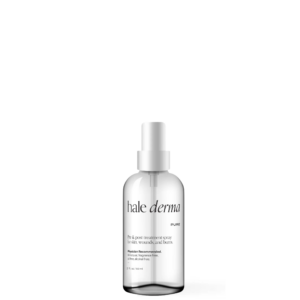
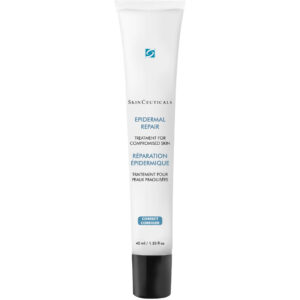
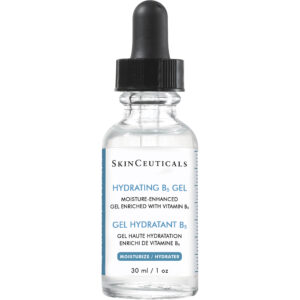
Post treatment skincare we trust
After radiofrequency microneedling the skin wants repair and sun protection, nothing fancy. This is what we stock.
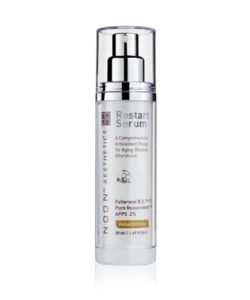 Restart Serum 50ml.
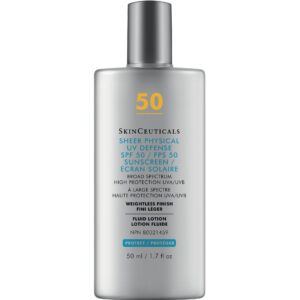 SHEER PHYSICAL UV DEFENCE SPF 50 50 ML
Stocked in clinic and shipped across Canada. Free express shipping over $150, or free pickup at 46 Fort York Blvd.
For the weeks in between, the Préime DermaFacial maintains firmness and clarity non-invasively, using surface radiofrequency rather than needles.
Ready to look into it properly?
Our consultation is free. We will look at your skin, give you an honest recommendation, and say so if a different treatment would suit you better.
Or call 416 923 1200 · 46 Fort York Blvd, CityPlace, Toronto
Package Pricing
A course usually costs less per session than booking one at a time. These are live package prices from our booking system, valid one year from purchase.
| Package | Sessions | Price | Per session |
|---|---|---|---|
| Morpheus 8 – Neck 3 sessions | 3 | $1,440 | $480 |
| Morpheus 8 Face 3 Sessions | 3 | $2,160 | $720 |
| Morpheus 8 Half of the Face | 3 | $1,440 | $480 |
| Forma InMode Skin Tightening 15 session + Morpheus 8 Face&Neck 5 session | 20 | $5,200 | $260 |
Full list on our price list. Free consult before you commit to a course, call (416) 923-1200.
Not sure whether this is the right tightening treatment for your face? Our skin tightening guide compares Forma, Morpheus8, Venus Bliss and BodyFX by area, downtime and price, and explains when heat is not the answer.
Questions about this treatment?
Ask us anything before you book. Consultations are free, and we will tell you honestly if a treatment is not right for you.