


By Basil Russo, Founder, Bar Beauty Medical, 46 Fort York Blvd, CityPlace Toronto. Clinically reviewed by Jasmine Saggu, RN, Lead Injector.
Warts are stubborn in a way that surprises people. Most have already tried a drugstore salicylic acid treatment for weeks, and many have been frozen at a clinic once or twice, and the thing is still there. That experience is normal, and it makes more sense once you understand what a wart actually is and what any treatment is really doing.
Short version: a wart is a viral infection of the skin, your immune system is what ultimately clears it, and treatment works by provoking or assisting that process rather than by removing something inert. This page explains how laser fits into that, what it can and cannot do, and the firm limits on what we will treat.
The most useful thing to change about a wart is usually not what you put on it, it is what you stop doing to it. A wart is a viral infection of the skin, so anything that moves virus from the wart onto intact skin plants another one. All four of these are ordinary habits and all four are avoidable.
| What happens | Why it spreads the virus | What to do instead |
|---|---|---|
| Picking or scratching at it | Breaks the surface and carries virus on your fingers to wherever you touch next | Cover it if it sits somewhere that rubs, and keep the area clean and dry. |
| Shaving or running a razor over one | The commonest reason flat warts turn up in clusters on the face and the legs | Shave around it, or leave that patch alone until it has been treated. |
| Shared towels, razors, nail files and socks | The virus travels on the object, not only on skin | Keep them to yourself for as long as there is an active wart. |
| Bare feet on damp communal floors | Softened, wet skin takes it up readily, which is why pool decks and changing rooms are classic sources | Wear something on your feet in changing rooms, pools and shared showers. |
Clearing the warts you have while quietly seeding new ones is why a course stalls. Warts on the soles and around the nails need more sessions than warts on hands, and we reassess each visit instead of pre-selling a number. Genital warts and anything not confirmed as a wart go to a physician rather than to us.
What a wart actually is
Warts are caused by human papillomavirus infecting the outer layer of the skin. The virus drives local cells to multiply faster than normal, producing the thickened, rough growth you see. The virus lives in the wart itself, which is why warts can spread to other parts of your own body and, with close contact, to other people.
This has a few practical consequences worth knowing:
- They are contagious, including to yourself. Picking or shaving over a wart is a reliable way to seed new ones nearby.
- They often resolve on their own, because immune systems do eventually recognise and clear the virus. This can take many months to a couple of years, which is longer than most people are willing to wait.
- No treatment kills the virus directly. Every available approach, including ours, works by destroying infected tissue or provoking an immune response. That is why recurrence happens.
The types, and why some are much harder
- Common warts. Rough, raised, usually on hands, fingers and around nails. The most straightforward to treat.
- Plantar warts. On the soles. Pressure from walking pushes them inward, so they grow into thick skin rather than outward. They are flatter, often painful, and considerably more stubborn. Expect more sessions here than anywhere else.
- Flat warts. Smaller, smoother and often in clusters of many, commonly on the face or legs. Frequently spread by shaving.
- Periungual warts. Around and under the nails. Difficult because of the nail structure, and frequently painful.
If someone quotes you the same session count regardless of type and location, they are not being straight with you. A common wart on a finger and a plantar wart on a heel are different propositions.
What we will not treat, stated up front
This section is deliberately near the top rather than buried.
- We do not treat genital warts. That is a medical matter requiring a physician, and it is outside both our scope and our appropriate setting. Please see your doctor or a sexual health clinic.
- We do not treat undiagnosed lesions. Several things resemble warts, including seborrheic keratoses, corns and calluses, and, importantly, some skin cancers. Anything that is bleeding, changing, darkly pigmented, growing quickly or not healing needs a physician’s eyes before a laser.
- We do not treat children. Warts are extremely common in children and usually resolve without intervention.
- We do not treat during pregnancy.
- We do not treat where immunity is significantly compromised without physician involvement, because warts behave differently and can be far more persistent.
If you turn up with something we are not confident is a wart, you will leave with a recommendation to get it assessed rather than a treatment.
How the Neo Elite approaches a wart
The Aerolase Neo Elite is a 1064nm Nd:YAG delivering energy in 650 microsecond pulses. The mechanism here is different from how it works on redness or pigment and it is worth understanding.
A wart is fed by its own small network of blood vessels. In a wart that has had the surface pared down, those vessels are often visible as tiny dark dots, sometimes described as seeds, which are not seeds at all but capillary tips. The 1064nm wavelength is well absorbed by haemoglobin and penetrates deeply enough to reach that vascular network beneath the thickened surface.
The aim is to disrupt the blood supply feeding the wart, so the infected tissue is starved rather than burned off from the top. Two advantages follow. It reaches the base of a wart that has grown inward, which is exactly the problem with plantar warts. And it can be done without the open wound and prolonged healing that come with more destructive methods, which matters on hands and feet you still need to use.
Expect a series. Warts are among the more treatment resistant things anyone deals with, and multiple sessions spaced a few weeks apart is the norm rather than a sign something is going wrong.
What to expect honestly, including failure
We would rather set this out clearly than have you disappointed at session four.
- Multiple sessions are standard. Several, sometimes more for plantar and periungual warts.
- Some warts do not clear. This is true of every wart treatment that exists. Persistence varies with the individual, the location and the immune response.
- Recurrence happens. The virus can persist in surrounding skin that looks entirely normal, so a wart can return in the same place or nearby even after it has apparently cleared.
- Paring helps. Reducing the thickened surface between sessions, gently and safely, helps energy reach where it needs to go. We will show you how, and it does not mean cutting yourself.
Anyone who guarantees clearance of a wart in a fixed number of sessions is guessing.
Sessions and what they feel like
Wart treatment is more uncomfortable than most of what we do. The energy is concentrated on a small area and warts on hands and feet sit on sensitive tissue. Most people describe a sharp hot snapping sensation. It is brief, sessions are short, and most people tolerate it without numbing, though we take it at your pace.
Afterwards the wart typically darkens over the following days as the treated tissue responds, and it may look worse before it looks better. That is expected. The area can be tender for a day or two, which is worth planning around if you are treating a plantar wart and have a long day on your feet.
What laser wart removal costs
| Treatment | Price | Notes |
|---|---|---|
| Single wart | $50 | Per spot, the usual booking |
| Small cluster | $300 | Several warts in one area |
| Larger area | $300 to $600 | By size, quoted at consultation |
Because session counts vary so much by wart type and location, we quote per session and reassess as we go rather than selling a package that assumes an outcome we cannot promise. Consultations are free. Our full price list covers everything else.
Aftercare, and not spreading them
- Keep the area clean and dry, and cover it if it is somewhere that rubs
- Do not pick, scratch or shave over a wart or a treated site, which is the main way people spread them
- Do not share towels, razors, nail files or socks while you have an active wart
- Wear something on your feet in changing rooms, pools and communal showers
- Tenderness for a day or two is normal, particularly on the soles
- If a treated site becomes hot, increasingly painful or discharges, that needs a physician rather than us
How laser compares to what you have already tried
Most people arrive having tried at least one thing. Here is an honest map.
- Salicylic acid. The standard first line and genuinely effective for many common warts, with reasonable evidence behind it. It requires real persistence, often twelve weeks or more of daily application with paring in between. Most people who say it failed actually stopped early.
- Cryotherapy. Freezing works from the surface downward. It is effective on many hand warts and much less reliable on plantar warts, because the wart has grown inward under thick skin and the cold does not reach the base. It typically needs repeated rounds and can blister.
- Cantharidin. Applied in clinic, causes a blister that lifts the wart away. Used more often in children.
- Duct tape. Popular online, with genuinely mixed evidence. Harmless to try, not something to rely on.
- 1064nm Nd:YAG. Targets the blood supply beneath the wart rather than destroying it from the surface, which is exactly why it is worth considering for the deep and stubborn cases where freezing has already failed.
If you have a new common wart on a finger and you have not tried salicylic acid properly, we will usually suggest you do that first. It is cheap, it works often enough, and we would rather you kept your money. Where we are genuinely useful is the wart that has already resisted a fair attempt.
Who comes to us about warts
The plantar wart that has been frozen four times. The most common presentation by far. Deep, painful, thickened, and unmoved by treatment that never reached the base. This is the case the mechanism is best suited to.
The spreading cluster. Started as one, now several, usually because of picking or shaving over it. Part of the visit is behavioural, because clearing the existing ones while continuing to seed new ones is a losing game.
The one that is not a wart. More often than people expect. Corns, calluses and seborrheic keratoses all get self diagnosed as warts. We send these on rather than treating them.
Why they come back
The virus can persist in skin surrounding the wart that looks completely normal to the eye. Clearing the visible growth does not necessarily clear every infected cell nearby, which is why a wart can reappear in the same spot weeks or months later.
This is true of every treatment modality, not a shortcoming of one. It is also why the immune response matters so much, and why the same wart on two different people can behave completely differently. We mention it before treatment rather than after a recurrence.
Wart questions we get asked most
Do warts go away on their own?
Many do, as the immune system eventually clears the virus, but it commonly takes many months to a couple of years. Most people treat because they do not want to wait that long or the wart is painful or spreading.
Are those black dots seeds or roots?
Neither. They are the tips of tiny blood vessels supplying the wart. Warts do not have roots or seeds, despite how often that is repeated.
Why did freezing not work?
Cryotherapy works from the surface down, and on a thick or inward growing wart, particularly on the sole, it often does not reach the base. That is a common reason people come to us after several rounds of freezing.
Can I catch warts from someone else?
Yes. They spread by direct contact and via surfaces, especially where skin is damp and softened, which is why pool decks and changing rooms are classic sources.
Will it definitely work?
No, and we will not tell you otherwise. Warts are genuinely resistant, some do not clear with any modality, and recurrence is possible. What we will do is tell you honestly how yours is responding.
How many sessions will I need?
It depends heavily on type and site. Common warts on hands generally need fewer. Plantar and periungual warts usually need more. We reassess at each visit rather than pre selling a number.
Does it hurt more than freezing?
Both are uncomfortable and it is individual. Laser is a brief hot snapping sensation during the session. Freezing often aches for longer afterwards and can blister. Many people who have had both prefer laser.
Can I treat a wart on my face?
Flat warts on the face can be treated, and we take particular care there. As always, the lesion needs to be confirmed as a wart first, because facial lesions carry a wider differential.
Is it safe on darker skin?
The 1064nm wavelength is among the safer choices across deeper Fitzpatrick types because it is not strongly absorbed by surface melanin. See Aerolase for darker skin tones.
Should I keep using salicylic acid at home?
Often yes, and gently reducing the thickened surface between sessions can help. We will tell you what suits your particular wart rather than giving blanket advice.
Where are you and how do I book?
46 Fort York Blvd in CityPlace, downtown Toronto. Consultations are free and booking is online.
Warts treated with the Neo Elite
Read this first. These photographs come from Aerolase Corp., the company that makes the Neo Elite. Each was taken at the practice credited underneath it. They are not our patients and we are not claiming them as our results. We show them because they are the clearest published record of what this device does, and we run the same machine at our CityPlace clinic. Our own patient photographs go up as we build a consented library.
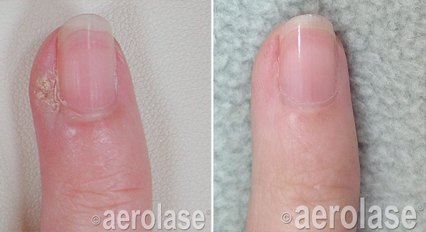
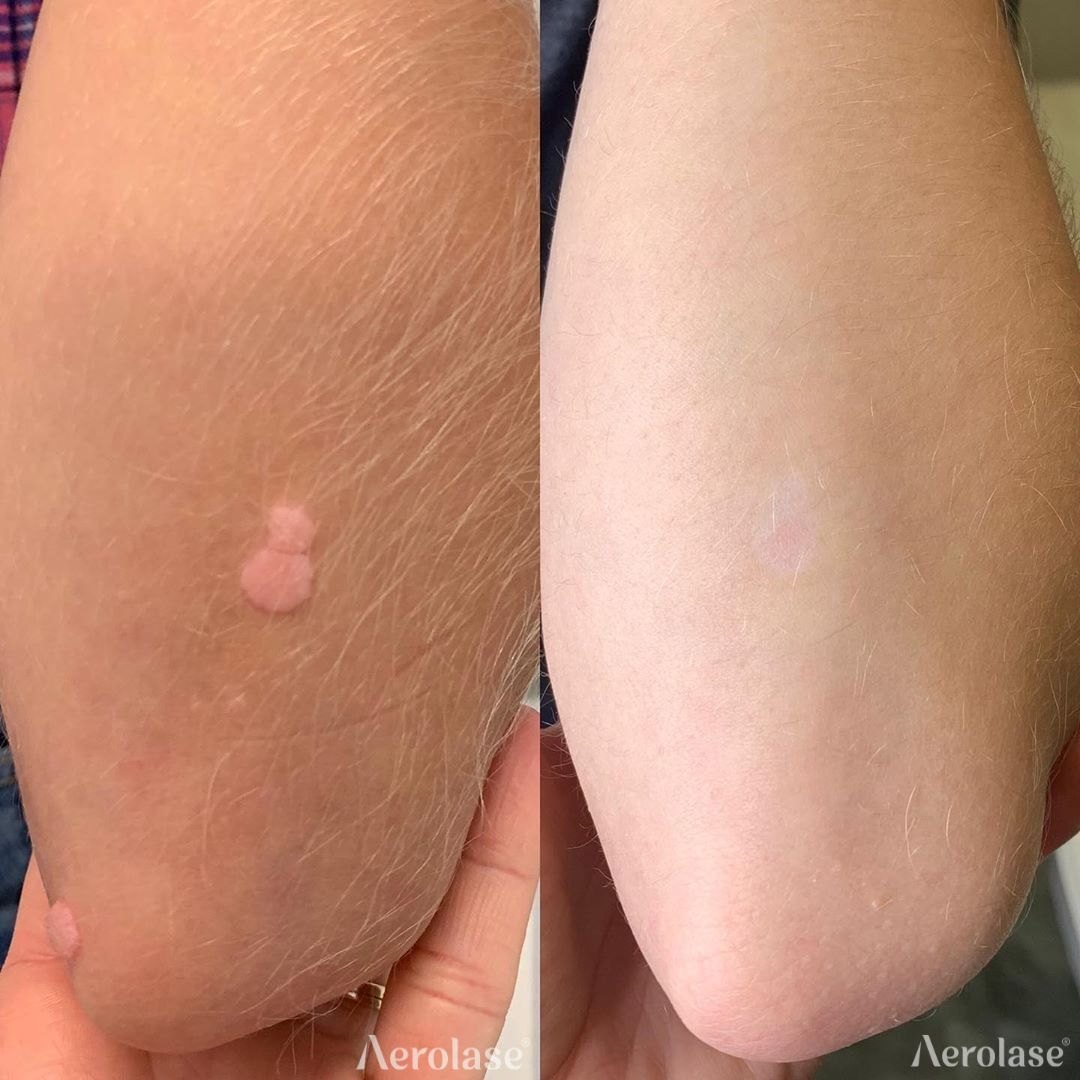
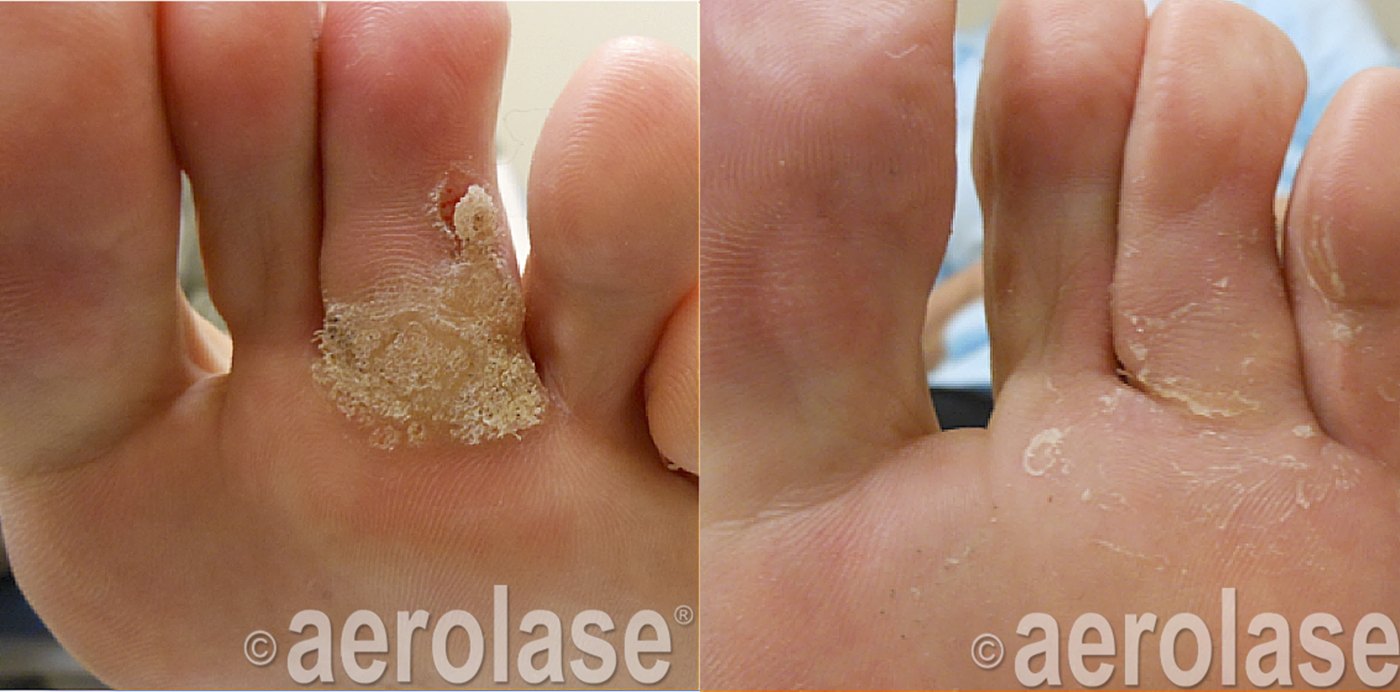
More Neo Elite results. The full set, covering every condition we use this laser for, is on our Aerolase before and after page.
Sessions needed vary by person, severity and skin type. Individual results vary and nothing here is a guarantee of outcome. We do not diagnose from a photograph; anything that has changed in size, shape or colour, or that you have not had looked at, needs a proper assessment before any laser is pointed at it.
Questions about this treatment?
Ask us anything before you book. Consultations are free, and we will tell you honestly if a treatment is not right for you.