


Top line: Most patients need 8 to 20 units of Botox in the forehead, with the typical Toronto first-timer landing at 10-14 units in the frontalis muscle (the horizontal-line forehead) plus another 16-25 units across the glabella (“11 lines”) for a full upper-face result. The exact number depends on muscle strength, gender, age, brow position, and whether you want a subtle softening or a “frozen” effect (we don’t recommend the frozen look, ever). This guide breaks down the anatomy of your forehead, dosing ranges by goal, why under-dosing fails, and what a fair Toronto price looks like in 2026.
Most forehead (frontalis) Botox doses at Bar Beauty Medical land between 8 and 20 units, at $10 per unit. Forehead Botox is dosed once and judged twice: at two weeks, when the effect is complete, and again at week eight to twelve, when you find out whether the number was right. The number only proves itself across a full cycle rather than on the day, and this is what that cycle looks like.
| When | What is normal | What we do |
|---|---|---|
| Days 1 to 2 | A mild headache. A tiny lump at each injection site that settles within 24 to 48 hours. | Nothing. Both are expected. |
| Days 3 to 5 | Onset begins. Botox and Nuceiva start at 3 to 5 days, Dysport at 1 to 3. Slight asymmetry around day 5. | Wait. This is not the result yet. |
| Days 5 to 10 | Pinpoint bruises can surface. A heavy, tight feeling through the first two weeks. | Nothing, unless it appears on the call-us list further down this page. |
| Week 2 | Full effect. This is your actual result. | Follow-up visit. If you are under-treated we add 2 to 6 units at no charge, provided no promotion or discount was applied to the original treatment. |
| Weeks 8 to 12 | Correctly dosed, you are still smooth. Movement coming back at week 8 means the dose was too low. | We increase the dose next round. We also reduce it if your result held past 4 months. |
| Months 3 to 4 | Movement is back. First rounds often run 2 to 2.5 months; round two usually reaches the full 3 to 4. | Re-treat, adjusting the dose to how long the last one actually held. |
These timings assume Botox or Nuceiva. Dysport comes on faster and is counted in different units, so confirm the brand and the Botox-equivalent dose before you compare a quote. A drooping eyelid, a brow that will not lift at all, severe headache with vision changes, or spreading redness, warmth or fever is a same-day phone call, not a wait.
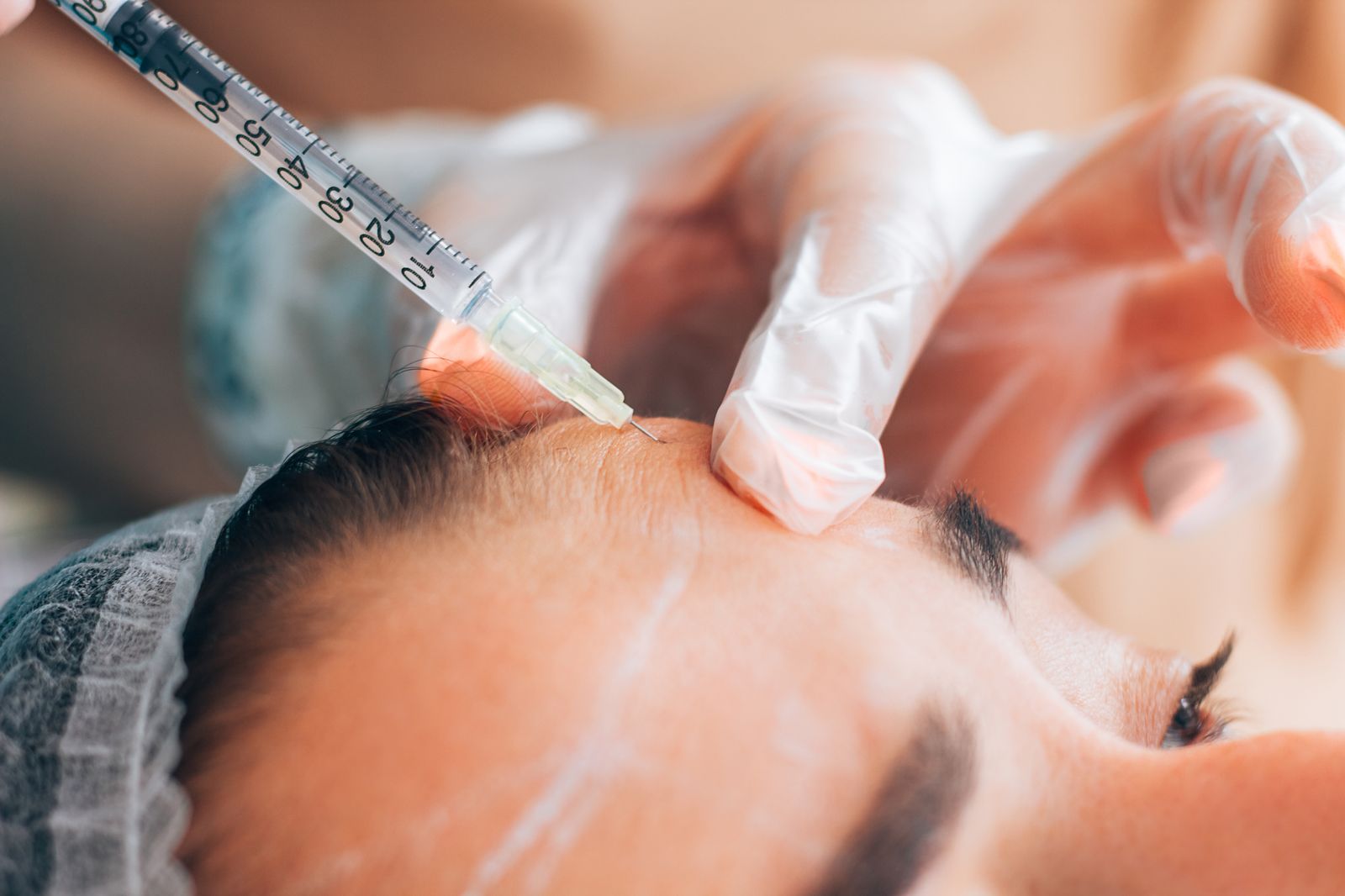
Quick reference: Botox units for the forehead (frontalis only)
| Patient profile | Typical units | Result style |
|---|---|---|
| First-time, female, 25-35, light lines | 6-10 units | Soft, brow movement preserved |
| First-time, female, 35-50, moderate lines | 10-14 units | Smoother, still expressive |
| Female, 50+, deeper static lines | 12-18 units | Smooths most lines; some shadow may remain |
| Male, 30-50, strong frontalis | 14-22 units | Visible softening, retains masculine brow |
| Male, 50+, heavy frontalis | 18-26 units | Smoother forehead, brow stays low |
| Anyone wanting brow lift | 4-8 units (selective) | Slight lift of the tail of the brow |
Forehead anatomy, why “units of Botox” varies so much
The forehead has three muscles that create the lines you see:
- Frontalis, the broad muscle that pulls your brows UP. Creates the horizontal forehead lines.
- Corrugators (two of them), pull your brows DOWN and TOGETHER. Create the “11 lines” between the brows.
- Procerus, pulls the medial brows DOWN. Creates the horizontal line at the top of the nose.
When someone says “Botox for the forehead,” they usually mean the frontalis. But treating the frontalis alone, without addressing the corrugators and procerus underneath, often produces a “heavy brow” outcome because the depressor muscles still pull the brow down while the lifter is paralyzed. This is why most experienced injectors treat the frontalis + glabella together.
Full upper-face Botox dosing, what we actually do in Toronto
| Area | Typical units (female) | Typical units (male) | What it does |
|---|---|---|---|
| Frontalis (forehead lines) | 8-14 | 14-22 | Softens horizontal lines |
| Glabella (corrugators + procerus, “11 lines”) | 16-25 | 20-30 | Removes frown lines, opens the eye area |
| Crow’s feet (orbicularis oculi) | 8-16 (4-8/side) | 10-18 (5-9/side) | Smooths eye-corner lines |
| Full upper face total | 32-55 | 44-70 | Most common Toronto treatment |
This is why the dose your friend got might be radically different from yours. Someone hearing “I got 12 units in my forehead” without knowing it was JUST the frontalis (not the glabella, not crow’s feet) is comparing apples to oranges.
The 8-20 unit range explained, why each number
8 units
Bare-minimum dose for a young, female, first-timer with light dynamic lines. Result: lines fade with movement, but movement is preserved. Lasts: about 2 months. We rarely under-dose to this level, it’s “money you won’t see again at week 8.”
10-12 units
The most common Toronto first-time female frontalis dose. Result: softer movement, lines visible only with strong expression. Lasts: 3 months.
14-16 units
Moderate-strength frontalis or female 40+ with deeper lines. Result: smoother forehead at rest and with most expressions; lines visible only with maximum frown. Lasts: 3-4 months.
18-20 units
Strong frontalis (often men) or anyone wanting near-complete smoothing without going “frozen.” Result: visibly smoother, movement still possible but limited. Lasts: 3-4 months.
22-26 units
Very strong frontalis in larger faces (often male). Result: smooth forehead. Lasts: 4 months. Above this you’re risking heavy brow drop.
Why we don’t dose above 26 units in the frontalis
The frontalis is the only muscle lifting your brow. Over-dosing it weakens that lift and the depressors (corrugators) win, your brow drops, your upper eyelid looks heavier, and your face looks tired. The art of forehead Botox is finding the dose that smooths the lines without dropping the brow.
Brand differences, Botox vs. Dysport vs. Xeomin vs. Nuceiva
| Brand | Conversion to Botox units | Onset | Spread |
|---|---|---|---|
| Botox (Allergan) | 1 unit = 1 unit | 3-5 days | Tight (1 cm) |
| Dysport (Galderma) | 2.5-3 units = 1 unit Botox | 1-3 days (faster) | Wider (2-3 cm) |
| Xeomin (Merz) | 1 unit = 1 unit | 3-5 days | Similar to Botox |
| Nuceiva (Daewoong) | 1 unit = 1 unit | 3-5 days | Similar to Botox |
Some clinics quote Dysport-equivalent units to make a “30 unit” forehead seem like a big dose, it’s actually equivalent to ~10 units of Botox. Always ask what brand and clarify the unit-equivalent.
Toronto Botox forehead pricing, what’s fair in 2026
Real Botox costs the clinic ~$7-9 CAD/unit wholesale. Anyone selling at $5/unit is using diluted, expired, or counterfeit product. See our full 2026 Botox pricing breakdown.
Step-by-step: how we choose your forehead unit dose
- Resting photo. Look at your forehead at rest. How many static lines?
- Maximum brow-raise photo. Pull your brows up as high as possible. How deep are the dynamic lines? How strong is the muscle?
- Brow position assessment. Is your brow already low? If yes, we dose conservatively to avoid dropping it further.
- Glabella assessment. Treating the glabella alone (without frontalis) sometimes elevates the brow. We use this in patients with heavy brow position.
- Discuss goal. Soft, expressive, smooth, “snatched”, very different doses.
- Plan injection map. Typically 4-6 points across the frontalis with 1.5-3 units per point.
- Inject conservatively the first time. Better to add at 2 weeks than to over-correct on visit 1.
- 2-week follow-up. Add 2-6 units if undertreated, no charge at Bar Beauty.
- Adjust dose at month 3 based on result and longevity.
How many units of Botox for first-time patients (specifically)
For first-time forehead Botox patients we typically:
- Inject 10-12 units of Botox in the frontalis (female).
- Plus 18-22 units in the glabella.
- Skip crow’s feet on the first visit if the patient isn’t sure they want them treated.
- Hold back 2-4 units for the 2-week touch-up.
Total first-time upper-face for the average Toronto female: 28-34 units. Total first-time cost at fair Toronto pricing: $340-510.
How many units of Botox last longer?
Yes, correctly dosed Botox lasts longer. Under-dosing the frontalis at 8 units when you needed 14 means at week 8 the muscle is back and you’re booking a touch-up. Properly dosed Botox at 14 units lasts 3-4 months. The math:
- 8 units, $80 at $10/unit, lasts 8 weeks = $10/week of result
- 14 units, $140, lasts 14 weeks = $10/week of result
- 20 units, $200, lasts 17 weeks = $12/week of result
Diminishing returns kick in above 20 units, you pay proportionally more for marginal longevity gain.
What’s normal vs. what’s not after forehead Botox
| Normal | Call within 24 hours |
|---|---|
| Heavy “tight” feeling first 2 weeks | Drooping eyelid (ptosis, treatable) |
| Pinpoint bruises 5-10 days | Severe headache with vision changes |
| Mild headache 24-48 hours | Drooped brow that doesn’t lift at all |
| Slight asymmetry day 5 | Severe asymmetry at week 2 |
| Tiny lump at injection site (24-48 hours) | Spreading redness, warmth, or fever |
Red flags, save your money
- “How many units do you want?” The injector should be telling you, not asking you. Unit count is anatomy + goal + judgment, not patient self-prescription.
- $5/unit Botox. Wholesale is ~$7-9 CAD; pricing below that is diluted, expired, or counterfeit.
- “50 units guaranteed flat-rate forehead.” Real dosing varies by patient. Flat-rate pricing often means under-dosing tall foreheads and over-dosing short ones.
- No 2-week follow-up. A reputable clinic checks your result once the toxin has fully settled.
- “Same dose every time.” Dose should adjust as you build pattern over treatments, reduce when results last 4+ months, increase when they fade at week 8.
- “You need 60+ units.” Massive doses in young, light-lined patients are over-treatment.
Frequently asked questions
How many units of Botox for forehead first time?
Female first-timers: 10-14 units in the frontalis, plus 18-22 in the glabella. Total upper face 28-34 units typical.
Is 10 units of Botox enough for the forehead?
For a light-lined female under 35, yes. For deeper lines, mid-strength frontalis, or men, usually not.
How many units of Botox for “11 lines” only?
16-25 units of Botox in the glabella for women; 20-30 for men.
What’s the maximum safe Botox dose for the forehead?
Total upper face is typically capped at 70 units (Botox equivalent). Above this is rarely cosmetically appropriate.
Will more Botox last longer?
Up to a point. 14 units typically lasts longer than 8; 20 units typically lasts longer than 14; above 20 you see diminishing returns.
How much does forehead Botox cost in Toronto?
$100-200 for frontalis only; $400-600 for frontalis + glabella; $500-750 for full upper face.
Does Botox give you a brow lift?
Yes, when placed selectively in the corrugator/glabella area without over-treating the frontalis. We can give most patients a 1-3 mm tail-of-brow lift.
What happens if you don’t use enough Botox?
Result fades fast (4-8 weeks instead of 12-16), partial movement remains, and lines return early.
Can I just do glabella and skip the forehead?
Yes, many patients do glabella-only on their first visit. This often produces a small natural brow lift.
How long does forehead Botox last?
3-4 months at correct dose. First-timers often see 2-2.5 months on round 1; round 2 typically reaches the full 3-4.
Deeper Look: How Forehead Botox Units Actually Works
Most rushed consult conversations skip the mechanism. They jump straight to price. That’s a mistake because when you understand why forehead Botox produces the result it does, two things become possible. First, you can spot a clinic that’s running the protocol wrong before it costs you money. Second, you can predict whether the treatment will actually solve your concern, versus a concern someone on Instagram had that looked similar but wasn’t.
The mechanism is neuromuscular. A neuromodulator temporarily blocks the release of acetylcholine at the neuromuscular junction, so the treated part of the muscle contracts less forcefully. Weaker contraction means the skin above it folds less, and the horizontal line that fold was creating softens. Nothing is heated, resurfaced or removed, and nothing is left behind in the skin. The line fades because the movement that creates it fades.
That is why the timeline behaves the way it does. Onset is about 3 to 5 days for Botox and 1 to 3 days for Dysport. The effect settles over roughly two weeks, which is why we book the 2-week follow-up and add 2 to 6 units at no charge if the frontalis was undertreated. A correctly dosed result then holds 3 to 4 months before the muscle recovers and the lines come back. First-timers often see 2 to 2.5 months on round one and reach the full 3 to 4 months on round two. There is no build-up phase to wait out and no result that keeps improving at month six. Dose, placement and your own anatomy decide the outcome.
Because the effect stays close to where it is placed, placement matters more than volume. Botox spreads roughly 1 cm from each point, and our typical map is 4 to 6 points across the frontalis at 1.5 to 3 units per point. This is also why treating the frontalis without addressing the corrugators and procerus underneath tends to produce a heavy brow: the depressors keep pulling the brow down while the only muscle that lifts it has been weakened. The whole art of forehead dosing is finding the dose that smooths the lines without dropping the brow.
Botox vs Dysport vs Xeomin vs Nuceiva for the forehead: A Practical Decision Matrix
The products patients usually compare in Toronto are Botox, Dysport, Xeomin and Nuceiva. We carry Botox, Dysport and Nuceiva; we do not carry Xeomin. All four are neuromodulators and all four work the same way, by temporarily blocking acetylcholine release at the neuromuscular junction so the treated muscle contracts less. None of them is universally “better.” They differ in how they are dosed, how quickly they start working, and how far the effect spreads from each injection point.
Choose Botox or Nuceiva when you want the tightest, most predictable spread, roughly 1 cm from each point. That is what you want in a short forehead or a low brow, where a wider spread risks dropping the brow further. Both are dosed 1 unit to 1 unit against Botox, so a quoted unit number means the same thing. Choose Dysport when you want faster onset, typically 1 to 3 days rather than 3 to 5, and when a wider 2 to 3 cm spread suits a broad, evenly strong frontalis. Mind the conversion: 2.5 to 3 Dysport units equal 1 Botox unit, so a “30 unit” Dysport forehead is about 10 Botox units, not a large dose. Nuceiva converts 1 unit to 1 unit and behaves much like Botox. Whatever you are quoted, ask which brand is in the syringe and clarify the unit equivalent before you compare prices.
The trap to avoid is brand loyalty for its own sake. Some clinics stock one product and put everyone on it because it is what they buy. Switching you between brands without explaining why is no better. The clinic that says “your last result held four months, we can drop your dose this time” is the one to trust with the bigger decisions later.
Cost Breakdown by Provider Type in the GTA
Sticker prices for forehead Botox (toxin) in the Greater Toronto Area cluster into four tiers depending on who’s performing the treatment and where:
- Medspa, esthetician-led (entry tier): roughly $150-$200. Lower price, often a less experienced injector, faster session, limited customization. Suitable for maintenance-only patients with healthy skin.
- Medspa, RN- or NP-led (standard tier): roughly $200-$325. Most Toronto patients land here. Medical oversight, experienced injectors, structured before/after photography. This is the price-quality sweet spot for first-time patients.
- Physician-led aesthetic clinic (premium tier): roughly $325-$450. Higher price reflects MD time, broader complication-management capability, and typically more years of injecting experience. Worth it for medically complex skin or combination protocols.
- Hospital-affiliated or dermatology-derm clinic (specialty tier): $450+. Highest price, narrowest scheduling, longest waitlists. Reserved for cases involving prior complications, severe pigmentary disorders, or post-surgical reconstruction.
The pricing band that most overpays is the entry tier, not because the treatment failed, but because it usually has to be redone at the standard tier within 12 months. Two cheap sessions plus a corrective is almost always more expensive than one properly-done session.
Sticker Price vs True Annual Cost
One number ruins more Forehead Botox Units budgets than any other: the single-session sticker. Patients see “$200” and plan a one-and-done. Then six months in, they’re either underwhelmed because they skipped the series, or they’ve spent $1,350+ on touch-ups they didn’t budget for.
The honest framework is annual, not per-session. For a typical first year of Forehead Botox Units in Toronto: initial series (2-3 sessions front-loaded) + maintenance (1-2 sessions in months 6-9) + medical-grade home care (cleanser, antioxidant serum, retinoid, mineral SPF, call it $400-$700 across the year) + one consultation or photo review. Realistic year-one total in the standard tier: $600-$1,350. Year two, with the proliferation phase done, drops by roughly 40%. Build the budget on that arc and you won’t be surprised.
Pre-Treatment Prep: The 14-Day Runway
The single highest-leverage thing you can do before Forehead Botox Units is barrier prep. Two weeks out, drop the actives that thin or sensitize the skin, pause prescription retinoids, AHAs/BHAs above 5%, benzoyl peroxide on the treatment area, and any scrub or brush. Keep the cleanser bland, layer a ceramide moisturizer morning and night, and run mineral SPF 30+ daily even on overcast days. Hydration matters more than people credit; aim for steady water intake rather than a panic-drink the morning of.
Forty-eight hours out, avoid alcohol (it amplifies post-procedure redness and prolongs swelling), skip aspirin and high-dose fish oil if you aren’t on them for a medical reason, and do not book a workout in the four hours before your session. The morning of, come in with a clean face and bring sunglasses. None of this is dramatic, but together it shaves visible recovery time by roughly a day.
Twelve-Month Maintenance Plan
Maintenance is where most Toronto patients accidentally undo their own results. The simple, working plan after the initial Forehead Botox Units series:
- Months 1-3: finish the series on the cadence your provider set. Resist the urge to add new actives before week six. Re-photograph at week 12 against the original baseline.
- Months 4-6: single maintenance session at month four or five. Layer in retinoid two to three nights a week if tolerated. Repeat baseline photo at month six.
- Months 7-9: the “quiet quarter.” No new treatments unless there’s a clear change. Focus on SPF compliance and sleep. Most relapses we see start here, from missed SPF on grey-sky days.
- Months 10-12: assessment visit. Decide whether to repeat the series, step down to twice-a-year maintenance, or stop. Repeat baseline photo at month 12, this is the photo that tells you whether the year was worth it.
Common Mistakes Toronto Patients Make with Forehead Botox Units
- Booking on a discount code without checking the provider. Groupon-style pricing on medical aesthetics in Toronto correlates with shorter sessions, junior operators, and skipped post-care reviews. The unit price looks great; the per-result price is often worse.
- Stacking treatments in the same week. Filler on Monday, Forehead Botox Units on Wednesday, a peel on Friday, the skin can’t allocate repair resources to all three. Space modalities by at least seven to ten days.
- Skipping the week-12 photo. Without it, you’re judging results from memory, and memory is a flattering liar in both directions. The week-12 photo is the only honest scoreboard.
- Adding a “stronger” home-care product the night after treatment. The barrier is busy. Keep it boring for at least 72 hours. New product reactions in this window get blamed on the procedure.
- Chasing the wrong concern. Patients often book Forehead Botox Units for pigment when they should be booking it for texture, or vice versa. A 15-minute consult catches this. A self-diagnosed booking does not.
- Quitting after one session. Almost no Forehead Botox Units-class treatment delivers its final result in one visit. The “it didn’t work” reviews online are usually one-session reviews.
How to Vet a Toronto Forehead Botox Units Provider in Ten Minutes
Before you book, ask three questions and listen for the texture of the answer, not the speech. One: “Can I see a week-12 photo of a patient with skin similar to mine?” A practiced clinic answers within a minute. Two: “What’s your protocol when a patient has a delayed reaction at week two?” The right answer is specific and includes a callback policy. Three: “If Forehead Botox Units isn’t right for me, what would you recommend instead?” If they can’t name an alternative, they only sell one thing, and that’s not a clinic, it’s a counter.
None of this is a substitute for an actual consult. But it filters the bottom 30% of providers fast, and that’s where most regretted spend in the GTA ends up.
Book your Toronto Botox consultation
At Bar Beauty Medical we map every patient’s Botox plan on a printed face diagram, photograph at rest and at maximum expression, and follow up at two weeks. See 2026 Toronto Botox pricing and pair with our day-by-day aftercare.
Ready to look into it properly?
Our consultation is free. We will look at your skin, give you an honest recommendation, and say so if a different treatment would suit you better.
Or call 416 923 1200 · 46 Fort York Blvd, CityPlace, Toronto
Questions about this treatment?
Ask us anything before you book. Consultations are free, and we will tell you honestly if a treatment is not right for you.