


By Basil Russo, Founder, Bar Beauty Medical, 46 Fort York Blvd, CityPlace Toronto. Clinically reviewed by Jaskeerit (Jasmine) Saggu, Registered Nurse at Bar Beauty Medical.
Some people’s nostrils widen every time they smile. That flare comes from small muscles on the sides of the nose. A few units of a wrinkle relaxer can make the movement smaller for a few months, but it won’t make your nose narrower when your face is still. At Bar Beauty Medical in CityPlace, Toronto, nasal flare treatment is $10 per unit ($11 with Shahram, our advanced injector), and you get an exact quote at a free consultation before anything is injected.
Book a free consultation → Call 416-923-1200
The short version
- Nostrils that flare when you smile are pulled open by small muscles at the sides of the nose, mainly the alar part of the nasalis.
- A small dose of botulinum toxin relaxes those muscles so the nostrils move less. It works on movement only and won’t reshape bone or cartilage.
- A 2024 review, citing French experts, puts the effect at 3 to 4 months.
- The evidence is thin. We found one small controlled study, and most other studies had no comparison group.
- Flaring when you’re working to breathe, or with a blocked nose, is a medical question. See a doctor first.
- It’s $10 per unit ($11 with Shahram), the unit count is small, and the check-in at about two weeks is free.
What makes nostrils flare?
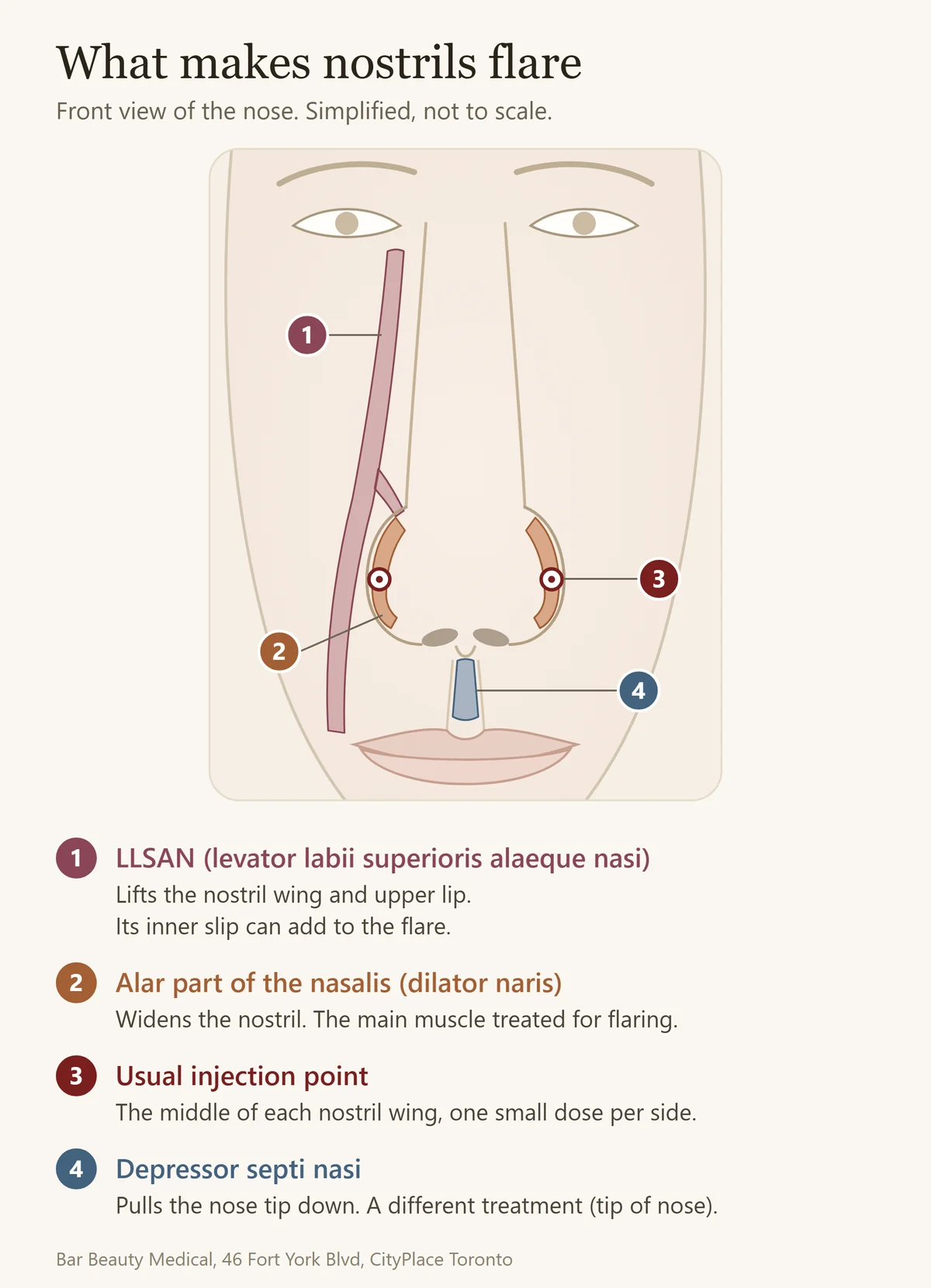
The cosmetic kind of flaring is movement. Your nostrils widen when you smile or make certain expressions. The only controlled study we found measured exactly that, the change in nostril width from rest to a full smile without showing teeth. A 2024 systematic review adds that the same muscle can contract with anger or discomfort.
The main muscle is the alar part of the nasalis, often called the dilator naris. Smaller dilator muscles sit inside the nostril wing itself. A slip of a nearby lip-lifting muscle, the levator labii superioris alaeque nasi (LLSAN), can add to the flare. These muscles have a real job, too. They help hold your nostrils open when you breathe in.
When flaring is a medical sign
There’s a second kind of nasal flaring, and it has nothing to do with looks. The MedlinePlus Medical Encyclopedia describes nostrils widening while breathing and says “It is often a sign of trouble breathing.” It advises getting emergency help for signs of breathing difficulty.
If your nostrils flare because you’re working hard to breathe, or your nose feels blocked, see a doctor. That’s a medical question, not a cosmetic booking.
How the treatment works
Botulinum toxin blocks the signal from nerve to muscle where it’s injected, so the muscle weakens for a while. Over time the nerve reconnects and the effect wears off. Placed in the nostril muscles, it limits how far the nostril wings move.
The most common placement is one point in the middle of each nostril wing. The Global Aesthetics Consensus, a 2016 expert panel, suggests 1 to 2 units of onabotulinumtoxinA per point, usually 1 to 4 units in total, and says the LLSAN slip may also be considered. Some papers use more, up to 6 units per side in the 2024 review. Units differ between products and aren’t interchangeable. Your injector sets the dose after looking at your nose at rest and while you smile.
What it can and can’t do
This treatment changes movement and nothing else. The 2016 consensus advises using toxin on its own only when the target muscle is the main cause.
| What you notice | What’s usually behind it | What fits |
|---|---|---|
| Nostrils widen when you smile | The nostril muscles, mainly the alar part of the nasalis | A wrinkle relaxer may help. That’s this page. |
| Nostrils look wide even when your face is still | Bone, cartilage or the shape of the nostril base | An injection won’t change it. For significant structural problems, the 2024 review says surgery remains the preferred option. |
| Your nose tip drops when you smile | Mainly a different muscle, the depressor septi nasi | A separate treatment. See tip of nose. |
| You’d like a different nose shape or profile | Structure, not movement | Not something a muscle relaxer does. See liquid rhinoplasty. |
| Nostrils flare when you breathe hard, or your nose is blocked | Effort to breathe | See a doctor first. |
The evidence is limited. The controlled study was small, 20 people with a saline comparison. Average nostril movement on smiling fell from about 10% to about 5%, with no significant side effects reported. The 2024 review covered 23 studies but couldn’t pool the results, and most of those studies had no control group. The 2016 consensus put it plainly: “Clinical data pertaining to botulinum toxin type A alone for the midface are limited.”
Is this an approved use in Canada?
No. Health Canada has authorized Botox Cosmetic for upper facial lines (forehead, crow’s feet and frown lines) and for platysma prominence, the vertical bands in the neck. The four other cosmetic neuromodulators we checked in Health Canada’s database are authorized for upper-face lines only. Nasal flare isn’t on any of those labels, so treating it is off-label. Health Canada describes off-label use as use that isn’t in line with a drug’s labelled uses or conditions of use. We’ll go over what that means at your consultation.
Who it suits, and who should wait
It suits flaring that clearly comes from muscle movement. The 2024 review says nasal toxin is “most suitable for patients with minor issues who do not expect significant changes.” It also says it can help overactive nostril muscles or pinched nostrils after a rhinoplasty, so tell us about any nose surgery you’ve had.
Tell us before booking if any of these apply. They can rule the treatment out or call for extra caution.
- You’re pregnant or breastfeeding. The Canadian product monograph says the drug shouldn’t be used in pregnancy and advises caution when breastfeeding.
- You have a nerve-muscle condition such as myasthenia gravis or Lambert-Eaton syndrome.
- You’ve had a reaction to any botulinum toxin product or its ingredients.
- There’s an infection where the injection would go.
- You take aminoglycoside antibiotics, which can increase the effect.
- Your upper lip is long. If the LLSAN point is planned and your lip measures over 1.8 cm from the nasal spine to the peak of your Cupid’s bow, a 2012 paper rules the treatment out.
Side effects and risks
The risks specific to this area come from the toxin weakening nearby lip muscles. The 2016 consensus lists upper lip droop and asymmetry. The 2024 review, citing a Korean consensus, adds drooping mouth corners, a longer-looking upper lip, speech changes and trouble eating or drinking through a straw.
General effects include pain, swelling, redness and bruising where the needle goes in, and some people feel faint from needle pain or nerves. The Canadian product monograph carries a boxed warning that the toxin’s effect can spread beyond the injection area, hours to weeks later, and that swallowing and breathing problems can be life-threatening. Get medical care right away if you have trouble swallowing, speaking or breathing after treatment.
Breathing needs its own note. The muscles being relaxed help keep your nostrils open when you inhale, and full facial nerve paralysis can make the nasal valve collapse. That’s complete paralysis, not a small cosmetic dose, but it shows these muscles matter for airflow. The research we read doesn’t answer whether small doses change your breathing, so we won’t tell you there’s no effect. If you already struggle to breathe through your nose, see a doctor before considering this.
When you’ll see it and how long it lasts
We couldn’t find a good source on how quickly the change shows for nostril flaring. For nearby nose injections, one paper says to wait 7 to 15 days before judging the result and books a review at about 15 days. Ours is at about two weeks, and it’s free. The 2024 review, citing the French consensus, puts the effect at 3 to 4 months. The product monograph says injections should be no more frequent than every three months. Our guides to how long wrinkle relaxers last and aftercare cover the rest.
What nasal flare treatment costs at Bar Beauty Medical
Nasal flare is $10 per unit ($11 with Shahram, our advanced injector). It’s billed per unit like our other wrinkle relaxer areas, and in our online booking it’s listed as Nasal Flare under Neurotoxin Treatment. The unit count is small. The 2016 consensus puts the typical total at 1 to 4 units of onabotulinumtoxinA, but your injector sets your dose, and you get an exact quote before anything is injected. The check-in at about two weeks is free. Any extra units you need then are charged per unit. See the price list for current pricing.
We’re at 46 Fort York Blvd in CityPlace, Toronto, ON M5V 3Z3. Call 416-923-1200, get directions, or book online.
Frequently asked questions
Can a wrinkle relaxer stop my nostrils flaring when I smile?
It can make the movement smaller for a few months when muscles are driving it. In the one controlled study, movement roughly halved. The rest of the evidence is mostly uncontrolled.
How many units are used for nasal flare?
The 2016 Global Aesthetics Consensus suggests 1 to 4 units of onabotulinumtoxinA in total, over two injection points. Some papers use more. Units differ between products, and your injector sets the dose.
How much does nasal flare treatment cost in Toronto?
At Bar Beauty Medical it’s $10 per unit, or $11 per unit with Shahram, our advanced injector. You get an exact quote at your free consultation before anything is injected, and the check-in at about two weeks is free.
Is treating nasal flare off-label in Canada?
Yes. Health Canada has authorized Botox Cosmetic for upper facial lines and platysma prominence, and the other cosmetic neuromodulators we checked for upper-face lines only. Nasal flare isn’t one of those uses.
Will it make my nose look narrower?
Only in that your nostrils widen less when you smile. It doesn’t reshape bone or cartilage, and no study we found shows it narrows the nose at rest.
Will it affect my breathing?
We can’t promise it won’t. These muscles help hold your nostrils open when you breathe in, and the research doesn’t answer the question either way. If your nose is blocked or you flare when breathing hard, see a doctor first.
How long does nasal flare treatment last?
About 3 to 4 months, according to the 2024 review citing French experts. Repeat injections should be at least three months apart.
What are the side effects?
Pain, swelling, redness or bruising where the needle goes in. Risks specific to this area include upper lip droop, uneven results, drooping mouth corners, speech changes and trouble drinking through a straw. Get urgent care for any trouble swallowing, speaking or breathing.
What if it’s my nose tip or shape that bothers me?
That’s a different treatment. A tip that drops when you smile mainly involves another muscle, the depressor septi nasi. See tip of nose, or liquid rhinoplasty for shape.
Who does the treatment at Bar Beauty Medical?
One of our injectors, including Jaskeerit (Jasmine) Saggu, RN, and Shahram, our advanced injector. Nasal flare is $10 per unit ($11 with Shahram). You can meet the team before you book.
Book a free consultation → Call 416-923-1200
Sources
- MedlinePlus Medical Encyclopedia, Nasal flaring
- Health Canada, Botox Cosmetic product monograph, revised April 9, 2025
- Health Canada product monographs for the other cosmetic neuromodulators checked: Dysport Aesthetic, Xeomin Cosmetic, Nuceiva and Letybo
- Health Canada, Statement on the investigational use of marketed drugs in clinical trials (definition of off-label use)
- Sundaram H, et al. Global Aesthetics Consensus: Botulinum Toxin Type A. Plast Reconstr Surg. 2016. PMC5242214
- Modarresi ZS, Beshkar M, Bakhtiari Z. The Use of Botulinum Toxin for Nasal Esthetics: A Systematic Review. Indian J Otolaryngol Head Neck Surg. 2024. PMC11455741
- Zhong Y, et al. A Single-Blinded Prospective Study on Using Botulinum Toxin Type A for Reducing Alar Mobility. Aesthet Surg J. 2022. PubMed 34533193
- Redaelli A, Limardo P. Minimally invasive procedures for nasal aesthetics. J Cutan Aesthet Surg. 2012. PMC3461788
- Bruintjes TD, et al. A functional anatomic study of the relationship of the nasal cartilages and muscles to the nasal valve area. Laryngoscope. 1998. PubMed 9665251
- Gold AR, Smith PL, Schwartz AR. Effect of alae nasi activation on maximal nasal inspiratory airflow in humans. J Appl Physiol. 1998. PubMed 9609807
- Lindsay RW, et al. Prospective evaluation of quality-of-life improvement after correction of the alar base in the flaccidly paralyzed face. JAMA Facial Plast Surg. 2015. PubMed 25554967
- Rohrich RJ, et al. Importance of the depressor septi nasi muscle in rhinoplasty: anatomic study and clinical application. Plast Reconstr Surg. 2000. PubMed 10627007
- Price and booking name: Bar Beauty Medical price list and booking system, November 2026
This page is general information, not a diagnosis.
Questions about this treatment?
Ask us anything before you book. Consultations are free, and we will tell you honestly if a treatment is not right for you.