


- Retinol is an over-the-counter retinoid. Your skin converts it to retinaldehyde (retinal), then to retinoic acid (Duell 1997).
- In controlled studies, 0.1% to 0.4% retinol improved fine lines and uneven pigment more than a plain cream did (Kafi 2007, Tucker-Samaras 2009, Randhawa 2015).
- Start with a pea-sized amount every other night, use it at night only, and wear sunscreen every morning (AAD, Cleveland Clinic).
- Don’t use retinoids if you are pregnant or trying to get pregnant (AAD, Mayo Clinic).
- In Canada, most cosmetics can contain up to 1.0% retinol equivalents. Tretinoin and adapalene are prescription only (Health Canada).
What is retinol?
Retinol is a form of vitamin A that is added to creams, lotions and serums (Cleveland Clinic). It belongs to the retinoid family, the group of vitamin A ingredients that also includes prescription drugs such as tretinoin and adapalene. The American Academy of Dermatology (AAD) describes retinol as a retinoid used to improve uneven skin tone, pigmentation and texture.
Retinol doesn’t work in the form you buy it. Your skin converts it in two steps. First it becomes retinaldehyde, also called retinal. Then retinal becomes retinoic acid, the form skin cells respond to (Duell 1997). Retinyl esters such as retinyl palmitate need one more step, because they have to be converted to retinol first (Zasada and Budzisz 2019).
Each step between the jar and retinoic acid makes an ingredient gentler and slower. That is why two vitamin A products at the same percentage can feel completely different on your skin.
| Vitamin A form | Steps to retinoic acid | How you buy it in Canada |
|---|---|---|
| Retinyl esters (for example retinyl palmitate) | Three | Cosmetic |
| Retinol | Two | Cosmetic, up to 1.0% retinol equivalents in most products |
| Retinaldehyde (retinal) | One | Cosmetic, with a much lower limit (0.05% in most products) |
| Retinoic acid (tretinoin) | None, it is the active form | Prescription only |
| Adapalene | A synthetic retinoid | Prescription only in Canada |
What does retinol do for your skin?
So what does retinol do for your skin? According to Cleveland Clinic, it increases skin cell production, helps unclog pores, exfoliates the skin and increases collagen production. Cleveland Clinic also lists thicker, more elastic skin, slower melanin production and less inflammation among its benefits. Here are the main retinol benefits, and what the studies show.
- Fine lines and wrinkles. In a 24-week trial of 36 older adults, 0.4% retinol improved fine wrinkles and raised levels of procollagen I, a building block of collagen, compared with a plain cream (Kafi 2007). In a year-long study of 0.1% retinol on 62 faces, crow’s feet fine lines improved by 44% (Randhawa 2015).
- Dark spots and uneven tone. In an 8-week split-face trial, 0.1% retinol beat a plain cream on lines, wrinkles and pigmentation (Tucker-Samaras 2009). Cleveland Clinic notes that fading spots with retinol takes months and can be irritating.
- Texture and large pores. Faster cell turnover and fewer clogged pores can make pores look smaller (Cleveland Clinic).
- Acne. Retinol works on acne by preventing clogged pores (Cleveland Clinic).
- Overall sun damage. Across six pooled studies with 471 people, 0.1% retinol improved every sign of sun damage measured more than a plain cream did, with changes seen as early as week 4 (Farris 2024).
Some of these studies were run by researchers working for skincare companies, so treat the exact percentages with some caution. The direction of the results matches what dermatology bodies say about retinoids in general.
Does retinol help with acne scars?
It depends on the scar. Retinol can calm the swelling and inflammation that come with breakouts and help prevent new ones, but Cleveland Clinic says it doesn’t always work on severe scars that are sunken or raised. Flat dark marks may fade slowly, since retinol can lighten dark spots over a few months (Cleveland Clinic). For indented scars, talk to us about in-clinic options such as microneedling or chemical peels, or read our guide to acne scar treatment.
Is retinol good for your skin?
For most adults, yes, but not for everyone. Cleveland Clinic suggests that people prone to allergies or with sensitive skin may do better with other ingredients. The AAD says people with a lot of redness or inflammation should avoid retinoids, and DermNet notes that retinoids can make eczema worse because they dry the skin. If rosacea is part of the picture, get advice before you start.
How long does retinol take to work?
Retinol starts working in your cells right away, but you will usually need several weeks before you see a change, and wrinkles typically take several months (Cleveland Clinic). The AAD gives a similar timeline for anti-aging products in general: at least six weeks, and sometimes up to three months.
Give any new retinol a fair trial of about three months before you judge it. If you have used an over-the-counter retinol for a few months without results, Cleveland Clinic suggests talking to a healthcare provider about next steps.
What are the “retinol uglies”?
Your skin may look worse before it looks better. Dryness, flaking, redness and a few extra breakouts in the first weeks are common. Cleveland Clinic says some people call the breakouts a retinol purge, and researchers use the word retinization for this adjustment period (Draelos 2020). If you are comparing retinol before and after photos, remember that the first few weeks are often the roughest part.
These side effects are usually temporary (Cleveland Clinic). A severe reaction is different. Stop using the product and contact a healthcare provider.
How to use retinol on your face, step by step
- Patch test first. Cleveland Clinic suggests trying a little on a small area and waiting a couple of days. If the patch isn’t very red or itchy, add retinol to your bedtime routine.
- Use it at night only. The AAD’s advice is to use retinol only at night and always use sun protection during the day.
- Cleanse gently and let your face dry. Don’t scrub. If your skin is easily irritated, Cleveland Clinic suggests waiting 30 minutes after washing before you apply retinol.
- Use a pea-sized amount for your whole face (Cleveland Clinic). Keep it out of your eyes, nose and mouth.
- Start slowly. The AAD suggests every other night to start. SkinCeuticals and Vivier both tell first-time users to start once or twice a week and build up to every night as their skin allows.
- Moisturize. Finish with a moisturizer that won’t clog your pores (Cleveland Clinic).
- Wear sunscreen every morning. Retinol makes your skin more sensitive to the sun, so use SPF 30 or higher (Cleveland Clinic). Our sunscreen guide covers how to pick one.
How often should you use retinol?
Start with two or three nights a week, or every other night, then add nights as your skin settles. Most people can build up to every night. Cleveland Clinic’s advice is to move to a stronger product only when your current one causes no irritation, burning or redness.
Should you use retinol in the morning or at night?
At night. The AAD recommends using retinol only at night. Light also breaks retinol down: in a test of 12 retail retinol products, light did more damage than heat (Temova Rakuša 2021).
How much retinol should you use?
About the size of a pea for your whole face (Cleveland Clinic). Spread it in a thin layer.
Retinol side effects and how to manage them
The usual side effects are dry or irritated skin, itching or burning, redness, peeling, and sunburn (Cleveland Clinic). They tend to fade as your skin adjusts. Cleveland Clinic suggests a few ways to keep them down:
- Use only one retinol product at a time.
- Use it every other day instead of every day.
- Wait 30 minutes after washing your face before you apply it.
- Skip it on sunburnt, broken or irritated skin.
- Use SPF 30 and wear a hat and sun-protective clothing.
If you have deeper skin, go slowly. The AAD warns that in skin of colour, irritation can trigger dark marks. Planning to wax your face? The AAD advises stopping retinol two to five days before.
Who should not use retinol?
Pregnancy. The AAD and Mayo Clinic both say retinoids should not be used during pregnancy. A 2015 review did not find a clear rise in birth defects after topical retinoids. Its authors still said the data were not strong enough to justify using them in pregnancy (Kaplan 2015). SkinCeuticals’ own directions advise against its retinol creams during pregnancy or when you plan to become pregnant soon.
Breastfeeding. Little topical retinoid reaches the bloodstream, and Cleveland Clinic says healthcare providers believe the risk to a breastfeeding baby is low. If you use it, don’t apply it to your breasts, and keep it from rubbing onto your baby’s skin. Check with your doctor first.
Sensitive, red or eczema-prone skin. See the advice from the AAD and DermNet above. Retinol can make these worse.
What can you mix with retinol?
You can combine or alternate retinol with other skincare, but many actives irritate, so add one thing at a time (Cleveland Clinic). Here is how the common pairings work.
| Ingredient | Use it with retinol? | How |
|---|---|---|
| Vitamin C | Yes | Vitamin C in the morning, retinol at night. Start one, then add the other over a couple of weeks (Cleveland Clinic). |
| Hyaluronic acid | Yes | It slows water loss from the skin and can help offset some of retinol’s irritation (Cleveland Clinic). |
| Niacinamide | Yes | Cleveland Clinic says it helps protect skin and may help counter retinol’s irritating side effects. |
| Glycolic acid (an AHA) | With care | Alternate days, or glycolic acid in the morning and retinol at night (Cleveland Clinic). |
| Salicylic acid (a BHA), including cleansers | With care | Salicylic acid in the morning, retinol at night (Cleveland Clinic). |
| Benzoyl peroxide | Keep them apart | Mayo Clinic says not to apply tretinoin at the same time as benzoyl peroxide. In a small study, benzoyl peroxide in the morning and retinol at night did not increase irritation (Kosmoski 2022). |
| A second retinoid | No | Use one retinol product at a time (Cleveland Clinic). |
Want a simple way to rotate actives through the week? Our guide to skin cycling walks through it. Our post on treating acne and aging at the same time covers the trickier combinations.
Retinal vs retinol vs tretinoin vs adapalene
All four are retinoids, but they are not interchangeable.
Retinal vs retinol
Both are cosmetic vitamin A ingredients. Retinal (retinaldehyde) is one conversion step closer to retinoic acid than retinol is (Duell 1997). Health Canada allows far less of it in most cosmetics: 0.05%, against 1.0% for retinol equivalents. We explain retinal in more depth in our retinaldehyde guide.
Tretinoin vs retinol
Tretinoin is retinoic acid itself. In Canada it is prescription only and banned from cosmetics (Health Canada). Cleveland Clinic says it is stronger than over-the-counter retinol, so it may work faster, and DermNet ranks it the most irritating topical retinoid. A small 12-week split-face trial found no significant difference in results between retinol and tretinoin at the strengths tested (Babcock 2015), so a good retinol can do a lot.
Is adapalene a retinol?
No. Adapalene is a synthetic retinoid, and DermNet calls it the least irritating topical retinoid. In the United States you can buy it at a drugstore. In Canada it is on the Prescription Drug List, and Differin 0.1% gel is listed as prescription in Health Canada’s Drug Product Database.
| Retinol | Retinal | Tretinoin | Adapalene | |
|---|---|---|---|---|
| What it is | Vitamin A that converts twice | Vitamin A that converts once | The active form, retinoic acid | Synthetic retinoid |
| Buying it in Canada | Over the counter | Over the counter | Prescription | Prescription |
| Limit in most cosmetics | 1.0% retinol equivalents | 0.05% | Not allowed | Not allowed |
| Good to know | Weaker than tretinoin (Cleveland Clinic) | Lower legal limit than retinol | Most irritating topical retinoid (DermNet) | Least irritating topical retinoid (DermNet) |
Retinol rules in Canada
Canada is more generous than Europe on retinol strength, and stricter than the United States on adapalene.
- Health Canada’s Cosmetic Ingredient Hotlist caps vitamin A at 1.0% total retinol equivalents in most cosmetics, and 0.2% in leave-on products meant for the whole body (Hotlist, updated 13 August 2025).
- Retinoic acid (tretinoin) is prohibited in cosmetics. Tretinoin and adapalene are both on the Prescription Drug List.
- The EU’s scientific safety committee recommended 0.3% retinol equivalents for face products and 0.05% for body lotion (SCCS 2022). Canada’s 1.0% limit is higher.
Which retinol strength should you start with?
Start low. The AAD’s advice is to use the lowest formulation you can find. In a 12-week study, 0.5% retinol caused more frequent and more intense irritation than 0.3% (Zasada 2020). A 2026 study suggested roughly 0.1% as a good balance of results and comfort for a first retinol (Pordąb 2026). The three brands we carry all label 0.3% as their first-timer strength.
Move up only when your skin handles your current strength without irritation, burning or redness (Cleveland Clinic).
How to store retinol
Retinol breaks down with oxygen, heat and light (SCCS 2022). When researchers kept 12 retail retinol products at 25 °C for six months, retinol content dropped by anywhere from 0% to 80%, and light was worse than heat (Temova Rakuša 2021). Keep the cap closed and store your retinol somewhere cool and out of the sun.
Retinol products we carry
We stock three brands of retinol at our Toronto clinic. Here is how each brand describes its strengths.
| Product | Retinol | Who the brand makes it for |
|---|---|---|
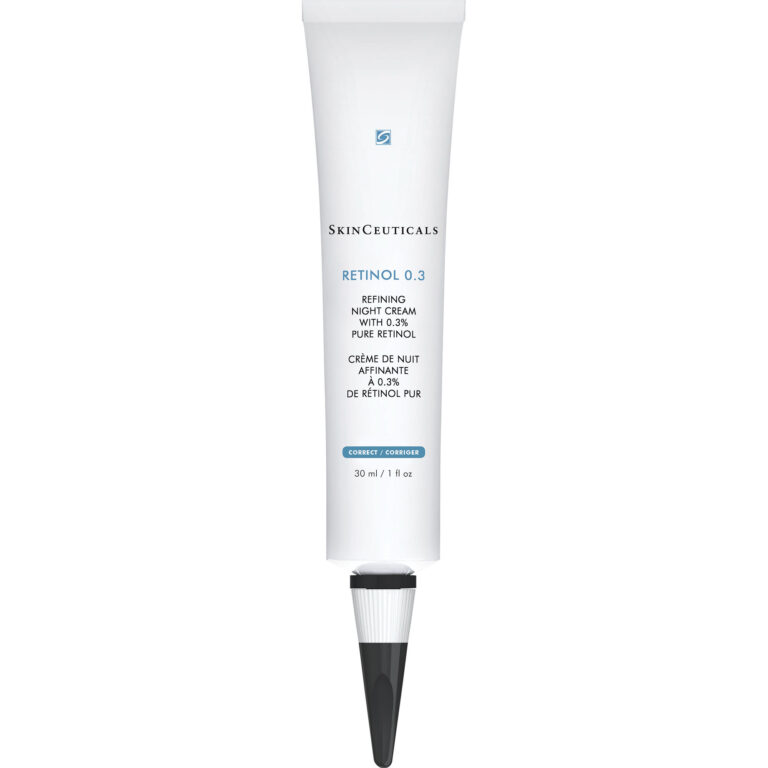
| SkinCeuticals Retinol 0.3 | 0.3% | First-time retinol users |
| SkinCeuticals Retinol 0.5 | 0.5% | Skin already conditioned with Retinol 0.3 |
| Vivier Retinol 0.3% | 0.3% | First-time or sensitive skin |
| Vivier Retinol 0.5% | 0.5% | Users ready to build on their results |
| Vivier Retinol 1.0% | 1.0% | Experienced retinol users |
| NOON Retinol Charisma Delicate | 0.3% | First-time users or milder signs of aging |
| NOON Retinol Charisma Intense | 1.0% | Regular retinol users |
NOON Aesthetics products are available at our clinic. Whichever you choose, follow the AAD’s basics: evenings only, start slowly and wear sunscreen every morning. You can compare the full ranges on our SkinCeuticals, Vivier and NOON pages.
Retinol and clinic treatments
Waxing. Stop retinol two to five days before waxing your face (AAD).
Chemical peels. Before a peel, Mayo Clinic says you might be asked to use a retinoid cream such as tretinoin for a few weeks to prepare your skin. Around peels, microneedling and other resurfacing treatments, follow your provider’s timing for when to pause and when to restart.
Dark spots that won’t budge. Retinol works slowly on pigment. If spots are your main concern, see our page on hyperpigmentation treatment or book a free consultation at our Toronto clinic.
Frequently asked questions
What does retinol do for your face?
Retinol speeds up skin cell turnover, helps keep pores clear and increases collagen production (Cleveland Clinic). Over weeks to months that can soften fine lines, smooth rough texture, fade dark spots and reduce breakouts. Use it at night and wear sunscreen in the morning.
How long does retinol take to work?
Usually several weeks for a visible change and several months for wrinkles (Cleveland Clinic). The AAD says most anti-aging products need at least six weeks and sometimes up to three months. Your skin may look worse in the first few weeks.
Can I use retinol every night?
Yes, once your skin is used to it. Start every other night or two to three nights a week, then build up. SkinCeuticals and Vivier both describe working up to every night as your skin tolerates it. If you get red or flaky, drop back a night or two.
Can you use retinol around your eyes?
Keep face retinols away from your eyes. SkinCeuticals’ directions say to avoid the eye area, and Cleveland Clinic says to keep retinol out of your eyes, nose and mouth. Follow the label on any product you use.
Does retinol help with acne?
Yes. Retinol works on acne by preventing clogged pores (Cleveland Clinic). You may still get pimples for the first couple of months, and some people get a short flare, often called a retinol purge. For stubborn or painful acne, see our acne treatment page.
Can I use niacinamide with retinol?
Yes. Cleveland Clinic says niacinamide helps protect the skin and may help counter retinol’s irritating side effects. As with any new product, add it on its own first.
Can I use hyaluronic acid with retinol?
Yes. Hyaluronic acid slows water loss from the skin, and Cleveland Clinic says it can help offset some of retinol’s irritating effects.
Can I use a salicylic acid cleanser with retinol?
Yes, with some care. Both can dry the skin, so Cleveland Clinic suggests using salicylic acid in the morning and retinol at night. On retinol nights, Cleveland Clinic’s routine starts with a gentle cleanser.
Can you use vitamin C with retinol?
Yes. Use vitamin C in the morning and retinol at night, and add them one at a time over a couple of weeks, because both can irritate (Cleveland Clinic).
Can you use retinol while breastfeeding?
Cleveland Clinic says healthcare providers believe the risk to a breastfeeding baby is low, because little topical retinoid reaches the bloodstream. Don’t apply it to your breasts or let it rub onto your baby’s skin, and check with your doctor before you start.
Is tretinoin a retinol?
No. Tretinoin is retinoic acid, the active form that retinol eventually turns into. It is stronger than retinol (Cleveland Clinic) and in Canada it is prescription only.
Retinal vs retinol: which is stronger?
Retinal is one conversion step closer to retinoic acid than retinol is (Duell 1997). Health Canada also allows much less of it in most cosmetics: 0.05% for retinal against 1.0% retinol equivalents for retinol.
What percentage of retinol should a beginner use?
Start with the lowest strength you can find. SkinCeuticals, Vivier and NOON all label 0.3% as the first-timer strength, and one 2026 study suggested about 0.1% as a good starting balance (Pordąb 2026).
Is retinol safe for darker skin?
It can be, with extra care. The AAD warns that in skin of colour, irritation can trigger dark marks. Start with a low strength, go slowly, wear sunscreen daily and stop if your skin becomes red or irritated.
Last updated November 2026. This guide is general information, not medical advice. If you are pregnant, breastfeeding, or have a skin condition, speak with your doctor before using retinol.
Sources
- American Academy of Dermatology. Retinoid or retinol? aad.org/public/everyday-care/skin-care-secrets/anti-aging/retinoid-retinol
- American Academy of Dermatology. How to maximize the results from your anti-aging products. aad.org/public/everyday-care/skin-care-secrets/anti-aging/maximize-anti-aging-products
- American Academy of Dermatology. How to wax. aad.org/public/everyday-care/skin-care-basics/hair/how-to-wax
- Cleveland Clinic. Retinol. my.clevelandclinic.org/health/treatments/23293-retinol
- Cleveland Clinic Health Essentials. The best skin care ingredients for your neck. health.clevelandclinic.org/the-best-skin-care-ingredients-for-your-neck
- Mayo Clinic. Wrinkle creams. mayoclinic.org/diseases-conditions/wrinkles/in-depth/wrinkle-creams/art-20047463
- Mayo Clinic. Acne: diagnosis and treatment. mayoclinic.org/diseases-conditions/acne/diagnosis-treatment/drc-20368048
- Mayo Clinic. Chemical peel. mayoclinic.org/tests-procedures/chemical-peel/about/pac-20393473
- DermNet. Topical retinoids. dermnetnz.org/topics/topical-retinoids
- Health Canada. Cosmetic Ingredient Hotlist. canada.ca/en/health-canada/services/consumer-product-safety/cosmetics/cosmetic-ingredient-hotlist-prohibited-restricted-ingredients/hotlist.html
- Health Canada. Prescription Drug List. hpr-rps.hres.ca/pdl-phu.php
- Health Canada. Drug Product Database, Differin 0.1% gel (DIN 02148749). health-products.canada.ca/dpd-bdpp
- European Commission, Scientific Committee on Consumer Safety. Opinion on vitamin A (SCCS/1639/21). health.ec.europa.eu/system/files/2023-08/sccs_o_261.pdf
- Duell EA et al. J Invest Dermatol 1997. PMID 9284094. doi:10.1111/1523-1747.ep12335788
- Zasada M, Budzisz E. Postepy Dermatol Alergol 2019. PMID 31616211. doi:10.5114/ada.2019.87443
- Kafi R et al. Arch Dermatol 2007. PMID 17515510. doi:10.1001/archderm.143.5.606
- Tucker-Samaras S et al. J Drugs Dermatol 2009. PMID 19852122
- Randhawa M et al. J Drugs Dermatol 2015. PMID 25738849
- Farris P et al. J Drugs Dermatol 2024. PMID 38564380. doi:10.36849/JDD.8124
- Babcock M et al. J Drugs Dermatol 2015. PMID 25607905
- Kosmoski G et al. J Drugs Dermatol 2022. PMID 36468957. doi:10.36849/JDD.6845
- Draelos ZD et al. J Drugs Dermatol 2020. PMID 32574009. doi:10.36849/JDD.2020.5085
- Kaplan YC et al. Br J Dermatol 2015. PMID 26215715. doi:10.1111/bjd.14053
- Zasada M et al. Skin Pharmacol Physiol 2020. PMID 32428912. doi:10.1159/000508168
- Pordąb et al. Int J Mol Sci 2026. PMID 42653210. doi:10.3390/ijms27167205
- Temova Rakuša Ž et al. J Cosmet Dermatol 2021. PMID 33206444. doi:10.1111/jocd.13852
- SkinCeuticals Canada. Retinol 0.3 and Retinol 0.5 product pages. skinceuticals.ca
- Vivier. Retinol 0.3%, 0.5% and 1.0% product pages. vivierskin.ca
- NOON Aesthetics. Retinol Charisma Delicate 0.3% and Intense 1% product pages. noonaesthetics.ca
Questions about this treatment?
Ask us anything before you book. Consultations are free, and we will tell you honestly if a treatment is not right for you.